
FUGO Precision 3D’s upcoming debut of its centrifugal 3D printing technology at LMT LAB DAY Chicago 2026 marks more than a product showcase. It may offer early signals of a deeper shift in additive manufacturing workflows for dental labs and adjacent medical device sectors. The U.S.-based company confirmed that it will publicly demonstrate its all-in-one centrifugal printing system—capable of combining printing, washing, drying, and curing in a single automated cycle—for the first time during the February event.
While the additive manufacturing field is saturated with innovation claims, FUGO’s platform stands apart due to its novel use of centrifugal force to produce parts in a self-supporting resin bath. The company’s claim of 10x throughput and sub-30 micron repeatability would, if validated under real-world operating conditions, place it in a different tier from conventional resin-based stereolithography (SLA) or digital light processing (DLP) machines.
What centrifugal 3D printing could change for dental labs and medical-grade production workflows
If FUGO’s system proves production-ready, it could upend assumptions about how post-processing bottlenecks constrain throughput in high-volume dental manufacturing. Unlike traditional systems that require manual or semi-automated washing and curing after print completion, FUGO’s integrated cycle compresses the entire production sequence. This has implications not just for time, but for labor intensity, cleanroom footprints, and even shift-based operational models in mid-size labs.
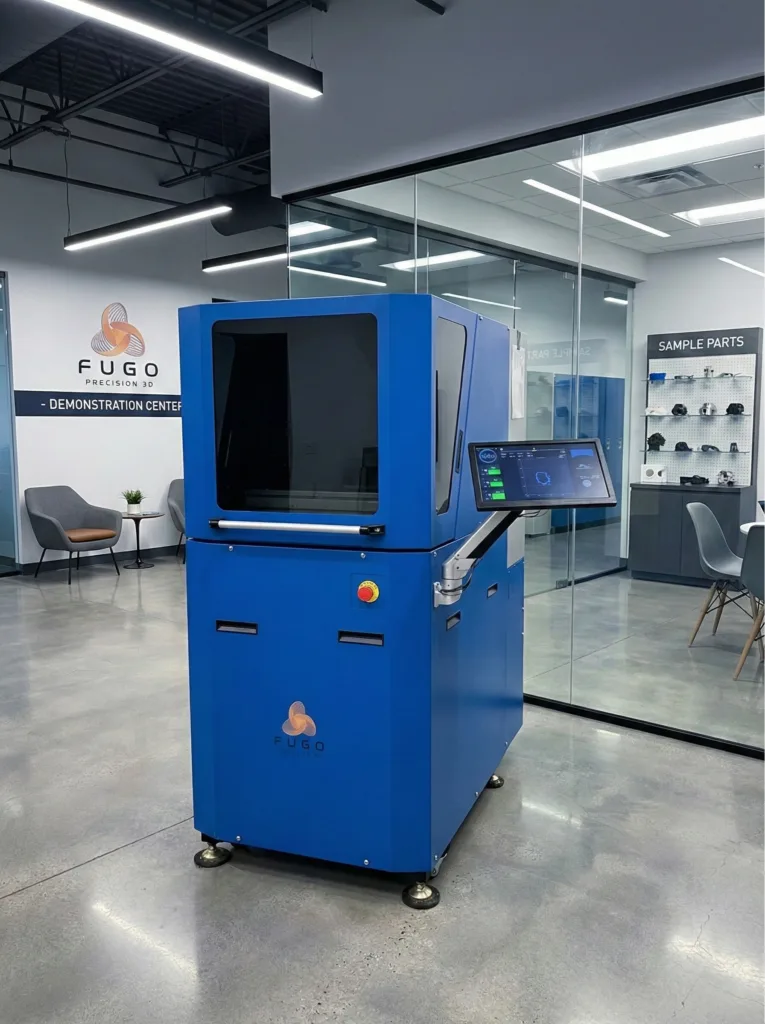
The use of centrifugal force—reportedly generating up to 2,000 G’s—addresses another long-standing SLA issue: trapped volumes and support removal. The in-situ artificial gravity enables real-time capillary drainage of excess material, followed by auto-sealing, which may eliminate the need for perforation strategies or overexposure workarounds in conventional resin printing. If reliable, this design simplification could reduce the cost-per-part variability in complex geometries, including dental aligners, retainers, and multi-material appliances.
For dental manufacturers accustomed to optimizing around light-curing ovens, IPA washes, and UV exposure setups, FUGO’s integrated automation potentially unlocks a shift from batch-based processing to continuous manufacturing—particularly if paired with modular robotics or digital queue management systems.
Why the Graphy partnership may become a force multiplier in biocompatible applications
FUGO’s alliance with Seoul-based Graphy Inc., known for its Shape Memory Aligner (SMA) materials, adds a strategic layer that moves beyond printer mechanics. By combining hardware innovation with clinically validated, biocompatible resins, the two firms are targeting more than dental aligners—they are framing a full-stack solution for labs that want to bridge cosmetic, orthodontic, and functional restoration markets.
Graphy’s SMA materials, which return to a pre-set shape under specific thermal conditions, could see enhanced performance in centrifugal environments where material distribution is more uniform. FUGO’s multi-resin cycle capability theoretically allows co-printing of rigid and flexible components in the same build, a long-standing barrier in multi-material oral appliances such as functional retainers, occlusal splints, or even class II correctors.
This co-development model, where the printing physics and material formulation are optimized in tandem, could offer a strategic advantage over open-material platforms that rely on third-party validation and retrofit resin profiles. For dental labs constrained by FDA-cleared workflows or CE-marked material systems, an integrated print-material pipeline could accelerate both clinical adoption and regulatory alignment.
What adoption challenges and validation gaps still remain for centrifugal 3D systems
Despite the engineering novelty, industry observers will likely scrutinize FUGO’s system for operational reliability, long-term resin behavior under centrifugal force, and comparative material costs. Traditional SLA and DLP workflows—however manual—are already well-integrated into lab ERP systems, technician training modules, and validated post-processing protocols. Convincing risk-averse labs to retrain staff, revise SOPs, and reorder material stock in exchange for throughput gains will require more than a compelling demonstration.
Additionally, while centrifugal printing solves certain structural and layer resolution issues, it may introduce new variables in part consistency, resin shelf life, and build plate balancing. For dental appliances where micron-level variance can affect fit or patient outcomes, reproducibility data will need to be shared not just in lab settings, but across diverse climate and ambient conditions that real-world labs face.
Regulatory watchers will also focus on how the system handles traceability, sterilization compliance, and quality control within the integrated cycle. With dental device MDR requirements tightening in the European Union and FDA oversight of 3D-printed Class II devices increasing, platforms that automate too much of the process without sufficient transparency may face longer regulatory review cycles or additional validation requirements.
How FUGO’s modular automation pitch could appeal to non-dental sectors next
Beyond dental applications, FUGO’s technology has been positioned for scalable use in medical devices, hearing health, and aerospace manufacturing. If the company proves the centrifugal cycle’s repeatability in dental-grade polymer workflows, it could provide a platform foundation for high-output manufacturing of small, customized parts—particularly where geometries are complex and traditional support removal is time-consuming.
Hearing aid shells, orthopedic inserts, microfluidic casings, and even surgical planning guides could benefit from the self-supporting resin bath model. However, non-dental verticals will demand broader resin certification, part validation standards, and integration with different CAD ecosystems. Success in dental may serve as a proving ground—but not a passport.
Clinical specialists, particularly those in hearing and prosthetics sectors, will look for material adaptability, thermal distortion benchmarks, and print-to-fit calibration data before adopting centrifugal methods. Institutional procurement teams may also weigh the cost of retooling legacy DLP or inkjet systems against FUGO’s claimed throughput and surface quality gains.
What industry stakeholders will watch as FUGO makes its public debut
The LMT LAB DAY showcase will not just be a product launch but an early referendum on the centrifugal approach. Key questions facing potential adopters include whether FUGO’s automation can maintain consistency over hundreds of cycles, how consumables and maintenance routines compare to existing systems, and whether the Graphy material integration delivers clinical-grade precision without introducing new points of failure.
What matters most now is not the novelty of the physics, but the repeatability of the output and the robustness of the full-stack workflow—from slicing to curing. If those fundamentals hold under scrutiny in Chicago, FUGO may find itself at the center of the next competitive realignment in digital dental manufacturing.