T-CURX has acquired Pantherna Therapeutics to combine its non-viral, transposon-based CAR-T platform with Pantherna’s mRNA engineering and lipid nanoparticle delivery technologies. The transaction gives the German biotech group an integrated route toward non-viral in vivo CAR-T development, with Pantherna continuing as a wholly owned subsidiary and the combined platform aimed at accelerating clinical translation in cancer and potentially other indications.
Why does the T-CURX Pantherna deal matter for the future of in vivo CAR-T therapy?
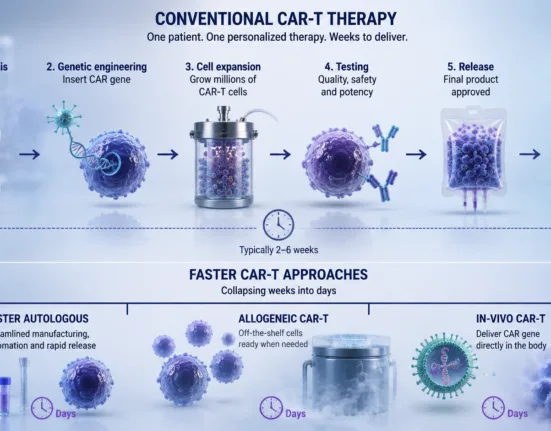
The strategic importance of the T-CURX Pantherna acquisition is that it brings together two technology layers that the next generation of cell therapy may require: programmable immune-cell engineering and efficient in-body genetic delivery. Conventional CAR-T therapy has already changed parts of blood cancer treatment, but its manufacturing model remains cumbersome, expensive and operationally demanding. Patient cells are collected, engineered outside the body, expanded, quality checked and reinfused, which makes treatment powerful but difficult to scale.

In vivo CAR-T seeks to challenge that model by engineering immune cells directly inside the patient. If this approach works, it could reduce the need for individualized ex vivo manufacturing and potentially make cell therapy more accessible across a wider range of treatment centres. That is why mRNA and lipid nanoparticle delivery matter. They offer a possible way to deliver instructions to immune cells without relying on the same manufacturing architecture that has constrained today’s autologous CAR-T field.
The deal is therefore not just another small biotech acquisition. It reflects a broader industry bet that cell therapy’s next growth phase will depend on delivery innovation as much as antigen selection or CAR design. T-CURX brings CAR-T engineering experience, while Pantherna brings mRNA and lipid nanoparticle capabilities. The unresolved question is whether combining these technologies under one roof will meaningfully reduce development risk or simply move the hardest scientific problems into a new operating structure.
How could non-viral and mRNA-based delivery change the CAR-T manufacturing equation?
The manufacturing logic behind this acquisition is clear. Viral vectors have played a central role in CAR-T development, but they can be expensive, capacity-constrained and complex to produce. Non-viral approaches, including transposon-based engineering, are attractive because they may offer greater flexibility and lower production complexity if they can match the durability, efficiency and safety required for clinical use.
T-CURX’s non-viral CAR-T work gives the combined group a platform that already speaks to one of the field’s main pain points: how to build potent engineered immune-cell therapies without locking every product into viral-vector manufacturing. Pantherna adds a different but complementary capability. Its mRNA and lipid nanoparticle technologies are relevant because in vivo CAR-T depends on getting genetic instructions into the right cells, at the right dose, with the right duration of expression and an acceptable safety profile.
This is where the promise becomes difficult. Delivering mRNA or genetic payloads to immune cells inside the body is not the same as delivering a vaccine antigen or liver-targeted therapy. Cell specificity, biodistribution, immune activation, repeat dosing, off-target transfection and transient versus durable expression all become central development questions. A combined technology stack may speed experimentation, but it does not remove the biological challenge of safely reprogramming immune cells in vivo.
Why is in vivo CAR-T attracting attention after years of ex vivo cell therapy growth?
The growing interest in in vivo CAR-T reflects a frustration that has followed the cell therapy industry since its first commercial successes. Approved CAR-T treatments can deliver deep responses in certain haematological cancers, but access remains uneven. Treatment often requires specialized centres, complex logistics, bridging therapy, long manufacturing timelines and close monitoring. For patients with aggressive disease, time is not an administrative detail. It can decide whether treatment remains possible.
In vivo CAR-T offers a more radical proposition. Instead of turning every patient’s cells into a manufacturing project, developers aim to turn the patient’s own body into the site of immune-cell engineering. If the strategy works, it could simplify supply chains, reduce batch-to-batch complexity and make cell therapy more compatible with broader oncology workflows. That would be a major shift for hospitals, payers and manufacturers.
The risk is that the field is still early. In vivo CAR-T remains more of a strategic frontier than a routine clinical category. Developers must prove that engineered cells generated inside the body can be potent, controllable and safe. They must also show that delivery platforms can avoid unwanted targeting of non-immune tissues. For all the excitement, the clinical bar will be high because regulators will scrutinize any technology designed to genetically reprogram cells inside patients.
What does Pantherna add beyond a standard mRNA platform story?
Pantherna’s value to T-CURX is not simply that it works in mRNA. The more important point is that Pantherna brings delivery and engineering capabilities that could be aligned with cell therapy development. mRNA alone is not a product strategy. It becomes clinically relevant only when it can be delivered precisely enough to produce the intended biological effect without creating unacceptable immune or tissue-level consequences.
The acquisition gives T-CURX access to lipid nanoparticle and mRNA know-how at a time when delivery has become one of the central bottlenecks in genetic medicine. Lipid nanoparticles proved their importance in vaccines, but oncology and cell therapy require more sophisticated targeting, dosing and safety logic. In vivo CAR-T is likely to demand delivery systems that can reach relevant immune-cell subsets while limiting expression in unintended cells.
This is also why the integration of Pantherna as a subsidiary matters. Keeping Pantherna operationally intact could preserve platform expertise while allowing closer strategic alignment with T-CURX’s CAR-T priorities. However, integration risk remains. Small biotech combinations can look neat on paper, but platform fusion depends on team coordination, intellectual property alignment, development prioritization and the ability to decide which assets deserve scarce capital.
Can T-CURX become a European challenger in next-generation CAR-T development?
T-CURX’s ambition appears to sit within a larger European biotech question: can Europe build differentiated cell therapy platforms rather than mainly watching U.S. and Chinese developers define the field? The acquisition gives T-CURX a stronger claim to platform integration because it now combines CAR-T engineering, non-viral technology, mRNA design and lipid nanoparticle delivery within one corporate structure.
That could matter commercially if the industry moves toward modular in vivo platforms. A company that controls both the immune-cell engineering logic and the delivery technology may be better positioned to iterate quickly across targets and indications. It may also be able to protect more of the value chain rather than depending heavily on external delivery partners. In a field where speed and technical integration matter, that kind of control can be strategically valuable.
Yet becoming a European challenger requires more than owning complementary technologies. T-CURX will need to generate clinical proof, secure capital, manage manufacturing translation and compete with better-funded global players. In vivo CAR-T is attracting attention from multiple biotech and pharmaceutical groups because the upside is significant. That means T-CURX’s differentiation will depend on execution, not simply on being early.
What are the main scientific risks around non-viral in vivo CAR-T strategies?
The most important scientific risk is delivery specificity. In vivo CAR-T requires genetic instructions to reach the correct immune cells and generate the intended engineered phenotype. If delivery is inefficient, the therapy may not produce enough functional CAR-T cells. If delivery is too broad, off-target expression could create safety concerns. This is the central tension in the field.
The second risk is control. Ex vivo CAR-T allows cells to be engineered, expanded, tested and characterized before infusion. In vivo engineering removes some of those manufacturing steps, but it also removes certain opportunities for quality control before the engineered cells form inside the patient. Developers must therefore build safety and predictability into the delivery system, the construct design and the dosing strategy.
The third risk is durability. mRNA-based approaches may be transient by design, which could support safety but may limit persistence. Transposon-based systems can potentially support more durable genetic integration, but durable expression raises a different safety conversation. The clinical challenge is to find the right balance between sufficient persistence for efficacy and sufficient control for safety. T-CURX and Pantherna are combining tools that may help explore that balance, but the optimal design remains unresolved.
How could this acquisition influence oncology and non-oncology applications?
Cancer is the most obvious first arena because CAR-T therapy is already clinically validated in oncology. Haematological malignancies remain the clearest starting point for many cell therapy strategies, while solid tumours continue to represent a more difficult but commercially attractive frontier. If T-CURX can apply in vivo engineering to cancer targets with a credible safety profile, the platform could become highly relevant to next-generation oncology development.
The deal may also matter beyond cancer. In vivo immune-cell engineering is being explored for autoimmune disease, inflammatory disorders and other indications where immune reprogramming could change disease biology. The logic is powerful: if immune cells can be redirected or reset inside the body, the technology could move beyond killing cancer cells and into broader immune modulation.
However, non-oncology use could bring different clinical and regulatory expectations. In cancer, higher risk may be acceptable in late-stage or refractory disease. In autoimmune or chronic conditions, safety tolerance is often lower, especially if patients have alternative treatments. That means the same platform may need different payloads, dosing logic and risk thresholds depending on the indication. The acquisition expands possibility, but it also broadens the complexity of strategic prioritization.
Why does this deal reveal a broader shift in biotech platform consolidation?
The T-CURX Pantherna deal fits a broader pattern in which biotech companies are no longer treating platform technologies as isolated modules. Developers increasingly want control over the full stack, from target biology and payload design to delivery, manufacturing and clinical translation. This is especially true in advanced therapies, where a weak link in delivery or production can undermine an otherwise strong biological concept.
For smaller biotech companies, platform consolidation can be a survival strategy. Capital markets have become more selective, and investors often prefer assets with clearer translation paths rather than loosely connected technology claims. Combining platforms can create a more coherent story, provided the result is scientifically credible and operationally focused. T-CURX can now present a more integrated cell therapy thesis than either company could have advanced alone.
The danger is that platform breadth can become a distraction. A company pursuing ex vivo CAR-T, in vivo CAR-T, oncology, non-oncology indications, mRNA delivery and lipid nanoparticle optimization may stretch resources unless development priorities are sharply defined. The strongest outcome would be a focused lead programme that demonstrates the value of the combined platform. Without that, the acquisition could be seen as technically interesting but commercially diffuse.
What should regulators and clinicians watch as in vivo CAR-T moves closer to trials?
Regulators will likely focus on biodistribution, persistence, immunogenicity, off-target effects and reversibility. In vivo genetic engineering is a sensitive area because it changes the risk framework from manufacturing control to in-body control. Preclinical packages will need to show not only that the platform works, but that it behaves predictably across dose levels, tissues and immune-cell populations.
Clinicians will watch a different but related set of issues. They will want to know whether in vivo CAR-T can preserve the potency that made conventional CAR-T compelling while reducing the logistical burden that limits access. They will also ask whether treatment can be delivered safely outside highly specialized centres. If the approach still requires intensive monitoring and complex infrastructure, the access advantage may be smaller than the theory suggests.
Industry observers will also look for clarity on the first clinical indication. The best first target will likely be one where unmet need is high, biology is persuasive and safety risk can be justified. Choosing the wrong initial indication could slow confidence in the platform. Choosing the right one could create a proof-of-concept moment for European in vivo CAR-T development.
What comes next for T-CURX and Pantherna after the acquisition?
The next test is whether T-CURX can convert the acquisition into a visible clinical development roadmap. That means naming priority programmes, clarifying timelines, explaining how Pantherna’s mRNA and lipid nanoparticle technologies will be applied to in vivo CAR-T, and showing that the combined platform can move from strategic language into translational execution.
For the cell therapy industry, the acquisition is another sign that the next wave of CAR-T competition may be fought around delivery and scalability rather than only antigen discovery. Ex vivo CAR-T is not disappearing. It remains clinically important and continues to evolve. However, the field is clearly searching for ways to make immune-cell engineering simpler, faster and more broadly deployable.
For T-CURX, Pantherna offers a sharper platform story at a time when in vivo CAR-T is gaining momentum. The deal does not prove that non-viral in vivo CAR-T is ready to become mainstream. It does, however, give the German biotech group a more complete set of tools to try. In a sector where the biggest bottleneck is often not imagination but execution, that could make this small European acquisition more strategically important than its undisclosed transaction value suggests.