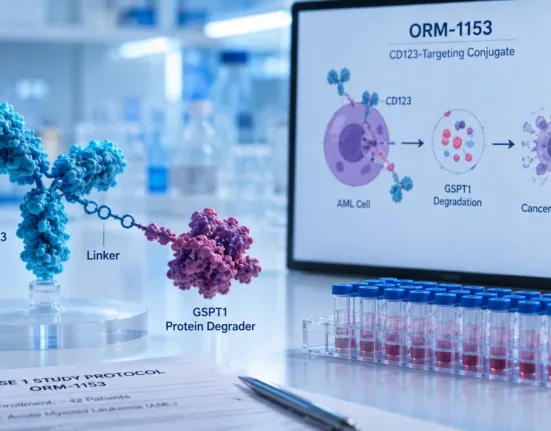
TScan Therapeutics, Inc. announced the completion of enrollment in Cohort C of its Phase 1 ALLOHA study evaluating TSC-101 in patients with hematologic malignancies undergoing allogeneic hematopoietic cell transplantation, while also disclosing that the U.S. Food and Drug Administration cleared investigational new drug applications for two additional heme candidates, TSC-102-A01 and TSC-102-A03. The updates position the U.S.-based clinical-stage biotechnology firm to transition toward a pivotal study for TSC-101 and broaden its addressable population in CD45-targeted T cell receptor-engineered T cell therapies.
The significance of the announcement lies less in the procedural milestone of enrollment completion and more in what it signals about manufacturing readiness, regulatory alignment, and strategic expansion of human leukocyte antigen coverage. In the T cell receptor-engineered T cell therapy field, operational execution and scalability often determine whether promising Phase 1 signals translate into viable late-stage programs.
How commercial-ready manufacturing in Cohort C could alter scalability assumptions for TCR-T therapies in transplantation settings
Cohort C of the ALLOHA study uses what TScan Therapeutics describes as a commercial-ready manufacturing process. That detail matters. In cell therapy, manufacturing comparability between early-phase material and later-stage or commercial supply is one of the most persistent friction points. Programs frequently encounter regulatory scrutiny when process changes occur mid-development, particularly if potency assays, vector design, or cell expansion steps evolve.
By enrolling more than ten patients under the updated manufacturing configuration before initiating a pivotal trial, the Massachusetts-based biotechnology developer appears to be de-risking that transition. Industry observers tracking autologous TCR-T and CAR-T programs note that regulators increasingly expect robust comparability data packages. Early integration of a commercial-intent process can reduce the risk of bridging studies later, which may compress timelines and conserve capital.
However, the clinical impact of this shift will depend on whether safety, cell persistence, and early chimerism metrics remain consistent with prior cohorts. Even subtle changes in activation or expansion protocols can influence T cell phenotype, exhaustion markers, or in vivo kinetics. Until comparative data are disclosed, the assumption that manufacturing optimization equals clinical continuity remains provisional.
What donor chimerism correlations reveal about TSC-101’s positioning in relapse prevention after allo-HCT
TSC-101 is being evaluated in HLA-A*02:01-positive patients undergoing allogeneic hematopoietic cell transplantation. The therapeutic hypothesis centers on eliminating residual malignant cells early after transplant, thereby preventing relapse. At recent transplant-focused meetings, TScan Therapeutics’ leadership highlighted data linking complete donor chimerism at two months with significantly lower relapse probability.
Chimerism as a surrogate biomarker is not new in transplantation. What is strategically relevant is the framing of TSC-101 as an intervention capable of influencing that early biological milestone. If early complete donor chimerism correlates with durable remission, then demonstrating that TSC-101 accelerates or stabilizes this state could provide a measurable, regulator-friendly endpoint in a high-risk population such as acute myeloid leukemia and myelodysplastic syndromes.
Yet the evidentiary burden remains substantial. Phase 1 transplant-adjacent studies are typically small and heterogeneous. Conditioning regimens, graft sources, and baseline disease risk all influence outcomes. Clinicians following the space are likely to scrutinize whether early chimerism improvements translate into statistically meaningful relapse-free survival benefits, and whether graft-versus-host disease rates remain controlled. Enhancing graft-versus-leukemia effects without triggering excessive immune toxicity is the central balancing act in this setting.
How expanding HLA coverage with TSC-102-A01 and TSC-102-A03 could reshape the addressable market in CD45-targeted cell therapy
The U.S. Food and Drug Administration clearance of investigational new drug applications for TSC-102-A01 and TSC-102-A03 extends the heme program beyond HLA-A02:01 to include HLA-A01:01 and HLA-A*03:01-positive patients. In TCR-based therapy, HLA restriction inherently fragments the market. Expanding to additional alleles is therefore not incremental housekeeping but a structural growth lever.
According to the biotechnology firm, adding these alleles could nearly double the U.S. addressable patient population in its heme program. That claim reflects the frequency of these HLA subtypes in North American populations. Broader HLA inclusion can improve commercial viability and make multicenter trials more efficient by reducing screening failures.
The new candidates, like TSC-101, target CD45, a protein widely expressed on hematopoietic cells but absent in non-hematopoietic tissues. Target selection is a defining risk variable. CD45’s broad expression may enhance the likelihood of eliminating malignant clones across diverse hematologic malignancies, but it also raises theoretical safety considerations. Depleting CD45-positive populations in the post-transplant period requires careful dosing and timing to avoid impairing immune reconstitution.
Regulatory watchers will likely monitor how the Phase 1 studies for TSC-102-A01 and TSC-102-A03 manage dose escalation, cytokine release risk, and graft-versus-host disease interactions. Given the shared target, cross-program safety signals could influence the entire heme portfolio.
What this dual update reveals about TScan Therapeutics’ broader competitive strategy in engineered T cell therapies
The competitive landscape in engineered T cell therapies is increasingly segmented between autologous CAR-T, allogeneic approaches, and TCR-engineered platforms targeting intracellular antigens. TScan Therapeutics is positioning itself within the TCR-T niche, focusing on precision targeting of peptide-HLA complexes.
In solid tumors, TCR programs face antigen heterogeneity and immune escape challenges. In hematologic malignancies following transplantation, the biological context differs. The immune system is already being reset, and minimal residual disease is often the therapeutic focus. By concentrating on relapse prevention rather than bulky refractory disease, the biotechnology developer is pursuing a risk-adjusted entry point.
This strategy could differentiate TSC-101 and the TSC-102 series from CAR-T products primarily used in relapsed or refractory settings. It also aligns with transplant center workflows, where early post-transplant monitoring is routine. However, integration into transplant protocols requires strong safety data and logistical coordination, as patients are medically fragile during this period.
Manufacturing scalability will also be under scrutiny. Even with a commercial-ready process, TCR-T therapies remain complex autologous products. Turnaround times, vein-to-vein logistics, and cost of goods will influence eventual reimbursement discussions. Payers may require clear relapse reduction data to justify adoption in a prophylactic or preemptive context.
What clinicians, regulators, and investors are likely to watch as TScan Therapeutics approaches pivotal development
With Cohort C enrollment complete and a pivotal trial anticipated in the second quarter of 2026, attention will shift to the quality of the forthcoming safety and early chimerism data. Clinicians will look for signals that TSC-101 improves measurable residual disease clearance without amplifying transplant-related morbidity.
Regulators will evaluate whether surrogate markers such as early donor chimerism can support accelerated pathways or whether hard clinical endpoints will be required. In hematologic malignancies such as acute myeloid leukemia, relapse-free survival and overall survival remain the gold standards. The design of the pivotal study, including control arm selection and stratification by conditioning intensity, will shape regulatory feasibility.
Industry observers will also assess capital efficiency. Advancing multiple HLA-specific candidates simultaneously increases development complexity. While allele expansion broadens the commercial horizon, it also multiplies manufacturing validation, regulatory documentation, and trial execution requirements.
The broader TCR-T field remains in an evaluative phase. Several companies have encountered setbacks due to off-target toxicity or insufficient persistence. Demonstrating reproducible safety in a transplant population could position TScan Therapeutics as a differentiated player, but failure to translate early biological signals into durable clinical benefit would reinforce skepticism around the platform.
In sum, the dual update from TScan Therapeutics is less about headline momentum and more about structural positioning. Enrollment under a commercial-ready manufacturing process and expansion of HLA coverage represent deliberate steps toward scale. Whether those steps translate into clinically meaningful relapse prevention in hematologic malignancies will determine whether the ALLOHA program becomes a pivotal inflection point for CD45-targeted TCR-T therapy.