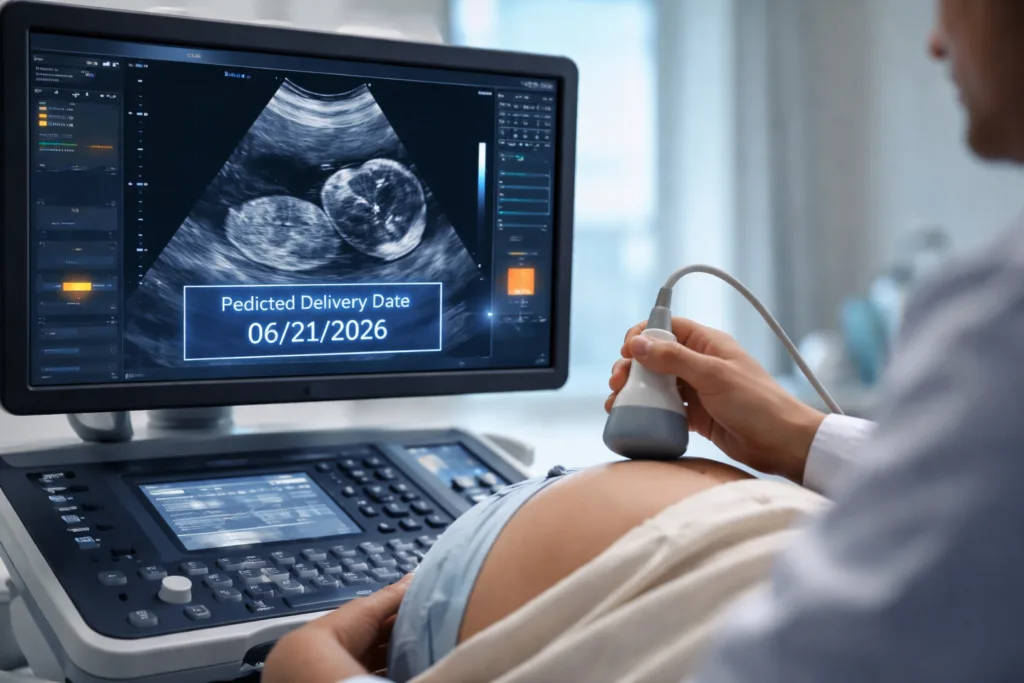
Ultrasound AI has received United States Food and Drug Administration De Novo clearance for Delivery Date AI, a cloud-based software-as-a-medical-device designed to predict a pregnancy’s delivery timing using standard ultrasound images. The technology analyzes ultrasound imaging data to produce a predicted delivery date in real time and is intended to assist clinicians when conventional pregnancy dating methods such as last menstrual period records or gestational-age ultrasound estimates are unreliable.
The clearance positions Delivery Date AI as one of the first regulatory-authorized systems aimed specifically at forecasting delivery timing using artificial intelligence rather than traditional biometric measurements. That distinction matters because obstetric care still relies heavily on dating methods developed decades ago, many of which depend on patient recall or ultrasound measurements taken during narrow gestational windows.
Why FDA clearance signals growing regulatory acceptance of AI in obstetric decision support
The De Novo pathway used for the approval indicates that the United States Food and Drug Administration considers Delivery Date AI sufficiently novel that it does not fit within an existing device classification. De Novo clearances are typically used when regulators determine that a device presents moderate risk but requires a new regulatory category rather than a standard premarket notification route.
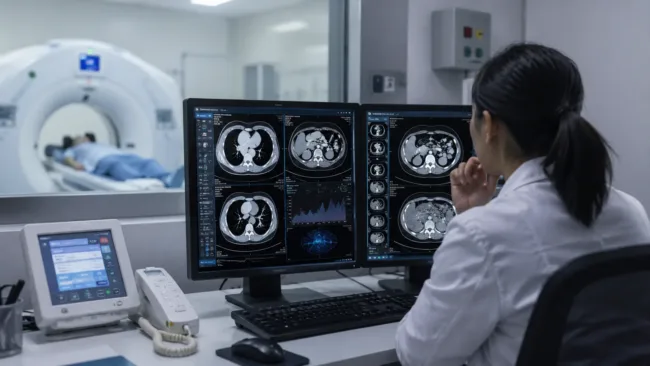
In the context of artificial intelligence in medical imaging, this is becoming a recurring regulatory pattern. The Food and Drug Administration has steadily expanded its oversight of software-as-a-medical-device products, particularly those designed to assist with clinical decision-making rather than replace physician judgment.
For obstetrics, this approval reflects a gradual shift toward algorithm-assisted interpretation of imaging data. Many existing ultrasound tools rely on measuring fetal structures such as crown-rump length or biparietal diameter to estimate gestational age. Those measurements are accurate only within specific gestational windows and can become less reliable later in pregnancy or when early scans are unavailable.
Industry observers note that artificial intelligence could address these limitations by analyzing entire ultrasound images rather than individual measurements. By evaluating broader patterns within imaging data, algorithms may detect signals that traditional measurements cannot capture.
How image-first artificial intelligence models could challenge traditional gestational dating methods
The central technical premise behind Delivery Date AI is an “image-first” approach to ultrasound interpretation. Instead of relying on manually measured fetal parameters, the algorithm analyzes the full ultrasound frame, including fetal anatomy and maternal features that may correlate with delivery timing.
According to data cited from the Perinatal Artificial Intelligence in Ultrasound study conducted with the University of Kentucky, the system was evaluated using more than 5,700 pregnancies and achieved an R² value of 0.92 when predicting days to delivery based solely on ultrasound images.
While this figure suggests a strong correlation between predicted and actual delivery timing, the clinical implications require careful interpretation. Obstetric timelines are influenced by multiple biological variables including fetal growth patterns, maternal health conditions, and obstetric interventions such as induction or cesarean delivery.
Clinicians tracking artificial intelligence applications in obstetrics believe image-based models may capture developmental signals that static biometric measurements overlook. However, the field remains cautious about relying solely on predictive models without contextual clinical evaluation.
The technology’s intended role as an adjunctive decision-support tool rather than a diagnostic replacement reflects this caution.
Why predictive delivery timing could matter in high-risk and poorly dated pregnancies
One of the most compelling use cases for Delivery Date AI lies in pregnancies where traditional dating methods are unavailable or unreliable. This scenario is more common than many clinical guidelines assume.
In many healthcare systems, particularly in underserved or rural settings, patients may first present for prenatal care later in pregnancy. When early ultrasound scans are unavailable, clinicians often rely on third-trimester measurements, which can produce substantial dating uncertainty.
This uncertainty has direct clinical consequences. Obstetric management decisions including induction timing, corticosteroid administration, and fetal surveillance protocols all depend on accurate gestational dating.
Industry observers note that inaccurate gestational estimates can increase the risk of both premature delivery and prolonged pregnancies. Either scenario can lead to complications that might otherwise be avoided with more precise dating.
If artificial intelligence models can improve delivery timing predictions in these scenarios, they could influence how obstetric teams manage high-risk pregnancies.
What the PAIR study suggests about the scalability of AI-driven obstetric imaging
The Perinatal Artificial Intelligence in Ultrasound study represents one of the larger clinical evaluations of artificial intelligence in obstetric imaging. With more than 5,700 patients included, the dataset is relatively substantial compared with many early-stage AI medical studies.
The study’s findings suggest that delivery timing may be inferred from patterns within ultrasound images that extend beyond standard fetal measurements. These patterns may include subtle indicators of fetal maturity, placental characteristics, and maternal anatomical features.
However, the scalability of such models depends heavily on dataset diversity. Artificial intelligence systems trained on narrow populations may perform poorly when deployed in broader clinical environments.
Regulatory watchers suggest that post-market surveillance will be important for determining whether Delivery Date AI performs consistently across different healthcare settings, patient demographics, and ultrasound hardware systems.
Why workflow integration may determine whether obstetric AI tools gain adoption
One of the practical challenges facing artificial intelligence tools in clinical imaging is workflow disruption. Technologies that require additional hardware, manual data entry, or complicated integration with hospital systems often struggle to achieve adoption.
Ultrasound AI’s platform attempts to address this barrier by positioning Delivery Date AI as a cloud-based system compatible with existing ultrasound machines. Images can be uploaded and analyzed within seconds, allowing predicted delivery dates to appear during routine obstetric visits.
Industry observers suggest this approach reflects an emerging trend in medical imaging software. Instead of replacing equipment, many artificial intelligence developers are focusing on augmenting existing imaging infrastructure.
For high-volume obstetric clinics, this could allow predictive analytics to be incorporated without altering standard scanning protocols.
However, clinicians tracking healthcare technology adoption caution that ease of installation does not automatically translate into clinical trust. Obstetricians and maternal-fetal medicine specialists typically require strong evidence before incorporating algorithmic predictions into patient care decisions.
What risks and uncertainties remain for predictive obstetric artificial intelligence
Despite the promising early data, several questions remain about how predictive delivery technologies will perform in real-world practice.
One concern involves algorithm transparency. Many deep-learning systems operate as “black box” models, meaning clinicians cannot easily see which imaging features influence predictions.
In obstetrics, where clinical decisions can affect both maternal and fetal outcomes, the ability to interpret algorithm reasoning may influence adoption.
Another unresolved question relates to obstetric interventions. If a predicted delivery date is used to guide care decisions, interventions themselves may influence the eventual timing of delivery. This creates a feedback loop that could complicate predictive accuracy.
Regulatory watchers suggest that long-term performance monitoring will be essential to determine whether artificial intelligence models remain reliable as clinical behavior evolves.
What clinicians and regulators are likely to watch next in AI-assisted obstetric care
The clearance of Delivery Date AI is likely to accelerate interest in predictive obstetric technologies. Researchers are already exploring artificial intelligence applications in areas such as fetal growth prediction, preeclampsia risk assessment, and early detection of fetal abnormalities.
If predictive models prove reliable across diverse populations, obstetric care could gradually shift toward more data-driven planning of prenatal interventions.
Clinicians tracking the field note that the most successful tools will likely combine artificial intelligence predictions with physician judgment rather than attempting to automate decision-making entirely.
Regulatory agencies will also play a central role in shaping the field. The Food and Drug Administration has increasingly emphasized the need for transparent validation data, ongoing monitoring, and clear clinical use cases for artificial intelligence medical devices.
For Ultrasound AI, the next stage will involve demonstrating that Delivery Date AI can deliver consistent performance outside controlled study environments. Large health system deployments and real-world evidence studies will likely determine whether predictive delivery technology becomes a routine component of obstetric imaging.
If successful, the approach could mark an important step toward a broader vision of predictive maternal-fetal medicine, where imaging data is not only diagnostic but also anticipatory.