Medra, an artificial intelligence and robotics company aiming to reinvent pharmaceutical R&D, has raised $52 million in Series A funding to accelerate development of its autonomous “Physical AI Scientist” platform. The funding round was led by Human Capital and included continued backing from Lux Capital, Neo, and NFDG, along with new participation from Catalio Capital Management, Menlo Ventures, 776, and Fusion Fund.
Medra is positioning itself as a category-defining player in biopharma R&D by integrating AI prediction engines with robotic lab execution systems. The startup’s platform enables scientists to run and iterate experiments using natural-language instructions, while an AI system interprets the results and dynamically adjusts future protocols. The result is a self-learning, fully closed-loop system that aims to vastly reduce the time and cost of therapeutic discovery.
What makes Medra’s lab AI system different from traditional automation tools?
Unlike many AI-for-drug-discovery platforms that focus exclusively on prediction or data modeling, Medra brings AI into the physical laboratory environment. Its Physical AI platform does not merely generate hypotheses—it executes them. The robotic system interacts directly with standard lab instruments, completing workflows that typically require human scientists to manually execute and refine. Medra’s Scientific AI layer then analyzes experiment outputs and makes real-time recommendations for protocol changes or new experiment designs, creating a continuous feedback loop where learning and execution are tightly coupled.
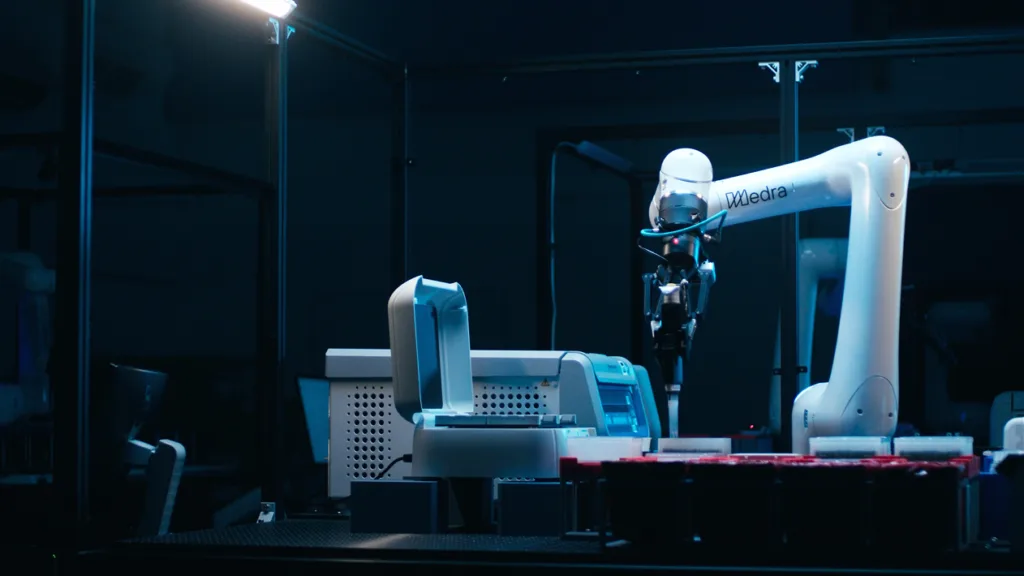
Medra’s approach addresses a fundamental disconnect in biopharma research, where experimental data often fails to loop back into model training. Current lab automation systems tend to be rigid, offering high-throughput execution but limited flexibility, and are rarely connected directly to AI systems. Conversely, AI tools that suggest molecular targets or experimental designs still require manual execution and validation. Medra’s platform fuses both ends of this spectrum into a cohesive, autonomous discovery engine.
Michelle Lee, Ph.D., founder and chief executive officer of Medra, said the existing model of pharma R&D is broken at the root, with millions of experiments being run each year that cannot be reused to inform or refine predictive models. She explained that Medra solves this gap by linking model predictions directly to automated execution and interpretation, allowing drug developers to iterate faster, run more intelligent experiments, and improve the probability of clinical success.
Why investors are backing Medra to disrupt preclinical drug development
The $52 million Series A round is notable not just for its size, but for the mix of investors it brings together. Human Capital, the round’s lead investor, has a track record of backing transformative companies at the intersection of software, science, and deep tech. Human Capital’s co-founder Armaan Ali described Medra as the beginning of an entirely new category in science infrastructure—one where scientific processes themselves can learn and scale autonomously.
Other investors such as Catalio Capital Management, Menlo Ventures, and 776 signal multi-sector confidence in Medra’s hybrid approach. Catalio, known for its deep bench in biotech, appears to see Medra as complementary to traditional platform biotech investments. Menlo and 776, meanwhile, bring perspective from enterprise automation and frontier AI, suggesting that Medra’s appeal cuts across verticals. The startup’s ability to unify predictive modeling with physical execution is attracting attention from stakeholders on both sides of the digital–biological divide.
Analysts watching the AI-for-drug-discovery space have noted that while billions have been poured into generative AI tools for molecule design, there remains a major gap in scalable, intelligent experimental validation. With regulatory agencies demanding stronger reproducibility standards and biopharma firms seeking to compress timelines, platforms like Medra could become foundational infrastructure over the next five years.
What is the broader challenge Medra is addressing in pharma R&D?
Drug discovery remains one of the most expensive and failure-prone processes in life sciences. On average, it takes over 10 years and more than two billion dollars to bring a single new therapy to market. Despite advances in omics technologies, cloud-based data platforms, and machine learning, the physical reality of lab work has not kept pace. Experimental workflows are still largely manual, fragmented, and poorly integrated with upstream prediction engines.
Medra aims to change this by reimagining the lab as an intelligent, self-adaptive system. Instead of scientists manually adjusting protocols or managing dozens of isolated tools, Medra’s platform acts as a scientific co-pilot—running, interpreting, and optimizing experiments on its own. The idea is not to replace human researchers, but to elevate them above repetitive tasks and focus their time on strategic problem solving and insight generation.
Patrick Hsu, assistant professor at the University of California, Berkeley, and co-founder of the Arc Institute, highlighted this gap in current systems. He noted that while AI models are increasingly capable of generating promising predictions, most laboratories are still bottlenecked by slow and rigid validation processes. He praised Medra’s general-purpose robotics engine as a bridge between these domains—capable of learning from every experiment and scaling the generation of useful data in a way that could accelerate frontier science.
How could Medra reshape data generation and regulatory reproducibility?
One of the most promising aspects of Medra’s approach lies in its potential to standardize and scale data generation. In the current drug development ecosystem, experimental data is often inconsistent, hard to replicate, and difficult to trace. Medra’s autonomous system not only runs standardized protocols but logs each step, enabling real-time traceability and high-confidence replication.
This could have implications not just for discovery, but also for regulatory compliance. As health authorities such as the United States Food and Drug Administration and the European Medicines Agency increase scrutiny of preclinical data quality and provenance, platforms like Medra could offer sponsors a strategic advantage. By producing tightly controlled, auditable datasets, companies may be able to accelerate filings or improve confidence during early-stage due diligence.
Furthermore, the data generated by Medra’s system is directly compatible with machine learning training loops. That means the more experiments a firm runs, the smarter the model becomes—creating a flywheel that improves both speed and accuracy over time.
What’s next for Medra following its Series A raise?
With funding secured, Medra plans to scale its engineering and deployment teams while expanding its San Francisco-based lab and demonstration facility. The company will host private tours during the JPM Healthcare Conference Week from January 12 to 16, 2026, where investors, potential partners, and R&D leaders can witness the Physical AI Scientist in action.
While the company has not yet disclosed specific commercial partnerships, its messaging suggests that its primary customers will be enterprise biopharma companies looking to modernize early discovery infrastructure. If Medra can demonstrate cost savings, increased throughput, and model improvement in real-world use cases, it may become a cornerstone of the next-generation wet lab.
Industry observers expect Medra to explore use cases across high-throughput screening, cell line development, and synthetic biology—all areas where experiment volume and iteration speed are critical. Its general-purpose design could allow it to move across verticals without the need for highly specialized hardware for each workflow.
As AI systems begin to influence every layer of the life sciences stack—from diagnostics and trial design to real-time manufacturing controls—Medra’s bet is that the physical lab itself cannot be left behind. The startup is betting that the lab must evolve into a dynamic, adaptive space where algorithms can reason and act with minimal friction. With its latest funding, Medra is one step closer to turning that vision into reality.