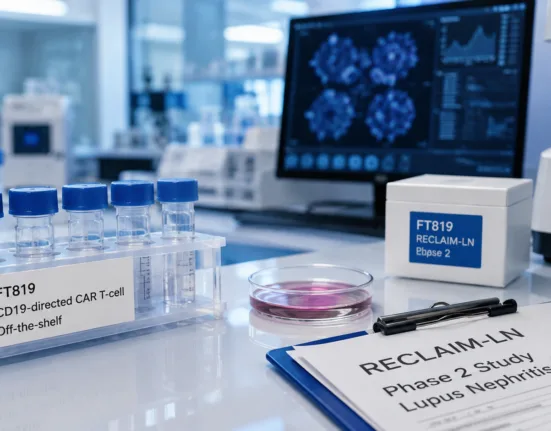
Fate Therapeutics, Inc. has announced that preclinical data for FT839, its next-generation off-the-shelf CAR T-cell product candidate, will be presented at the American Association for Cancer Research Annual Meeting, highlighting a dual-target CD19 and CD38 construct engineered for hematological malignancies and autoimmune diseases without the need for conditioning chemotherapy. The update places unusual strategic emphasis on immune evasion, functional persistence, and a chemotherapy-free treatment framework, a combination that, if it translates clinically, could materially reshape how cellular therapy is deployed across both oncology and immune-mediated disease settings.
Why the conditioning-free claim may matter more than the product update itself for the CAR T field
The most consequential element in this announcement is not simply the introduction of another off-the-shelf CAR T-cell candidate. What makes FT839 strategically important is the attempt to remove one of the most entrenched barriers in cell therapy: conditioning chemotherapy.
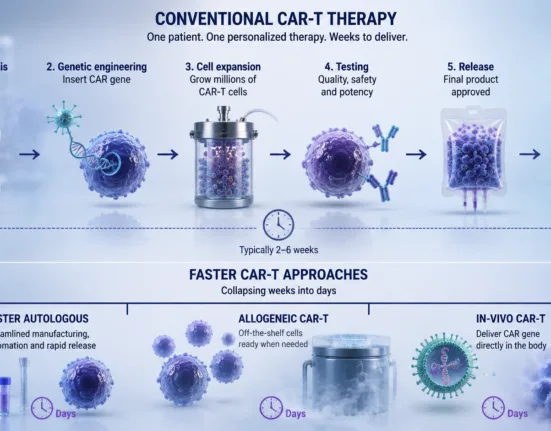
In current CAR T treatment paradigms, whether autologous or allogeneic, lymphodepleting chemotherapy is generally considered operationally unavoidable. It prepares the immune environment by reducing competing lymphocytes, creating biologic space for infused cells, and lowering the risk of rapid immune rejection. Yet this preparatory phase is also one of the most clinically and commercially problematic components of treatment.
For clinicians, conditioning introduces toxicity that can limit patient eligibility, particularly in frail oncology populations and in patients with chronic autoimmune disease who may otherwise tolerate targeted biologic therapies. For hospital systems, it adds complexity around scheduling, inpatient monitoring, supportive care, and adverse-event management. For payers and regulators, it raises questions about risk-benefit balance, especially when therapies move beyond late-line cancer into chronic indications.
This is where FT839’s positioning becomes analytically significant. If Fate Therapeutics, Inc. can eventually demonstrate that a conditioning-free allogeneic CAR T can persist and function in humans, the implications extend well beyond a single asset. It could materially reduce the treatment burden, expand addressable patient populations, and potentially lower logistical barriers that have historically confined CAR T use to highly specialized centers. In autoimmune disease, this could be especially important because the risk tolerance profile is fundamentally different from refractory hematologic malignancies. A chemotherapy-free cellular therapy model would be far more aligned with how rheumatologists, neurologists, and immunologists think about long-term treatment risk.
How the dual-target architecture could reshape both oncology and autoimmune development pathways
The biological architecture of FT839 deserves deeper analysis because it is likely central to the product’s cross-indication ambition. The candidate incorporates a dual CAR system targeting CD19 and CD38, a design choice that materially broadens its relevance across both malignant and immune-mediated disease settings.
CD19 remains one of the most clinically validated targets in B-cell malignancies and continues to hold importance in refractory leukemias and lymphomas. Its relevance has also expanded into autoimmune disease, where B-cell depletion strategies are increasingly being viewed as a path toward deeper immune reset rather than incremental symptom control. CD38 introduces another strategic layer by extending target coverage toward plasma-cell biology and activated immune-cell populations that may continue to drive disease activity even after B-cell reduction.
This matters because the field is increasingly moving toward broader immune reset frameworks, particularly in severe autoimmune diseases where durable remission remains difficult to achieve with conventional biologics. In oncology, the dual-target strategy may also be Fate Therapeutics, Inc.’s attempt to mitigate one of CAR T therapy’s longstanding weaknesses: antigen escape. Relapse through target downregulation has remained a material clinical limitation in certain hematologic cancers, and a broader targeting architecture could theoretically improve durability if supported by human data.
More importantly, the company’s decision to position FT839 across oncology and autoimmune disease suggests that this is not being developed as a narrow single-indication asset. It appears increasingly aligned with a platform thesis, which could become strategically meaningful if the initial translational signals prove credible.
Why persistence and immune evasion may ultimately determine whether FT839 is truly differentiated
The conditioning-free thesis ultimately rises or falls on one variable: persistence. Fate Therapeutics, Inc. has emphasized that FT839 incorporates Sword and Shield technology designed to evade and eliminate host allogeneic immune responses while promoting functional persistence. This should be viewed as the core scientific proposition behind the program rather than an auxiliary engineering enhancement.
Allogeneic CAR T development has historically been constrained by host immune rejection. Even when early preclinical tumor-killing data appears compelling, the infused cells often face rapid immune clearance in vivo, limiting durability and weakening long-term response potential. By attempting to directly engineer around this barrier, Fate Therapeutics, Inc. is addressing one of the most structurally important failure points in off-the-shelf cell therapy.
For clinicians and industry observers, the future value of FT839 will likely depend far less on laboratory cytotoxicity data and far more on whether persistence can be demonstrated in a fully competent human immune environment. Without durable cell survival, the conditioning-free narrative may remain scientifically interesting but commercially unconvincing.
Which translational, regulatory, and manufacturing risks could still materially constrain the upside thesis
Despite the strategic promise, the development risk remains substantial and needs to be framed as a continuous narrative rather than as discrete checklist risks. The most immediate concern is translational reliability. The history of cellular immunotherapy is filled with preclinical assets that generated strong mechanistic signals but failed to reproduce comparable efficacy, persistence, or safety profiles once moved into human studies. The gap between controlled experimental models and heterogeneous patient biology remains one of the most important reasons early enthusiasm often fades during clinical development.
That uncertainty becomes even more significant in a conditioning-free framework because the burden on immune evasion and persistence is materially higher. If the engineered cells are cleared rapidly by the host immune system, the platform’s central differentiation thesis could weaken considerably.
Regulatory complexity is likely to remain another major overhang. FT839 is described as a 13-point edited product candidate derived from induced pluripotent stem cells, which introduces a far more demanding Chemistry, Manufacturing, and Controls framework than less complex biologic modalities. Regulatory agencies are likely to scrutinize genomic stability, editing consistency, long-term persistence characteristics, and potential off-target consequences.
Manufacturing scalability could become equally important. In cell therapy, even compelling science can lose momentum if manufacturing reproducibility, lot consistency, and multicenter deployment prove difficult. This is especially relevant if the platform is intended to support expansion across both oncology and autoimmune indications.
Which clinical and regulatory milestones could determine whether FT839 becomes a viable conditioning-free CAR T platform over the next 12 months?
The next 12 months are likely to determine whether FT839 remains an intriguing scientific concept or begins to evolve into a credible development-stage platform. The immediate focus will be on the depth of the AACR dataset, particularly whether the preclinical evidence convincingly supports the persistence and immune-evasion claims that underpin the chemotherapy-free strategy.
Beyond that, the more strategically important signal will be development-path clarity. Industry watchers are likely to focus on investigational new drug-enabling timelines, the expected first-in-human study design, and whether Fate Therapeutics, Inc. prioritizes oncology, autoimmune disease, or parallel development tracks.
For the broader sector, FT839 may become an early test case for whether next-generation allogeneic CAR T platforms can move beyond the historical limitations that constrained first-wave off-the-shelf assets. That is what makes this announcement materially more important than a routine scientific meeting update. It may represent an early signal of whether the CAR T field can begin separating efficacy from chemotherapy-based preparation, a shift that could reshape long-term adoption across multiple disease categories.