Obsidian Therapeutics, Inc. said it will present Phase 2 clinical data for OBX-115 in advanced melanoma at the 2026 American Society of Clinical Oncology Annual Meeting, with the results selected for an oral presentation from the ongoing Phase 1/2 Agni-01 study. The update puts the engineered tumor-infiltrating lymphocyte cell therapy into a more visible clinical spotlight at a time when the melanoma field is searching for more durable post-checkpoint options and the wider cell therapy sector is trying to prove it can move beyond blood cancers into solid tumors.
Why an ASCO oral slot could matter more than the headline itself for OBX-115
The most important part of this announcement is not simply that Obsidian Therapeutics will be at ASCO. Biotechnology companies routinely present conference abstracts. What stands out here is that OBX-115 has been selected for an oral presentation in melanoma, which usually signals that the dataset is considered significant enough to warrant broader clinical attention. That does not guarantee practice-changing efficacy, but it does raise the level of scrutiny and interest around what the Agni-01 study may be showing.
For Obsidian Therapeutics, that matters because OBX-115 is not entering a blank market. Tumor-infiltrating lymphocyte therapy already has growing relevance in melanoma, particularly for patients whose disease has progressed after immune checkpoint inhibitors. That means the question is not whether TIL therapy belongs in the conversation. The real question is whether this engineered version can meaningfully improve the balance between persistence, anti-tumor activity, and tolerability in a setting where clinicians already understand both the promise and the logistical burden of adoptive cell therapy.
The risk is that conference visibility can create expectations that the underlying data may not fully support. An oral session can elevate perception before full details on response depth, durability, manufacturing success rates, patient selection, and toxicity management are widely interrogated. In cell therapy, the gap between an exciting presentation and a commercially workable product can still be painfully wide.
How engineered IL15 control could help OBX-115 stand out in a crowded TIL development race
OBX-115 is being positioned as more than another autologous TIL program. The distinguishing feature is its regulatable membrane-bound interleukin-15 construct, which is designed to enhance T-cell persistence and anti-tumor activity while using a controllable protein-regulation approach. Strategically, that is a smart place to differentiate. TIL therapies have often faced a basic challenge: strong biological activity is valuable, but uncontrolled immune stimulation can quickly complicate safety and tolerability.
If Obsidian Therapeutics can show that a pharmacologically regulated IL15 mechanism improves persistence without creating an unmanageable safety penalty, the platform could start to look more attractive than conventional TIL approaches that rely on less refined immune activation strategies. This is especially relevant in advanced melanoma, where patients progressing after checkpoint inhibitors may need treatments that are both potent and still feasible for heavily pretreated populations.
The unresolved issue is whether the engineering advantage translates into clinically meaningful separation rather than just scientific elegance. Many cell therapy programs look compelling mechanistically. Fewer show a clear enough efficacy and safety profile to justify the manufacturing complexity, hospital infrastructure demands, and patient selection constraints that come with autologous therapies. In other words, clever biology is necessary, but it is not enough.
Why post-checkpoint advanced melanoma remains one of the clearest test cases for solid tumor cell therapy
The indication itself makes strategic sense. Advanced melanoma has been one of the few solid tumor settings where immune-based therapies have repeatedly shown they can produce deep and durable responses. That creates a more favorable proving ground for engineered TIL platforms than many colder, more immune-resistant solid tumors. If a company wants to validate a next-generation TIL concept, melanoma is one of the most logical places to do it.
There is also a practical reason this setting matters. Once patients progress on or after immune checkpoint inhibitors, treatment choices become narrower and outcomes often worsen. Any therapy that can produce durable responses in that population will attract attention from oncologists, investors, and potential partners. The market does not necessarily need another incremental salvage option. It needs therapies that can deliver durable control in patients whose disease has already demonstrated resistance to frontline immune modulation.
Still, the bar is not low. In advanced melanoma, clinicians increasingly want to know not only whether a patient responds, but how long the response lasts, how treatment compares with existing cellular or targeted strategies, and how many patients can realistically receive it outside specialized academic centers. Solid tumor cell therapy has never suffered from too little ambition. It has suffered from too many programs that looked viable only in narrow clinical and operational windows.
What clinicians and investors are likely to watch when the Agni-01 data are finally presented
The headline release does not provide the Phase 2 results, which means the real test is still ahead. When the ASCO presentation arrives, the first metric many observers will look for is objective response rate, but response rate alone will not settle the debate. In melanoma, durability is crucial. If responses occur but prove short-lived, enthusiasm could cool quickly.
The second pressure point will be safety. Because OBX-115 includes an engineered cytokine-related enhancement strategy, clinicians will want to understand whether immune-related adverse events, cytokine-associated complications, or treatment-intensity burdens offset the intended benefit. The idea of regulated mbIL15 is appealing because it suggests more control. The data will need to show that this control is real, not merely theoretical.
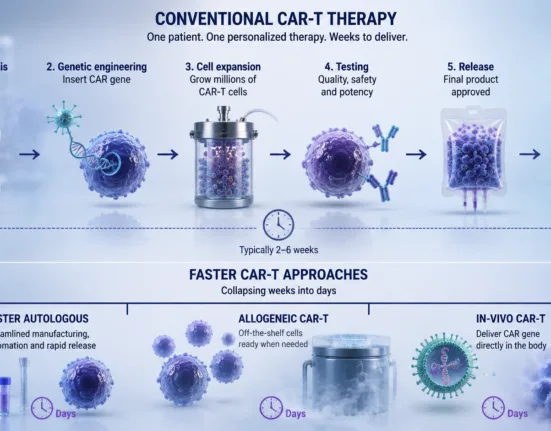
The third issue is manufacturing and treatment delivery. Autologous TIL products are personalized by design, which creates unavoidable complexity around tumor harvest, cell expansion, turnaround time, conditioning regimens, and treatment center readiness. Even strong efficacy can lose some of its practical shine if too many patients fail manufacturing, deteriorate while waiting, or require highly specialized treatment pathways. Investors tend to love breakthrough biology until manufacturing reminds everyone that biology has to travel through a factory first.
Why OBX-115 could also shape how the market thinks about engineered TIL platforms beyond melanoma
Obsidian Therapeutics has also disclosed that OBX-115 is in a Phase 1 trial for non-small cell lung cancer, and that broader pipeline angle matters. Melanoma may be the lead proving ground, but the larger commercial opportunity for any solid tumor cell therapy platform depends on whether it can extend into harder and more prevalent tumor types. A convincing melanoma dataset would therefore do more than support a single indication. It would strengthen the broader thesis that engineered TILs can move into additional solid tumor settings.
That said, success in melanoma does not guarantee success elsewhere. Melanoma is unusually immunogenic compared with many epithelial cancers. A platform that performs well there may still struggle in tumors with more suppressive microenvironments, poorer lymphocyte infiltration, or less favorable antigen landscapes. The industry has learned this lesson before. One hot tumor type can make a technology look universal right up until it meets a colder one.
This is why the ASCO readout matters beyond immediate response statistics. It could shape how seriously the market takes the cytoTIL15 concept as a platform architecture. Strong data would support the idea that regulated cytokine enhancement may improve the durability and functionality of TIL therapies. Mixed data would raise the possibility that the engineering is scientifically interesting but commercially insufficient.
How the pending Galera Therapeutics transaction adds another layer of pressure around execution
The press release also comes against the backdrop of the proposed transaction involving Galera Therapeutics, Inc., which gives the OBX-115 program added strategic weight. In merger or reverse-merger style situations, pipeline credibility matters enormously because investors are effectively underwriting not just a technology but a future public-company narrative. A visible ASCO presentation can help that narrative, especially if it supports the perception that the lead asset has differentiated potential.
But transaction context can cut both ways. When a company is moving through a corporate combination while also preparing to showcase clinical data, expectations can become compressed into a single moment. Strong data may support the combined company story and financing logic. Underwhelming or ambiguous data can quickly create questions about valuation, cash runway assumptions, and the credibility of expansion plans.
For that reason, the upcoming presentation is doing double duty. It is a scientific milestone, but it is also a reputational and strategic test. In biotech, that usually means the slide deck matters almost as much as the molecule.
Why ASCO 2026 may reveal whether OBX-115 is a genuine contender or simply another promising cell therapy story
At this stage, OBX-115 looks like one of the more conceptually interesting efforts in solid tumor cell therapy because it tries to solve a real problem rather than merely repackage a familiar one. The use of a regulated membrane-bound IL15 approach suggests Obsidian Therapeutics understands that persistence and safety must be improved together, not separately. In advanced melanoma, that is a rational and timely strategy.
The catch is that rational design has to survive clinical reality. The Agni-01 Phase 2 results will need to show enough efficacy to justify the complexity of treatment, enough durability to matter in melanoma, and enough operational credibility to suggest the product could scale beyond a handful of elite centers. That is a high standard, but it is the correct standard for a field that has spent years promising that solid tumor cell therapy is just around the corner.
ASCO 2026 will not answer every question, but it should answer a few critical ones. It should show whether OBX-115 is merely conference-worthy or whether it is starting to look commercially and clinically serious. In solid tumor immunotherapy, that distinction is everything.