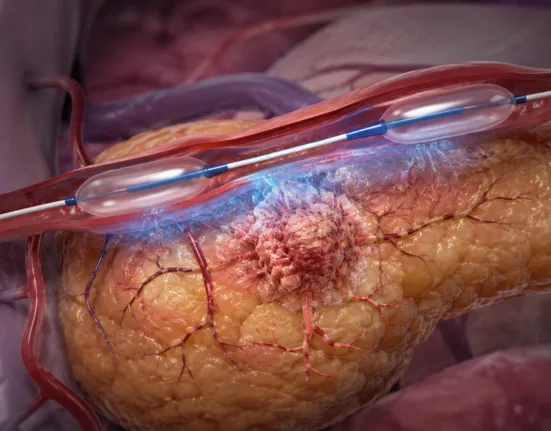
RenovoRx, Inc. announced new pharmacokinetic and pharmacodynamic findings from a sub-study within its ongoing Phase III TIGeR-PaC clinical trial evaluating the company’s Trans-Arterial Micro-Perfusion platform for targeted intra-arterial gemcitabine delivery in locally advanced pancreatic cancer. The data, presented in connection with the 2026 American Society of Clinical Oncology Annual Meeting, suggested that intra-arterial administration through the RenovoCath device may reduce systemic gemcitabine exposure while potentially increasing local drug potency compared with conventional intravenous gemcitabine delivery.
The results arrive at a time when pancreatic cancer treatment developers are increasingly confronting a difficult reality across oncology. Despite major advances in immunotherapy, antibody-drug conjugates, and molecularly targeted medicines, pancreatic ductal adenocarcinoma continues to remain one of the least responsive solid tumors in modern cancer medicine. Survival gains have been incremental, toxicity burdens remain substantial, and many therapies struggle to penetrate the tumor microenvironment effectively. In that context, RenovoRx’s strategy is notable because it focuses less on inventing an entirely new drug and more on changing how an established chemotherapy agent reaches the tumor.
Why localized chemotherapy delivery is regaining strategic importance in pancreatic cancer treatment development
Pancreatic cancer has historically exposed the limitations of systemic chemotherapy delivery more clearly than many other malignancies. The disease is characterized by dense stromal tissue, poor vascular penetration, hypoxic tumor regions, and highly immunosuppressive biology that collectively reduce therapeutic efficiency. Even when chemotherapy demonstrates anti-tumor activity, clinicians often encounter dose-limiting toxicities before achieving optimal local tumor control.
Gemcitabine has remained an important therapeutic backbone in pancreatic cancer for decades despite the introduction of more intensive regimens such as FOLFIRINOX and gemcitabine plus nab-paclitaxel. Yet the systemic administration of gemcitabine is associated with hematologic suppression, fatigue, gastrointestinal complications, and cumulative tolerability challenges that can restrict treatment intensity over time.
The RenovoRx TAMP platform is attempting to address that long-standing therapeutic bottleneck through targeted intra-arterial delivery. Rather than distributing chemotherapy broadly through systemic circulation, the approach delivers gemcitabine directly into arteries supplying the tumor region. Industry observers note that the concept reflects a broader shift in oncology thinking where drug delivery precision itself is increasingly viewed as a meaningful source of therapeutic differentiation.
How reduced systemic gemcitabine exposure could become clinically meaningful in pancreatic cancer care
The pharmacokinetic findings presented by RenovoRx appear designed to support the argument that localized delivery may improve the balance between efficacy and tolerability. According to the company, intra-arterial gemcitabine administration through the TAMP platform produced lower systemic gemcitabine levels alongside increased concentrations of an inactive metabolite. The company also reported a correlation between increased metabolite levels and reductions in CA 19-9, a biomarker commonly used to monitor pancreatic cancer treatment response.
Clinicians tracking the field may interpret those findings as an early indication that the therapy is potentially concentrating activity near the tumor while minimizing broader systemic exposure. That distinction matters because pancreatic cancer patients often experience rapid declines in performance status, making treatment tolerability almost as important as raw anti-tumor activity.
If future studies confirm that reduced circulating gemcitabine levels translate into fewer adverse effects, the platform could become particularly relevant for patients unable to tolerate aggressive multidrug regimens. Industry observers note that many pancreatic cancer patients ultimately discontinue or reduce therapy because cumulative toxicity becomes difficult to manage. A delivery platform capable of preserving efficacy while improving tolerability could therefore influence treatment sequencing and patient selection strategies.
How RenovoRx is positioning TAMP within the broader precision oncology delivery landscape
The broader significance of the RenovoRx data may ultimately extend beyond pancreatic cancer alone. Oncology drug development over the last decade has been dominated by efforts to discover new molecular targets, engineer more selective antibodies, and personalize therapy through biomarkers. However, the physical delivery of anti-cancer drugs into tumors remains an unresolved challenge across many solid malignancies.
Several oncology companies have previously explored locoregional delivery systems, including hepatic artery infusion pumps, chemoembolization technologies, isolated perfusion systems, and catheter-based infusion platforms. Yet many of those approaches historically struggled with procedural complexity, inconsistent clinical benefit, or limited scalability outside major academic centers.
RenovoRx appears to be positioning the TAMP platform differently by framing localized delivery as a potentially repeatable precision oncology infrastructure rather than a single procedural intervention. If the concept eventually demonstrates meaningful efficacy benefits, the company could attempt to expand the platform into additional solid tumor settings where local arterial targeting may improve chemotherapy concentration.
That possibility could become strategically important because many established cytotoxic agents still retain anti-tumor activity but remain constrained by systemic toxicity limitations. Improving delivery efficiency rather than replacing the drugs themselves could create a parallel innovation pathway within oncology development.
Why interventional oncology adoption barriers may still shape the commercial outlook for RenovoRx
The RenovoCath device adds an interventional oncology dimension that differentiates RenovoRx from conventional biotechnology developers. Device-enabled oncology delivery strategies often create more complex commercialization pathways involving physician training, catheter placement expertise, reimbursement structures, and procedural workflow integration.
Industry analysts have increasingly paid attention to technologies operating at the intersection of therapeutics and procedural oncology. The success of hepatic perfusion systems and certain catheter-directed oncology procedures has demonstrated that hospitals and clinicians are willing to adopt specialized treatment infrastructure when supported by convincing survival or tolerability data.
Even so, procedural scalability remains a meaningful concern. Intra-arterial chemotherapy delivery requires imaging guidance, catheter expertise, procedural coordination, and specialized institutional capabilities that may not be universally available across oncology networks. Adoption may therefore remain concentrated in larger cancer centers unless workflow integration becomes relatively straightforward and reimbursement support improves.
Healthcare systems have also become increasingly selective regarding procedural oncology technologies that add operational complexity without producing substantial outcome improvements. Payers will likely require evidence that the TAMP platform improves survival duration, quality of life, or hospitalization burden sufficiently to justify broader implementation costs.
Why the pharmacokinetic data alone may not resolve the larger regulatory and clinical questions ahead
Despite the encouraging mechanistic rationale, significant uncertainties continue to surround the TIGeR-PaC program. The pharmacokinetic and pharmacodynamic analyses involved only 16 patients across six clinical sites, limiting the ability to draw definitive conclusions regarding efficacy durability or reproducibility across broader patient populations.
Small sub-studies frequently generate biologically interesting signals that later fail to translate into meaningful survival improvements in larger randomized trials. Pancreatic cancer development history is particularly filled with therapies that produced promising early biomarker or mechanistic data before underperforming in late-stage studies.
That reality means regulators and clinicians are unlikely to focus primarily on reduced systemic gemcitabine exposure alone. Instead, the eventual commercial and regulatory viability of the TAMP platform will probably depend on whether the broader TIGeR-PaC study demonstrates clinically meaningful improvements in progression-free survival, overall survival, or patient tolerability relative to existing standards of care.
Competition within pancreatic cancer treatment is simultaneously intensifying. Developers across oncology continue pursuing next-generation KRAS inhibitors, stromal targeting therapies, cellular immunotherapies, and novel antibody-drug conjugates. That evolving competitive landscape raises the threshold for any platform seeking durable differentiation.
Still, the RenovoRx update strengthens the argument that the company’s platform may be generating biologically distinct effects rather than simply altering chemotherapy administration logistics. What clinicians and oncology investors will likely watch next is whether those pharmacokinetic observations translate into durable patient outcome improvements as TIGeR-PaC progresses.