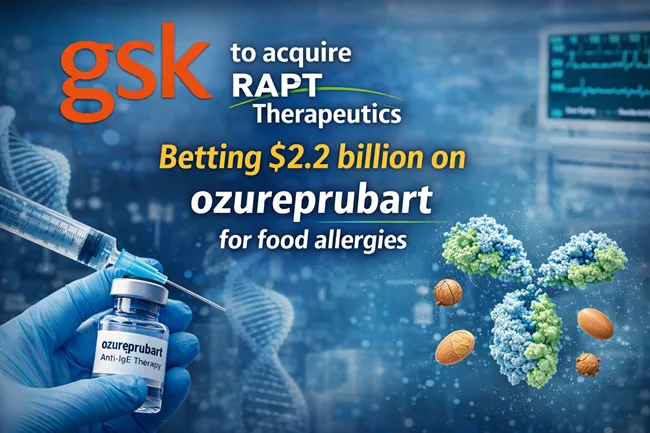
GSK plc has signed a definitive agreement to acquire RAPT Therapeutics Inc., a clinical-stage biopharmaceutical company based in California, in a transaction valued at approximately $2.2 billion. The centerpiece of the deal is ozureprubart, a long-acting anti-IgE monoclonal antibody currently undergoing Phase IIb evaluation for the prophylactic treatment of food allergies. With topline data from the prestIgE trial expected in 2027, the transaction marks GSK’s entry into a high-burden, underserved therapeutic category with significant commercial and public health implications. The acquisition is expected to close in the first quarter of 2026.
What this deal signals about GSK’s immunology ambition and its commitment to validated targets
This acquisition is a direct reinforcement of GSK’s increasingly focused pipeline strategy across respiratory, immunology, and inflammation. In a post-COVID pipeline reset, the pharmaceutical major has turned its attention toward validated biological targets with meaningful commercial runway and differentiated delivery profiles. Immunoglobulin E, or IgE, is a well-characterized and clinically proven pathway in allergic diseases, with extensive mechanistic and real-world evidence. The decision to acquire an anti-IgE asset in mid-stage development speaks to GSK’s confidence in reasserting its therapeutic presence around this pathway.
Ozureprubart offers a potentially meaningful advance over first-generation therapies such as omalizumab. GSK is targeting an unmet need that spans a wide clinical demographic, particularly children, who often face injection fatigue, scheduling difficulties, and limited eligibility under current prescribing criteria. The company’s emphasis on validated targets is also consistent with prior deals involving late-stage programs in respiratory disease and chronic inflammation. The acquisition adds another differentiated asset to GSK’s inflammation-focused roster while preserving regulatory and development optionality in future trials.
Why ozureprubart’s quarterly dosing could unlock both clinical and commercial leverage
The most notable differentiator for ozureprubart is its projected 12-week dosing schedule. This is in sharp contrast to current anti-IgE therapies which require administration every two to four weeks. Such a shift, if clinically validated, could drive both patient adherence and healthcare system efficiency. Less frequent injections mean lower procedural burden, reduced healthcare resource utilization, and better alignment with chronic care models that prioritize long-term compliance.
This potential has strong relevance for pediatric patients and caregivers. Children represent a disproportionate share of the food allergy population, but the burden of current therapies has limited real-world uptake. A quarterly injection cadence would significantly reduce the logistical friction that currently undermines therapeutic continuity in this group. Industry analysts believe that reduced injection frequency may also open pathways for coverage expansion and improved payer positioning, especially if safety and efficacy endpoints in Phase III studies support broader indications.
GSK is positioning ozureprubart not just as a differentiated molecule, but as a system-level intervention in food allergy care. By offering a more durable protection profile, the company could lower acute care costs associated with anaphylactic episodes and reduce emergency room utilization, both of which remain persistent pain points in allergy management.
How this transaction aligns with GSK’s bolt-on M&A playbook and long-term capital deployment strategy
The deal mirrors GSK’s established model of acquiring clinical-stage programs that align tightly with its therapeutic priorities while retaining enough developmental flexibility to shape Phase III trial design. The company will pay RAPT Therapeutics shareholders $58.00 per share, amounting to a total equity value of $2.2 billion. After accounting for cash on RAPT’s balance sheet, the net investment stands at $1.9 billion.
Importantly, the acquisition structure follows a tender offer mechanism. GSK will initiate the offer within ten business days of signing and will acquire all remaining shares through a second-step merger following the close. The transaction is subject to customary closing conditions, including antitrust review under the Hart-Scott-Rodino Act. The process ensures both regulatory compliance and speed of integration, giving GSK full ownership of ozureprubart’s development pathway outside mainland China, Hong Kong, Macau, and Taiwan. Shanghai Jeyou Pharmaceutical Co., Ltd. retains rights in those regions and will receive milestone and royalty payments based on future outcomes.
This approach reflects GSK’s capital deployment strategy of making concentrated, science-driven acquisitions rather than large-scale consolidations. The company has increasingly opted for platform-specific or target-specific deals that offer downstream optionality across multiple indications. With ozureprubart, GSK secures an asset with potential for lifecycle extension across other IgE-mediated disorders such as asthma, allergic rhinitis, or chronic spontaneous urticaria, although no such programs have been disclosed yet.
Why food allergies are a strategic entry point for long-term disease modification
Food allergy represents a therapeutic frontier that has long been underserved by systemic biologics. In the United States, more than 17 million people live with food allergies, and over 1.3 million report severe reactions annually. These figures translate into more than 3 million hospital and emergency care visits each year. Current therapies focus largely on reaction management rather than immune modulation, leaving a substantial gap for preventive approaches.
Ozureprubart is designed to operate prophylactically, offering baseline immune protection before accidental allergen exposure occurs. This anticipatory model could shift the food allergy care paradigm from reactive to preventive, improving quality of life and reducing economic burden. Moreover, the asset’s reach extends to approximately 25 percent of patients who are currently ineligible for existing anti-IgE treatments, potentially enlarging the addressable market without cannibalizing existing therapeutics.
Clinicians and regulatory experts suggest that if ozureprubart’s safety and efficacy profile hold up in larger trials, it could be the first major advancement in systemic food allergy care since the introduction of omalizumab. Its success could also catalyze broader investment in adjacent allergic indications, setting the stage for a new class of long-acting biologics with immune-protective intent.
What remains uncertain as GSK prepares for late-stage development
Despite its promise, ozureprubart still sits in the middle of its clinical journey. The ongoing Phase IIb prestIgE study is expected to report data in 2027. Until then, questions remain about how GSK will design the pivotal Phase III program and whether the U.S. Food and Drug Administration will require additional endpoints, particularly in pediatric cohorts. The absence of publicly available prestIgE data limits external confidence in the magnitude and consistency of effect sizes across different allergen types.
Another layer of complexity lies in regulatory pathways. While anti-IgE is a validated class, its use in food allergy prophylaxis remains narrowly approved. GSK may seek accelerated approval pathways based on surrogate endpoints, but the regulatory appetite for such approaches in allergy care has historically been conservative. Any deviation in trial design or safety concerns related to long-term IgE suppression could prompt regulatory delays or label restrictions.
There are also questions about manufacturing scalability and commercial readiness. Ozureprubart’s long half-life and lower injection frequency may reduce overall unit volume per patient annually, increasing pressure on GSK’s market access and prescriber conversion strategies. If uptake is slow or the pricing does not align with payer expectations, the commercial runway could face compression despite strong clinical potential.
How this deal reshapes competitive dynamics in anti-IgE therapeutics
The anti-IgE therapeutic class is currently dominated by omalizumab, a product with more than two decades of clinical presence and established formulary coverage. However, its frequent dosing and limited pediatric reach have left open strategic gaps. If ozureprubart proves superior in terms of durability and tolerability, it could force a re-evaluation of formulary priorities among payers and provoke a competitive response from existing players.
GSK may also opt to pursue label expansions for ozureprubart in additional IgE-driven conditions. Chronic urticaria, allergic rhinitis, and allergic asthma are all logical extensions, though GSK has yet to signal any intent. From a lifecycle management perspective, these adjacent markets could multiply ozureprubart’s addressable opportunity, but they would also require new trial infrastructure, indication-specific endpoints, and distinct regulatory filings.
The broader implication is that GSK is not merely buying a food allergy therapy. It is potentially securing a foundational biologic that can support a multi-indication franchise in IgE-mediated disease. This makes the acquisition a longer-term pipeline builder rather than a single-asset commercial bet.
A high-conviction pipeline move with strategic runway but near-term visibility risks
GSK’s acquisition of RAPT Therapeutics represents a calculated pipeline move anchored in biologic validation, patient need, and dosing innovation. Ozureprubart could shift the standard of care in food allergy by offering sustained protection with quarterly administration. Yet, the asset remains in mid-stage development, and visibility into trial design, regulatory reception, and commercial strategy is still evolving.
For GSK, the deal reinforces a broader commitment to immune-mediated conditions and biologic precision. For the biopharmaceutical industry, it signals renewed interest in building upon proven targets rather than chasing speculative mechanisms. As topline data from the prestIgE trial approaches in 2027, ozureprubart will serve as a litmus test for whether reduced dosing complexity can translate into real-world gains in adherence, access, and outcomes.

Can GSK’s $2.2bn acquisition of RAPT Therapeutics reshape the food allergy treatment landscape with ozureprubart? added by Pallavi Madhiraju on
View all posts by Pallavi Madhiraju →