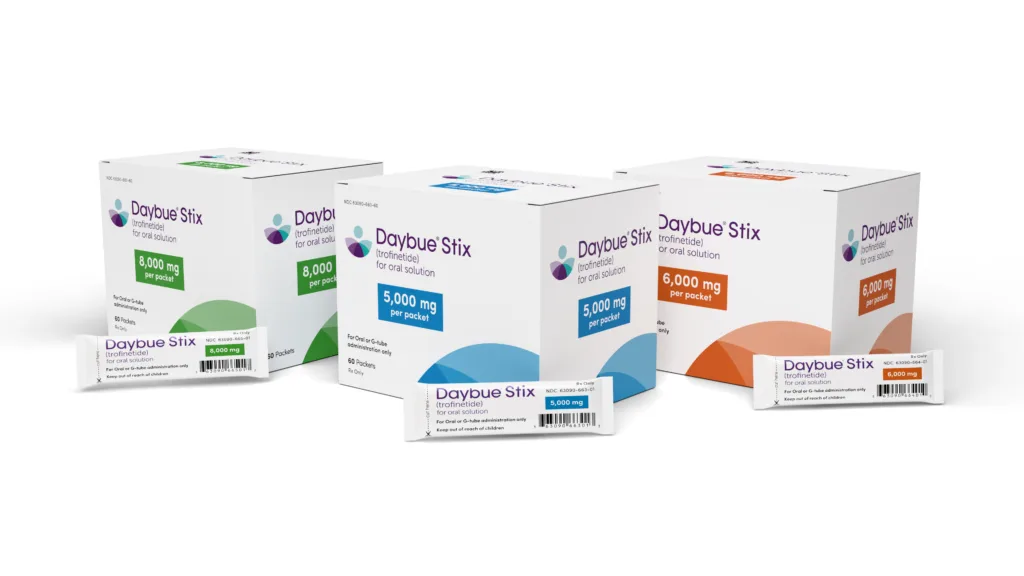
Acadia Pharmaceuticals has announced U.S. Food and Drug Administration approval for DAYBUE STIX (trofinetide) for oral solution, a new powder-based formulation of its existing drug DAYBUE used in the treatment of Rett syndrome. The approval covers use in adult and pediatric patients two years and older and is based on bioequivalence data, not new clinical trials. Both formulations are now the only FDA-approved treatments for Rett syndrome, a rare, debilitating neurodevelopmental disorder with no other approved therapies.
Why the formulation switch highlights real-world barriers in Rett syndrome care
The transition from a liquid to a powder formulation marks an attempt to address practical limitations associated with drug delivery in a patient population that struggles with motor coordination, swallowing difficulties, and sensory sensitivities. Rett syndrome typically begins between 6 to 18 months of age and progresses through stages that include loss of motor and communication skills, development of repetitive hand movements, and increasing dependence on caregivers.
In this clinical context, even minor formulation differences can be significant. Powder-based trofinetide allows caregivers to mix the drug with water-based liquids, enabling more control over taste and volume. While this does not constitute an advance in mechanism of action or pharmacological efficacy, it represents a patient-centric move that may improve medication adherence in a population where consistent dosing is often logistically challenging.
What the approval says about the FDA’s evolving stance on formulation changes
The U.S. Food and Drug Administration’s decision to approve DAYBUE STIX based on bioequivalence alone underscores a regulatory pattern increasingly evident in rare disease drug oversight. Provided the original therapy has already established a favorable risk-benefit profile, regulators appear willing to approve alternate formulations that deliver comparable systemic exposure without requiring repeat efficacy studies.
In this case, the pivotal LAVENDER study continues to serve as the clinical foundation for trofinetide. The bioequivalence study simply confirmed that DAYBUE STIX delivers similar plasma concentrations to the original oral solution. No new efficacy or safety endpoints were assessed. Regulators likely viewed this as sufficient, given that the drug targets a small, genetically defined population with no competing therapies.
Why this is a commercial lifecycle move, not a clinical expansion
Acadia Pharmaceuticals has made clear that DAYBUE STIX will not replace the original oral solution but will be marketed alongside it. A limited rollout is expected in the first quarter of 2026, followed by broader availability in the second quarter. This parallel marketing strategy reflects a classic orphan drug lifecycle approach, where maintaining patient and caregiver engagement over time often requires flexibility, customization, and reduced friction at the point of administration.
Analysts tracking rare disease commercialization models note that companies in this space often seek to deepen, rather than broaden, their footprint. Instead of expanding the label to new populations, the goal is to improve persistence and reduce abandonment rates. Acadia Pharmaceuticals now controls both delivery formats of the only approved drug for Rett syndrome. This allows the company to optimize physician and caregiver choice without diluting its reimbursement narrative or introducing additional regulatory risk.
What remains clinically unchanged for patients on DAYBUE STIX
Despite the convenience of a powder formulation, patients and clinicians should not expect any change in therapeutic effect. The mechanism of trofinetide remains the same, as does the expected side-effect profile and dosing frequency. The drug continues to function as a synthetic analog of the N-terminal tripeptide of insulin-like growth factor 1. While animal models have suggested benefits in dendritic branching and synaptic plasticity, the precise mechanism of action in humans remains unknown.
As a result, the clinical decision-making framework for trofinetide remains untouched. The powder formulation may increase acceptability, but not response rates. Physicians evaluating the suitability of DAYBUE STIX will likely focus on logistical and behavioral factors rather than any new promise of clinical differentiation.
How caregivers may shape the adoption curve for the new formulation
Caregivers in the Rett community are likely to welcome DAYBUE STIX, especially for children with specific aversions to liquid medicines or volume-based intolerance. The ability to mask the powder in a preferred liquid medium may increase day-to-day compliance, particularly during long-term administration.
However, widespread uptake will depend on how payers categorize the new formulation. If DAYBUE STIX is treated as a parity product by pharmacy benefit managers and health plans, physicians may face administrative hurdles when prescribing it as a first choice. Conversely, if it enters formularies as an interchangeable option under the same code as the liquid version, adoption may be smoother.
Industry observers note that caregiver advocacy groups can influence these access decisions, especially in the rare disease space. Should a groundswell of preference emerge in favor of the powder form, insurers may be pressured to accommodate that shift more rapidly.
What this reflects about industry priorities in post-approval formulation pipelines
The release of DAYBUE STIX aligns with a growing trend among pharmaceutical companies to invest in post-approval development work that focuses less on efficacy and more on user experience. In pediatric neurology, this trend is particularly pronounced. Difficulties with swallowing, sensory overload, and behavioral resistance often make formulation one of the most consequential factors in treatment success.
For a central nervous system condition like Rett syndrome, the ability to administer therapy without distress becomes almost as important as the drug’s pharmacology. By adding DAYBUE STIX, Acadia Pharmaceuticals is acknowledging that long-term success in this indication requires more than scientific novelty; it also demands day-to-day feasibility in a home care environment.
What the broader regulatory and commercial community will watch next
Looking ahead, attention may turn to whether the dual-formulation strategy leads to any measurable improvements in persistence rates, real-world adherence, or caregiver satisfaction. While none of these are formal endpoints, they have commercial and clinical implications.
Regulatory watchers may also look at whether the FDA continues to fast-track alternate formulations in rare diseases without requiring additional trials. If the DAYBUE STIX approval sets a precedent, other rare disease drugmakers may follow suit with powder, orally disintegrating, or taste-masked versions of already approved agents. This would represent a subtle but important evolution in how innovation is defined in tightly regulated, low-competition markets.
For now, Acadia Pharmaceuticals has reinforced its position as the category leader in Rett syndrome care. The challenge ahead will be proving that formulation convenience translates into meaningful gains in real-world outcomes.