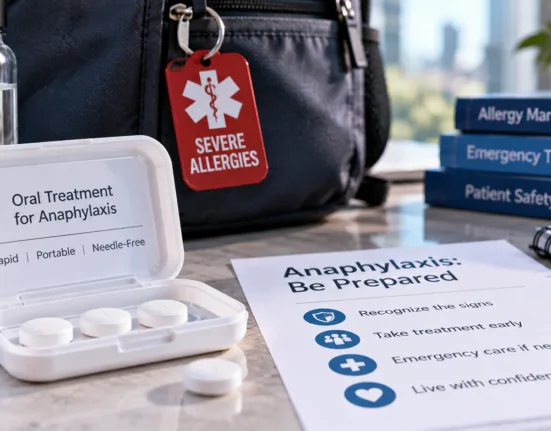
ARS Pharmaceuticals and ALK-Abelló have secured a positive opinion from the European Medicines Agency’s Committee for Medicinal Products for Human Use for EURneffy 1 mg (nasal adrenaline spray) as an emergency treatment for anaphylaxis in children weighing 15 to <30 kg. This decision positions EURneffy 1 mg to become the first needle-free adrenaline formulation approved in the EU for younger children, extending the existing EURneffy 2 mg authorization previously granted for older children and adults.
This CHMP recommendation marks a significant regulatory milestone in Europe’s evolving emergency allergy care framework. Rather than reiterating the topline, the discussion now centers on how EURneffy’s non-injectable format could alter treatment paradigms, compliance dynamics, and market competition in pediatric anaphylaxis across multiple geographies.
What EURneffy’s needle-free format reveals about treatment adherence barriers in pediatric allergy emergencies
The primary innovation underpinning EURneffy is not adrenaline itself, but its needle-free intranasal delivery. This subtle shift in administration may carry outsized impact in pediatric settings, where fear, poor coordination, or caregiver hesitation often delay injection-based intervention. Anaphylaxis progression is rapid, and needle phobia—especially among children and some caregivers—remains a documented obstacle in timely use of epinephrine auto-injectors.
Clinical observers tracking anaphylaxis response protocols suggest that a room-temperature-stable, easy-to-carry nasal spray like EURneffy could materially raise adherence in real-world, high-stress emergencies. The 1 mg dose is specifically calibrated for smaller pediatric populations who historically relied on adjusted use of 0.15 mg or 0.3 mg injectable pens. EURneffy may eliminate the trade-off between speed and dose precision while offering operational simplicity in scenarios where every second counts.
With the CHMP endorsement, clinicians in the EU may gain access to a therapeutic option that avoids both injection trauma and logistical encumbrances, potentially altering institutional stocking decisions in schools, pediatric clinics, and home-use settings.
Why regulatory convergence on nasal adrenaline delivery is likely to intensify global benchmarking
The EURneffy 1 mg recommendation aligns with a broader global regulatory trend recognizing intranasal delivery platforms for emergency indications. While injectable epinephrine has long been the gold standard, the EMA’s positive stance on EURneffy for a high-risk pediatric subgroup adds pressure on regulatory bodies in North America, Asia-Pacific, and Latin America to reassess nasal adrenaline pathways.
In the United States, ARS Pharmaceuticals already markets neffy for similar indications in children over 33 pounds (approximately 15 kg), with market penetration bolstered by the product’s ease of use and temperature tolerance up to 50°C. The FDA’s approval of neffy came after extensive usability testing that emphasized caregiver administration confidence—criteria the EMA has now echoed with its pediatric dose expansion.
Observers of regulatory harmonization note that agencies in Japan, China, and Australia have already moved forward with neffy approvals in partnership with local distributors. The CHMP’s endorsement of EURneffy 1 mg now raises the bar for guideline inclusion and national formulary acceptance elsewhere. Notably, this could accelerate international revisions to school-based emergency allergy protocols, especially where needle access is a barrier.
How EURneffy alters the pediatric epinephrine market dynamics dominated by auto-injectors
Historically, the pediatric epinephrine market in Europe has been monopolized by auto-injector devices like EpiPen and Jext. These formulations, while clinically effective, face adoption limitations due to cost, shelf-life, and caregiver proficiency concerns. The emergence of EURneffy as a needle-free competitor introduces meaningful differentiation in both product utility and cost-to-compliance ratios.
Pharmaceutical analysts tracking allergy care commercialization strategies believe EURneffy could fragment the current duopoly by offering a distinct use-case advantage: administration without training, injection, or even refrigeration. This feature set aligns with health authority efforts to reduce emergency room dependency and encourage decentralized allergy response.
Moreover, EURneffy’s rollout is backed by ALK-Abelló’s established allergy care distribution network, which has successfully launched the 2 mg version in several European and UK markets. This infrastructure advantage may enable faster pharmacy integration and physician onboarding compared to earlier niche device launches.
What manufacturing and supply challenges remain for EURneffy’s broader adoption trajectory
Despite regulatory momentum, key implementation risks persist. Nasal spray delivery devices, particularly those required to function reliably under emergency conditions, pose unique manufacturing and quality control burdens. Stability claims under extreme temperatures and after freeze-thaw cycles are impressive on paper, but sustained batch consistency will be closely watched by regulators and hospital procurement teams.
Additionally, industry observers caution that the expansion into the <30 kg pediatric cohort may raise scrutiny on long-term safety and device misuse. Intranasal pharmacokinetics differ from injectable counterparts, and subtle absorption variability in distressed pediatric patients could affect onset reliability. This will likely spur demand for additional post-market surveillance data across EU territories.
From a market access standpoint, cost-effectiveness analyses will also determine reimbursement success. While EURneffy’s value proposition is strong in theory, especially when accounting for missed-dose consequences, real-world price sensitivity—particularly in publicly funded health systems—may limit first-line adoption without bundled supply deals or school distribution subsidies.
Why the EURneffy–ALK-Abelló partnership structure could become a template for regional device commercialization
The regulatory success of EURneffy 1 mg in Europe reflects more than product innovation—it highlights a commercialization model that balances centralized R&D with decentralized market expertise. ARS Pharmaceuticals’ licensing partnership with ALK-Abelló leverages the latter’s European allergy domain reach, while avoiding redundant infrastructure buildout.
Such partnerships are increasingly attractive for U.S.-based biotech firms aiming to navigate the complexities of EU market fragmentation, local regulatory nuances, and divergent reimbursement landscapes. Industry strategists view the ALK-Abelló collaboration as a case study in regional asset leverage, especially relevant for niche emergency-use devices where distribution speed and physician trust are paramount.
As EURneffy moves closer to European Commission approval, competitors developing intranasal or needle-free solutions for emergency care may reevaluate partnership strategies, anticipating similar cross-border launches and joint marketing pathways.
What clinicians and caregivers will monitor as EURneffy 1 mg enters the pediatric allergy toolkit
Clinical adoption of EURneffy 1 mg will hinge not only on its regulatory greenlight but on real-world validation in diverse pediatric scenarios. Emergency medicine specialists and allergists are expected to evaluate device usability across caregiver demographics, response time in at-home and school settings, and any deviations in effectiveness compared to injectables under duress.
Caregivers, on the other hand, are likely to prioritize convenience, emotional burden reduction, and confidence of correct usage. Early education campaigns by ALK-Abelló will play a key role in shaping trust and familiarity with the nasal spray format, particularly among parents managing high-anxiety allergy profiles.
Regulatory watchers will also track post-market incident reports, particularly related to dosing accuracy and device malfunctions. Should initial data affirm EURneffy’s reliability in younger cohorts, broader inclusion in pediatric anaphylaxis guidelines may follow, resetting the standard for emergency care.