Corcept Therapeutics Incorporated has secured United States Food and Drug Administration approval for relacorilant, branded as Lifyorli, in combination with nab-paclitaxel for adults with platinum-resistant epithelial ovarian, fallopian tube, or primary peritoneal cancer who have received one to three prior systemic regimens, including at least one bevacizumab-containing treatment. The approval gives the commercial-stage biotechnology company the first approved selective glucocorticoid receptor antagonist in this setting and places the ROSELLA trial outcome directly into clinical practice.
What makes this approval stand out is not simply that another regimen has entered the platinum-resistant ovarian cancer market, but that Corcept Therapeutics Incorporated has introduced a mechanistically different way of trying to restore chemotherapy effectiveness in one of gynecologic oncology’s hardest-to-treat segments. Platinum-resistant ovarian cancer has long been marked by short response durability, weak survival outcomes, and limited enthusiasm around incremental cytotoxic combinations. In that context, a therapy designed to blunt cortisol-mediated resistance pathways rather than directly acting as another classic cytotoxic or targeted agent changes the commercial and scientific conversation.
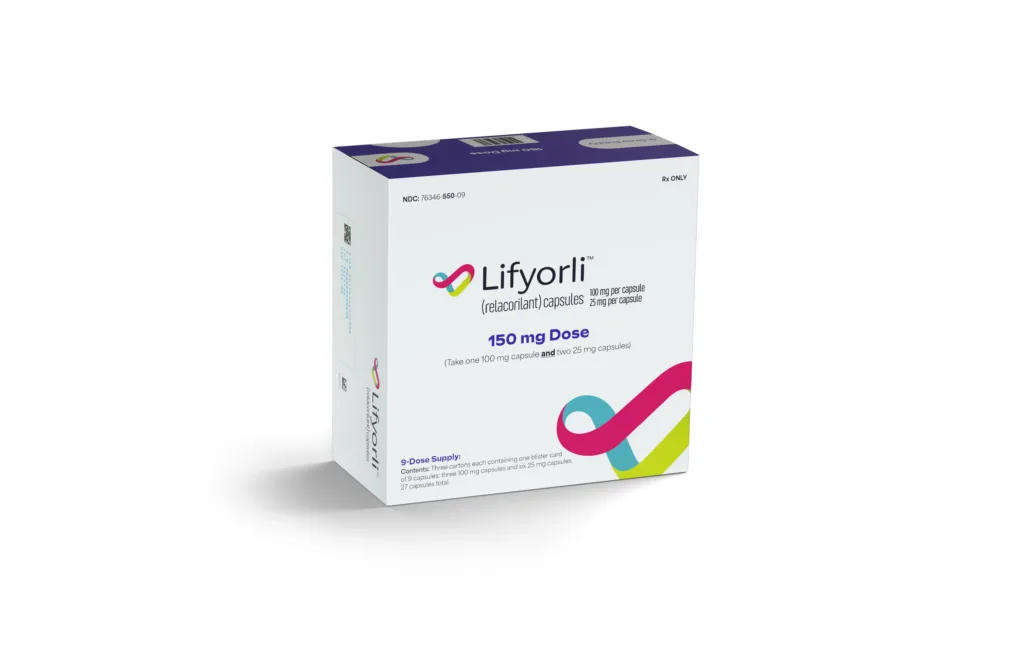
The central question now is whether relacorilant’s approval marks the beginning of a meaningful new treatment class in solid tumors or whether this success remains tightly tied to one chemotherapy backbone and one carefully defined clinical setting. Corcept Therapeutics Incorporated is clearly positioning the drug as more than a niche ovarian cancer asset. The oncology relevance lies in the broader premise that glucocorticoid receptor signaling can interfere with apoptosis, support tumor survival, and weaken chemotherapy response. If that logic holds up across additional tumor types, Lifyorli could become less a one-product story and more a proof point for cortisol modulation as a legitimate oncology platform.
The strength of the approval rests heavily on the ROSELLA study design and its survival readout. In platinum-resistant ovarian cancer, regulators and clinicians tend to look for more than tumor shrinkage because objective response alone often fails to translate into durable patient benefit. Corcept Therapeutics Incorporated said ROSELLA met both progression-free survival and overall survival endpoints, with a 35% reduction in risk of death and a 4.1-month median overall survival improvement versus nab-paclitaxel alone. That matters because overall survival remains the most persuasive endpoint in a late-line ovarian cancer setting crowded with therapies that can look active but struggle to redefine practice.
Why the relacorilant approval could matter more than a routine late-line ovarian cancer label expansion
The platinum-resistant ovarian cancer market has historically suffered from a credibility gap between statistical significance and practical relevance. Many regimens can buy time on scans without clearly altering long-term disease trajectory. A survival benefit of this size, if viewed as robust by treating oncologists once full conference data are dissected, has a better chance of influencing actual treatment sequencing than a marginal progression-free survival win alone. That gives Corcept Therapeutics Incorporated something many oncology developers chase but do not obtain: a clinically interpretable outcome in a population where therapeutic optimism is usually rationed.
Even so, the road to adoption will not be frictionless. Lifyorli is approved in combination with nab-paclitaxel, not as a standalone therapy, which means its uptake is partly tethered to physician comfort with the chemotherapy partner, practice logistics, and toxicity management in a population that may already be heavily pretreated and clinically fragile. The label also applies to a narrowed group defined by prior regimens and bevacizumab exposure, so real-world use will initially be shaped by how closely community oncology practice mirrors the trial population. Label precision can support regulatory confidence, but it can also limit early commercial breadth.
Another important feature is the lack of a biomarker requirement. In one sense, that is a commercial advantage because it removes the diagnostic gatekeeping that can slow uptake, complicate treatment pathways, and narrow eligible populations. In another sense, it creates a scientific question that will likely persist until further translational work matures. If no biomarker is needed, the field will want to understand whether relacorilant is broadly effective across biologically mixed platinum-resistant disease or whether the responder population is actually more selective than the label suggests. A biomarker-free approach can accelerate launch, but it can leave a mechanistic precision gap that becomes more visible over time.
How ROSELLA’s survival data could reshape expectations for chemotherapy-sensitising strategies in oncology
The approval also revives interest in a theme the industry has revisited for years without always converting it into durable commercial success: chemotherapy sensitisation. Many companies have tried to improve existing chemotherapy regimens through scheduling, pathway inhibition, or resistance-modulating combinations. The problem is that these strategies often look more elegant in theory than in randomized survival data. Corcept Therapeutics Incorporated now has regulatory validation that a resistance-modulating approach can clear that bar in a difficult tumor type. That may draw closer scrutiny to other combination programs attempting to improve old chemotherapies rather than replace them outright.
From a competitive standpoint, the approval may also complicate treatment conversations in a market where physicians often rely on sequential trade-offs rather than a clearly dominant standard. In platinum-resistant ovarian cancer, choice is often less about finding a perfect therapy and more about balancing tolerability, prior exposure, expected durability, and patient fitness. Lifyorli plus nab-paclitaxel enters that calculus with an argument that may resonate strongly: it appears to offer a survival advantage without requiring biomarker testing or an entirely new administration infrastructure. That is commercially meaningful because ease of integration matters almost as much as efficacy when the target users are busy oncology practices.
Still, the safety profile will remain under close watch. Corcept Therapeutics Incorporated described the regimen as well-tolerated and manageable, but the prescribing information includes warnings around neutropenia, severe infections, adrenal insufficiency, exacerbation of conditions treated with glucocorticoids, and embryo-fetal toxicity. The frequency of dose interruptions and the rate of serious adverse events suggest this is not a frictionless add-on. In practice, the drug’s adoption curve may depend on whether clinicians view the toxicity as manageable within familiar chemotherapy workflows or whether supportive care burdens dilute enthusiasm outside academic centers.
What clinicians, regulators, and commercial teams are likely to watch after the FDA decision
The next layer of scrutiny will focus on full data transparency. The press release gives the headline outcomes, but treatment pattern decisions are often shaped by subgroup performance, duration of benefit, discontinuation patterns, and detailed safety timing. Once the full ROSELLA data are presented more completely, clinicians will want to know whether the overall survival benefit was broadly distributed or driven by specific patient subsets. They will also examine whether the progression-free survival and overall survival curves separate early, remain durable, and align with a biologically credible mechanism. Those details can determine whether a drug becomes a broadly embraced regimen or a more selective option used by enthusiasts first.
Regulatory watchers will also be paying attention to Europe. Corcept Therapeutics Incorporated said it has submitted a Marketing Authorisation Application to the European Medicines Agency. A positive outcome there would widen the addressable market and strengthen the view that ROSELLA is not merely an FDA-specific success. At the same time, ex-United States regulators may interrogate the dataset differently, especially in a disease area where standard-of-care variability and prior-treatment patterns can differ across geographies. International regulatory expansion is plausible, but not automatic.
Commercially, this approval is unusually significant for Corcept Therapeutics Incorporated because it broadens the company beyond its historical endocrine identity and gives it a much more visible role in oncology. Companies built around single-mechanism franchises often struggle to convince the market that platform science can travel across disease categories. Lifyorli gives Corcept Therapeutics Incorporated a chance to argue that cortisol modulation is not just adjacent to oncology but operationally relevant to it. That could influence investor thinking, partnership options, and pipeline prioritisation across endometrial, cervical, pancreatic, and prostate cancers, where the biotechnology company says relacorilant is also being studied.
The unresolved issue is scalability of belief. One approved indication can validate a mechanism, but it does not automatically create a durable oncology franchise. The field has seen many examples where a first approval generated excitement that later programs failed to reproduce. For Lifyorli, the burden now shifts from proving it works once to proving cortisol modulation can become a repeatable oncology strategy. That will require confirmatory confidence from real-world use, disciplined safety management, clean regulatory execution beyond the United States, and further trial wins that show the mechanism is portable.
In that sense, the FDA decision is both an arrival and a stress test. It establishes relacorilant as a meaningful new entrant in platinum-resistant ovarian cancer, but it also exposes the program to a much higher standard of scrutiny. Industry observers are likely to see this as one of the more interesting oncology approvals of the year not because it instantly remakes ovarian cancer, but because it may signal that resistance biology, rather than another purely tumor-directed target, can still generate clinically important gains in a tough solid tumor setting. If that signal holds, Corcept Therapeutics Incorporated may have opened a broader door than the label alone suggests.

Can Corcept’s Lifyorli become a real new standard in platinum-resistant ovarian cancer after FDA approval? added by Pallavi Madhiraju on
View all posts by Pallavi Madhiraju →