
Lohman Technologies announced that it has expanded its strategic partnership with Salvo Health to broaden deployment of the HomECG Plus home electrocardiogram monitoring device within Salvo Health’s virtual care platform for gastrointestinal conditions. The initiative builds on a 2024 collaboration and will extend device deployments across additional U.S. states as part of a broader remote monitoring model integrating heart rate variability measurements into treatment programs for patients with irritable bowel syndrome and inflammatory bowel disease.
The deeper alliance reflects a growing convergence between digital chronic disease management platforms and physiologic monitoring technologies. While gastrointestinal care has historically focused on symptom tracking and medication management, the integration of cardiac biometrics such as heart rate variability suggests a shift toward more comprehensive monitoring of the gut brain axis and related metabolic processes.
Why integrating heart rate variability monitoring into GI care platforms signals a shift in chronic disease management models
Heart rate variability, commonly abbreviated as HRV, measures variations in the time intervals between heartbeats and is widely used as a proxy indicator for autonomic nervous system balance. In recent years, HRV monitoring has gained attention in fields ranging from cardiology to sports medicine as a marker of stress, recovery, and autonomic function.
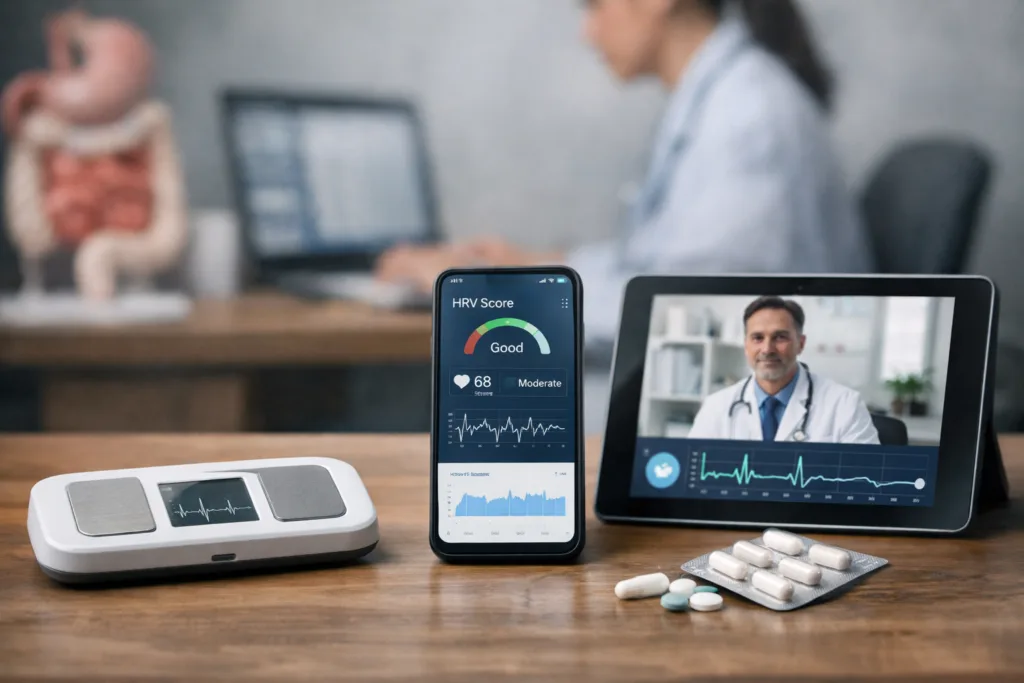
In the context of gastrointestinal disease, the relevance of HRV lies in the growing recognition of the gut brain axis as a central driver of symptoms in disorders such as irritable bowel syndrome. Research over the past decade has increasingly linked gastrointestinal symptoms to dysregulation of the autonomic nervous system, which controls processes including digestion, inflammation, and stress response.
Industry observers note that many digital GI care platforms have traditionally relied on patient reported outcomes and lifestyle tracking to guide treatment programs. While these data streams provide valuable insights, they lack objective physiologic markers that clinicians can use to measure progress or intervention effects. Integrating HRV monitoring introduces a quantifiable biomarker that may help clinicians track how behavioral therapies, dietary interventions, or stress management programs influence autonomic regulation.
The expanded partnership between Lohman Technologies and Salvo Health therefore highlights an emerging approach in digital health: combining behavioral care models with real time physiologic monitoring to create a more data driven feedback loop for chronic disease management.
What the Lohman Technologies–Salvo Health collaboration reveals about the evolution of virtual GI care platforms
Virtual care companies focused on gastrointestinal conditions have proliferated in recent years, responding to the high prevalence of disorders such as IBS and the shortage of specialist gastroenterologists in many regions. Many of these platforms emphasize multidisciplinary care models that combine dietitians, behavioral health specialists, and clinicians.
Salvo Health has positioned itself within this segment by offering hybrid care programs that coordinate remote monitoring with local physician oversight. The addition of medical grade home ECG monitoring devices suggests a strategy to differentiate the platform from competitors that rely primarily on app based symptom tracking.
Industry analysts tracking digital health platforms suggest that remote physiologic monitoring may become a key competitive differentiator in virtual care markets. Platforms that can provide objective clinical data alongside behavioral interventions may be better positioned to demonstrate measurable outcomes to payers and healthcare systems.
In the Lohman Technologies collaboration, the HomECG Plus device provides HRV measurements that can be transmitted directly to care teams without requiring a smartphone or home Wi Fi network. The device’s cellular connectivity is designed to reduce barriers for patients who may struggle with digital health technologies.
Clinicians following the evolution of remote monitoring platforms note that reducing technology friction is critical for patient adherence. Devices that require complex setup or frequent manual interaction often experience declining usage over time, limiting their usefulness in long term chronic disease programs.
How home ECG monitoring could expand beyond cardiology into broader chronic disease ecosystems
Remote ECG monitoring has historically been used for arrhythmia detection and cardiac rhythm analysis. However, the growing interest in HRV as a physiologic signal has opened potential applications beyond traditional cardiology.
In recent years, HRV has been studied as a marker for stress regulation, inflammatory response, and metabolic function. These associations have drawn attention from digital health companies seeking to integrate physiologic monitoring into behavioral and lifestyle interventions.
The collaboration between Lohman Technologies and Salvo Health illustrates how cardiac monitoring technology may increasingly function as a data layer within broader chronic disease ecosystems rather than as a standalone cardiology tool.
Industry observers note that chronic conditions such as obesity, metabolic syndrome, and inflammatory diseases often involve systemic physiological dysregulation that extends beyond a single organ system. Monitoring autonomic nervous system activity through HRV may therefore provide insights into how different interventions affect overall physiological balance.
For digital health platforms, integrating physiologic biomarkers can also support clinical validation efforts. Demonstrating measurable changes in biomarkers may help companies build evidence for improved outcomes, which is often necessary to secure reimbursement from insurers or healthcare providers.
What regulatory and clinical questions remain for HRV based monitoring in gastrointestinal care
Despite growing interest in HRV monitoring, the clinical interpretation of HRV data remains an evolving area. While HRV has been widely studied in cardiovascular research, its use as a clinical endpoint in gastrointestinal disease management is less established.
Regulatory watchers suggest that digital health companies integrating HRV monitoring into treatment programs will need to clarify how the data is used to guide clinical decision making. If HRV is positioned primarily as a wellness indicator or behavioral feedback tool, regulatory oversight may remain limited. However, if HRV measurements begin influencing diagnostic or therapeutic decisions, regulators may expect stronger evidence supporting their clinical validity.
Another challenge lies in standardization. HRV measurements can vary depending on the device used, the measurement conditions, and the algorithms applied to analyze the data. Without standardized methodologies, comparing results across platforms or clinical studies can be difficult.
Clinicians tracking HRV research also emphasize that HRV should be interpreted within broader clinical context rather than as a standalone indicator. Factors such as sleep quality, physical activity, medications, and underlying cardiovascular conditions can all influence HRV readings.
For digital GI care platforms, this complexity underscores the importance of integrating physiologic monitoring within multidisciplinary care frameworks that include clinical oversight.
Why adoption and reimbursement will determine whether physiologic monitoring becomes routine in virtual GI care
The expansion of the Lohman Technologies–Salvo Health collaboration highlights a broader question facing digital health platforms: whether physiologic monitoring can deliver enough clinical value to justify widespread adoption.
Healthcare systems and payers increasingly demand evidence that digital health interventions improve outcomes or reduce costs. For GI care platforms, demonstrating that HRV monitoring leads to measurable reductions in hospitalizations, medication use, or symptom severity could strengthen the case for reimbursement.
Industry analysts note that remote patient monitoring reimbursement pathways have expanded in recent years, particularly in the United States. However, reimbursement policies often focus on traditional chronic disease categories such as diabetes or heart failure. GI focused programs may need to build stronger clinical evidence before gaining similar reimbursement support.
Patient engagement will also play a significant role. Devices that require frequent use or produce confusing data outputs risk low adherence, which could undermine the effectiveness of monitoring programs.
Companies developing remote monitoring technologies therefore face a balancing act between generating clinically meaningful data and maintaining simple, user friendly device experiences.
What the expansion across multiple U.S. states suggests about scaling remote monitoring partnerships
The planned deployment of Lohman Technologies devices across additional states through Salvo Health’s network of partner GI clinics reflects an effort to scale the model geographically. Expanding into multiple regions allows digital health companies to test whether remote monitoring programs can function across diverse patient populations and healthcare environments.
Industry observers note that scaling remote monitoring programs often reveals operational challenges that are less visible in pilot deployments. These may include clinician workflow integration, patient onboarding processes, and data management across multiple healthcare systems.
Another consideration involves coordination with local physicians. Many digital health platforms operate hybrid models in which virtual care teams collaborate with community clinicians. Ensuring that physiologic monitoring data flows smoothly between digital platforms and traditional healthcare providers can be critical for adoption.
For Lohman Technologies, the expanded collaboration offers an opportunity to demonstrate how its monitoring technology can function within broader care ecosystems rather than solely within cardiology workflows.
What clinicians and digital health investors are likely to watch next in remote GI care monitoring
As digital GI care platforms evolve, industry watchers are likely to monitor whether physiologic monitoring technologies can translate into measurable improvements in patient outcomes. Key questions include whether HRV tracking helps clinicians identify flare triggers earlier, adjust treatment plans more effectively, or improve patient adherence to behavioral interventions.
Another area of interest involves integration with other data streams. Digital health platforms increasingly collect information from wearable devices, nutrition tracking tools, and metabolic monitoring technologies. Combining these data sources with HRV measurements could enable more sophisticated models of patient health.
Investors following the digital health sector also view remote monitoring capabilities as potential differentiators in an increasingly crowded market. Platforms that successfully combine clinical oversight, behavioral therapy, and objective physiologic data may be better positioned to demonstrate long term value.
At the same time, the field remains early in its development. While partnerships such as the Lohman Technologies and Salvo Health collaboration highlight the promise of integrated monitoring models, their long term clinical and commercial impact will depend on the ability to generate strong evidence and maintain patient engagement at scale.
