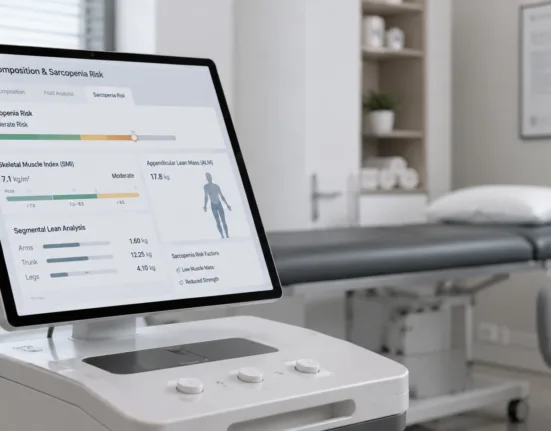
AMRA Medical has expanded its MRI-based fat and muscle composition scan to the Netherlands through a new partnership with Prescan, a leading Dutch preventative health clinic. The launch marks the third new EU market for the AMRA BCP Scan in 2025—following earlier entries in Sweden and Germany—and makes Prescan the exclusive provider of the scan in the Netherlands. The CE-certified scan offers clinicians standardized, quantitative biomarkers of visceral fat, subcutaneous fat, liver fat, and muscle composition, supporting proactive metabolic risk assessment and early intervention.
Why this launch shifts AMRA’s platform from research endpoints to preventive clinical diagnostics
This latest market entry signals a shift in AMRA Medical’s strategy—from research and pharma-driven use cases toward direct clinical implementation in high-touch, preventive screening environments. Until now, the Swedish health informatics company was best known for powering digital body composition endpoints in metabolic clinical trials and musculoskeletal studies. With the Prescan collaboration, AMRA is now bringing its proprietary platform into a patient-facing context, serving consumers and preventive care clinicians outside traditional hospital systems.
What Prescan’s clinic model reveals about the future of self-pay MRI-based health screenings
The decision to partner with Prescan is no accident. Based in Baarn, Prescan has built a reputation over two decades as a fast-track diagnostics provider catering to health-conscious individuals, executives, and second-opinion seekers. Its model—combining advanced imaging, cardiology, dermatology, and lab testing into streamlined check-up packages—fits perfectly with AMRA’s BCP Scan, which requires access to MRI scanners and quick turnaround analytics. The service will be deployed as a standalone offering at Prescan, allowing clients to receive detailed MRI-based assessments of fat and muscle distribution that go far beyond standard health check tools like BMI or waist circumference.
Why AMRA’s imaging biomarkers are being positioned as actionable early indicators of chronic risk
Clinically, the AMRA BCP Scan captures data that is increasingly seen as essential in early disease detection. Visceral fat and liver fat are strong predictors of cardiometabolic risk, while subcutaneous fat and muscle-fat infiltration patterns can inform sarcopenia status, functional decline, and even oncologic outcomes. The AMRA platform extracts this information from a rapid whole-body MRI, processed through cloud-based pipelines to deliver reproducible and standardized reports. While these measurements have long been available in academic centers or clinical trials, they are now being translated into front-line preventive care—where real-time action on metabolic risk is possible.
What limitations still block broader clinical integration of AMRA’s scan across EU health systems
This Dutch rollout comes at a time when the concept of “imaging biomarkers” is undergoing a reevaluation. Traditionally, imaging in preventive health has focused on detecting structural abnormalities—tumors, plaques, herniations. But the emerging view is that imaging can offer physiological metrics as well, providing dynamic, quantifiable insight into metabolic status long before overt disease presents. In this light, AMRA’s scan becomes a digital vital sign—a way of capturing fat and muscle patterns that can guide interventions around diet, exercise, endocrinology referral, or even drug eligibility.
However, while the CE mark clears AMRA’s software for clinical use across the EU, broader adoption still faces structural challenges. These include the lack of guideline support for imaging-based fat and muscle biomarkers in most European health systems, meaning doctors may struggle to interpret the data or incorporate it into routine workflows. Reimbursement, too, is a limiting factor. Because the BCP Scan is not yet covered by national insurers, it remains a self-pay product—potentially limiting uptake to wealthier or highly motivated individuals. That said, Prescan’s clientele already operates in this space, and the company’s ability to bundle BCP scans into full-body check-up packages may help normalize its use.
Why AMRA’s precision imaging platform stands apart from DXA, BIA, CT, and ultrasound tools
Clinician education is another gap that will need to be addressed. Most general practitioners and preventive care providers are familiar with standard lab panels or anthropometric measures, but far fewer have been trained to interpret MRI-derived biomarkers such as muscle-fat infiltration or regional adipose tissue volumes. To address this, AMRA will likely need to provide detailed interpretive guides or partner with digital health platforms to build structured decision pathways around its scan outputs. Only then will the full clinical potential of these metrics be realized at scale.
From a competitive perspective, AMRA’s biggest advantage lies in its precision and standardization. While many body composition tools exist—ranging from DXA and BIA to ultrasound—none offer the spatial granularity, cross-site consistency, and multi-organ quantification that MRI provides. DXA, for example, is limited in its ability to differentiate visceral from subcutaneous fat. Bioimpedance analysis is cheap and quick but lacks accuracy and is easily skewed by hydration status or electrode placement. CT, while precise, involves radiation and is generally not used in preventive contexts. AMRA’s platform fills a unique niche: radiation-free, high-resolution, and validated for repeat use with centralized processing that ensures consistency across sites and timepoints.
What AMRA must do next to transition from niche deployment to diagnostic standard of care
Looking forward, the success of this launch will depend not only on scan volume but on the clinical impact that the data can deliver. If clinicians begin to act on BCP scan results—by prescribing interventions, triggering referrals, or even integrating into chronic care pathways—then AMRA will have demonstrated more than a technology deployment. It will have created a new diagnostic category, one that may eventually be supported by reimbursement frameworks, clinical guidelines, and integrated care models.
It is also likely that this partnership will serve as a prototype for other markets. Countries with similar private preventive care ecosystems—such as the UK, Germany, Switzerland, or parts of the Middle East—could represent the next wave of expansion. In parallel, AMRA continues to serve pharma clients with BCP analytics for trial enrichment, stratification, and endpoint development. This dual model—research-grade precision for drug development, and clinically deployable scanning for population health—positions the company uniquely in a space where imaging, informatics, and lifestyle medicine converge.
What long-term impact this partnership could have on the global trajectory of metabolic screening
For preventive health watchers, the larger question is whether this approach can move beyond niche applications and into everyday care. That may ultimately hinge on three variables: the ability to reduce scan costs and MRI time through protocol optimization; the generation of evidence linking BCP metrics to health outcomes in longitudinal cohorts; and the alignment of AMRA’s readouts with interventions that demonstrably change the course of disease.
Prescan’s CEO, Haif Rood Nawzad, indicated that the collaboration aligns perfectly with the company’s vision of advancing early detection through clinically relevant imaging. His emphasis on integrating metabolic risk insights into Prescan’s MRI suite underscores the growing appetite for diagnostics that do more than just visualize—they quantify, stratify, and guide action. If this model takes hold, it could mark the beginning of a broader transition from snapshot-based imaging to biomarker-based diagnostics in outpatient medicine.
Meanwhile, AMRA’s CEO, Olof Dahlqvist Leinhard, described the Dutch launch as part of the company’s broader mission to bring MRI-based biomarkers from scientific research into the clinic. His comments reflect a deliberate evolution in AMRA’s positioning—from an advanced analytics provider for drug trials to a clinical innovator in precision diagnostics. This positioning may ultimately allow the company to navigate both regulatory and commercial pathways more effectively than competitors offering hardware-dependent or semi-quantitative solutions.
The Netherlands now joins the United States, Canada, the United Kingdom, Germany, and Sweden as part of AMRA’s operational footprint. With additional market entries anticipated in 2026, and an expanding base of strategic collaborations, AMRA’s challenge will be to convert technical validation into routine clinical use. That will require more than just partnerships. It will require trust, evidence, and education.
If AMRA and Prescan can show that MRI-based body composition scans change patient trajectories—whether through earlier intervention, improved monitoring, or better-informed treatment—they may not just carve out a niche. They may redefine how metabolic risk is screened, scored, and solved in modern medicine.