
Hardy Diagnostics has announced an exclusive partnership with NEMIS Technologies to introduce the N-Light rapid pathogen detection platform across North America. The move brings chemiluminescent-based hygiene monitoring—already validated in several European food manufacturing segments—into the U.S. market at a time when regulatory focus on proactive food safety and decentralized diagnostics is accelerating. The announcement positions Hardy Diagnostics to expand its role beyond lab-based culture media into real-time, facility-level contamination control.
Why chemiluminescent on-site diagnostics may disrupt legacy pathogen workflows
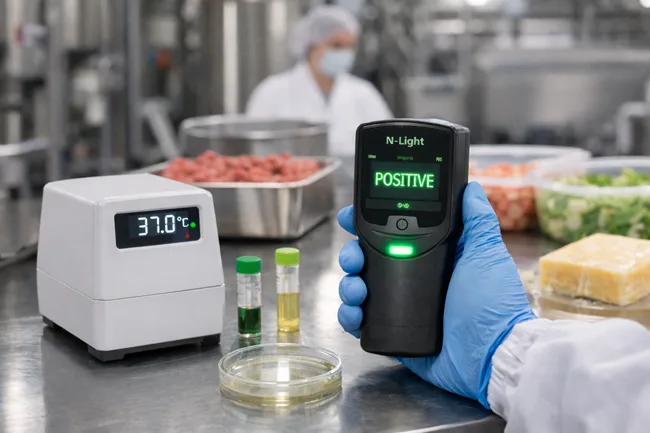
At the core of this collaboration is the N-Light platform, a proprietary chemiluminescent system developed by Swiss-based NEMIS Technologies. The platform is designed to offer food production teams a simplified and rapid way to detect specific pathogens directly within processing environments. Unlike conventional culture or PCR-based workflows that often require central lab submission and time-intensive processing, N-Light enables frontline teams to confirm contamination risks within hours on-site, using minimal equipment.
This shift is not merely incremental. The chemiluminescent reaction technology offers potential operational advantages by eliminating the need for skilled lab technicians during routine hygiene checks. In practical terms, the system may enable food safety officers and quality assurance leads to conduct frequent, high-sensitivity tests in response to real-time risk indicators, such as deviations in temperature control, water activity, or cleaning protocols. If validated broadly in U.S. environments, it could reduce dependence on reactive testing after contamination events and shift the balance toward active, on-the-floor surveillance.
What this reveals about regulatory and industry readiness for decentralized microbiology
The timing of Hardy Diagnostics’ move reflects a broader realignment in food safety regulation and industrial compliance strategies. Agencies like the United States Food and Drug Administration have been calling for digital traceability and smarter, faster safety verification under frameworks such as the New Era of Smarter Food Safety. However, most innovation thus far has been concentrated in molecular biology labs or central processing nodes. What this partnership highlights is a growing appetite for decentralized, self-administered tools that give line operators more agency in microbial quality control.
Hardy Diagnostics, traditionally recognized for its clinical microbiology solutions and diagnostic media, is signaling with this partnership that food safety no longer belongs solely to central laboratories. By introducing NEMIS Technologies’ tools to the North American market, the company is bridging the divide between regulated diagnostic infrastructure and day-to-day manufacturing operations. Industry observers note that the success of this approach will depend not only on performance data, but also on regulatory recognition, cost-effectiveness, and ease of training across different food sectors—from meat and dairy to frozen, RTE, and retail packaged goods.
What operational and adoption hurdles remain for North American market entry
Despite clear benefits in simplicity and response time, the N-Light system faces significant hurdles in transitioning from a European use case to broad adoption in the United States and Canada. First, regulatory validation remains a gating factor. U.S. food producers and contract labs typically rely on methods that are certified by bodies such as the Association of Official Analytical Chemists (AOAC) or recognized by the United States Department of Agriculture. European market use does not automatically guarantee equivalency in the eyes of U.S. regulators.
Second, consistency of field performance must be demonstrated across diverse environmental conditions and operator skill levels. The chemiluminescent principle, while robust in controlled laboratory or pilot settings, can be affected by temperature, humidity, and surface contamination. Facility managers will need proof that detection sensitivity and specificity remain within acceptable margins, even when administered by non-specialist staff under real-world production constraints.
Furthermore, stakeholder familiarity may slow early adoption. Food companies heavily invested in culture-based or PCR diagnostic systems may view the N-Light platform as either redundant or insufficient unless it can be validated across multiple pathogens and surfaces. While NEMIS Technologies currently supports Listeria monocytogenes detection as its lead use case, broader validation for Salmonella, E. coli, or Campylobacter would be required for widespread cross-category adoption. Education and proof-of-value will likely be essential parts of Hardy Diagnostics’ rollout strategy.
How this could redefine frontline hygiene surveillance in food production
If Hardy Diagnostics and NEMIS Technologies succeed in driving adoption, N-Light could catalyze a transition from episodic testing to continuous hygiene surveillance in food production. Because the platform’s test cycle is compact and can be executed without lab support, production teams could incorporate N-Light into their standard cleaning protocols or conduct post-cleaning verification on critical surfaces with minimal workflow interruption.
This shift has implications for HACCP compliance and root-cause traceability during contamination events. Real-time detection allows producers to respond immediately before contaminated products leave the facility. Additionally, data generated from routine testing could be integrated into broader quality management systems, enabling predictive analytics and long-term process optimization.
Analysts also point to the potential for integration with cloud-based dashboards, enabling regional safety officers or corporate quality leaders to track site-level performance remotely. This could improve corporate oversight and standardization across multi-facility operations, especially in sectors where contract manufacturing and distributed production are common.
What industry stakeholders, regulators, and clinicians are watching next
With the North American launch underway, attention will now turn to how the N-Light system performs in high-throughput production environments under North American regulatory scrutiny. Industry watchers are looking for third-party validations, AOAC method approvals, or comparative studies conducted in collaboration with U.S.-based labs or academic institutions.
Clinicians and microbiology professionals, especially those operating in dual roles across clinical and food safety diagnostics, may evaluate the technology for crossover applications. Although Hardy Diagnostics has not positioned N-Light for use in clinical or environmental pathogen surveillance outside of food production, the platform’s simplicity and adaptability may generate interest across sectors dealing with microbial contamination risk, such as water systems, animal health, or cosmetics manufacturing.
Meanwhile, regulatory observers will be watching for any guidance from the United States Food and Drug Administration, USDA Food Safety and Inspection Service, or Canadian Food Inspection Agency that signals openness to chemiluminescent-based diagnostics for compliance testing. These endorsements, if achieved, would significantly accelerate commercial uptake.
Hardy Diagnostics’ educational partnership with NEMIS Academy could also influence uptake. Industry stakeholders recognize that adoption of new technologies often hinges not just on performance metrics but on user training, risk communication, and stakeholder trust. The rollout of hands-on training, product demos, and data sharing will likely play a pivotal role in establishing N-Light as a viable, scalable addition to the North American food diagnostics ecosystem.
