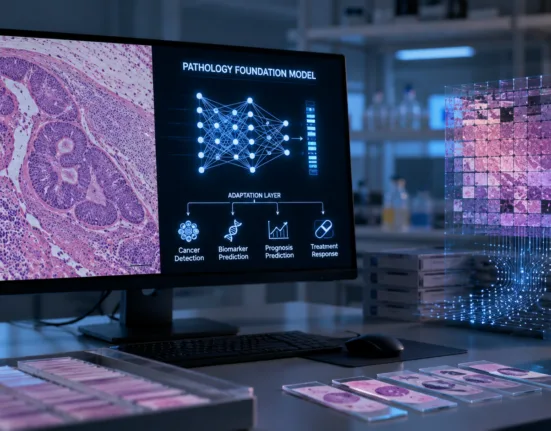
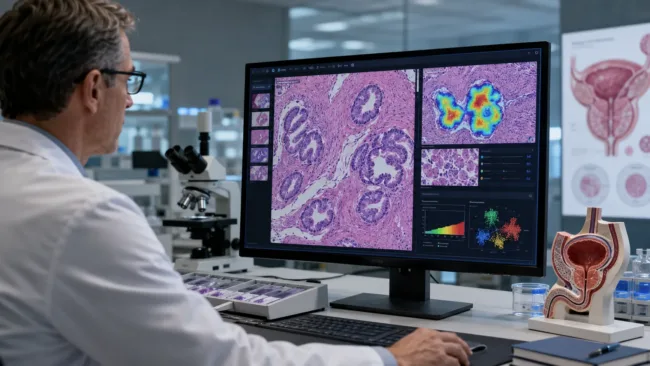
GE HealthCare and Tribun Health have jointly announced a major digital deployment at Sant’ Andrea University Hospital, part of Sapienza University of Rome, that could reshape how complex oncology diagnostics are delivered in Europe. The hospital will integrate GE HealthCare’s Datalogue platform with Tribun Health’s CaloPix digital pathology suite, creating an artificial intelligence–ready environment that unifies radiology and pathology data for cancer patients. The implementation is reportedly the first full digital pathology system in Italy’s Lazio region and was supported with €800,000 in public funding from the National Recovery and Resilience Plan.
What this deployment changes for digital cancer diagnostics
Sant’ Andrea’s move is not a basic IT upgrade. It represents a structural shift in how imaging and pathology departments can collaborate in real time across the oncology diagnostic journey. Historically, radiology and pathology have operated as siloed disciplines with minimal integration. Radiologists focus on structural imaging, while pathologists examine tissue samples, often using separate systems with inconsistent data interfaces.
This deployment collapses that gap. The combination of GE HealthCare’s Datalogue platform, which includes a vendor-neutral archive and a universal viewer, and Tribun Health’s AI-enabled CaloPix pathology environment introduces a fully integrated diagnostic backbone. Rather than piecemeal interoperability, the hospital is investing in a single diagnostic stack where clinical data flows between departments, enhancing collaboration, reducing turnaround times, and enabling more confident multidisciplinary treatment decisions.
Clinicians and industry analysts watching this space believe oncology is the most critical proving ground for such integration. Cancer diagnostics are increasingly data-dense, involving radiological scans, histopathology slides, molecular biomarkers, and clinical records. With tumor boards and treatment planning dependent on synchronized views across modalities, this type of unified platform could become a new standard for oncology centers seeking diagnostic precision and workflow efficiency.
Why the oncology focus amplifies the impact
The importance of this implementation is magnified by Sant’ Andrea’s profile as a high-volume oncology center and its status as a translational research hub. Oncology is a uniquely multidisciplinary field. Each patient journey can involve radiologists, surgical pathologists, molecular diagnosticians, and clinical oncologists working together. But that collaboration is often hindered by disconnected systems and staggered access to data.
By linking CaloPix and Datalogue within a hospital-wide imaging infrastructure, the facility aims to streamline the entire cancer care pathway. This includes enabling radiologists to access digital pathology reports within their imaging viewer, allowing tumor boards to jointly evaluate scans and histological slides in real time, and supporting AI-assisted decision-making based on comprehensive datasets.
Observers note that unifying pathology and imaging in this way supports more than efficiency. It lays the groundwork for advanced use cases like image-guided biopsy planning, radiogenomic correlation, and integrated reporting models that reflect both cellular and structural characteristics of tumors. These are capabilities increasingly demanded in trials for immuno-oncology drugs and targeted therapies, where timely and layered diagnostics can drive eligibility and outcomes.
What distinguishes this deployment from incremental upgrades
While digital pathology adoption has grown globally, most implementations remain limited to internal lab digitization or partial interoperability with radiology platforms. What makes Sant’ Andrea’s model notable is the scale and seamlessness of the integration. Rather than layering middleware between legacy systems, the hospital has opted for a clean pairing between GE HealthCare’s enterprise imaging architecture and Tribun Health’s computational pathology tools.
This pairing is designed from the ground up to support AI modules and data fusion. GE HealthCare’s Datalogue functions as a comprehensive content manager with universal viewing capabilities, while Tribun Health’s CaloPix system provides slide digitization, AI-powered image analysis, diagnostic workflow tools, and structured data export.
The AI readiness is particularly important. While many hospitals are piloting artificial intelligence in either imaging or pathology, few have the infrastructure to apply AI across both domains simultaneously. By choosing a platform pairing already tuned for machine learning augmentation, Sant’ Andrea positions itself to be an early adopter of cross-modal AI tools such as image-based cancer staging, metastasis prediction, or response monitoring algorithms.
What implementation and scalability challenges persist
Despite the promise, full imaging–pathology convergence carries well-documented risks. Enterprise imaging systems can be notoriously complex to deploy across clinical departments with entrenched workflows and varying IT maturity. Digital pathology introduces its own hurdles, including data volume, storage formats, scanner calibration, metadata tagging, and clinician retraining.
One of the key operational challenges will be ensuring seamless integration of legacy pathology data into the new platform without compromising diagnostic integrity. Histological slide data, especially when digitized retrospectively, often lacks the structured annotations or standard formats needed for efficient AI indexing or cross-platform use.
There is also the question of clinician adoption. Digital transformation of this scope typically requires retraining of radiologists, pathologists, and support staff. Pathologists in particular may be reluctant to shift from microscope-based review to screen-based diagnostics, especially in high-pressure oncology workflows where diagnostic confidence and speed are critical. Training, change management, and interface usability will determine whether the new system is embraced or bypassed.
What this reveals about public investment in hospital digitization
The public funding component of this deployment is significant. Italy’s National Recovery and Resilience Plan provided more than half of the total €1.5 million cost, underlining how national governments across Europe are now backing diagnostic transformation as part of health system modernization. The European Union’s digital health priorities are increasingly focused on data integration, AI-readiness, and infrastructure upgrades that can reduce diagnostic disparities and support population-level outcomes.
Sant’ Andrea’s model could become a case study for how regional hospitals—not just elite cancer centers—can digitize diagnostic services using national investment vehicles. If the integration proves successful in improving diagnostic speed or treatment selection, it may provide a blueprint for replicable scale-up across Europe’s fragmented public health systems.
Regulatory watchers suggest that such flagship projects could also accelerate clarity around reimbursement and approval pathways for digital pathology and AI modules, which remain inconsistent across EU member states. Demonstrated impact on clinical workflows and patient outcomes could help justify broader public or payer support for similar platforms elsewhere.
What clinicians, regulators, and the industry will track next
For clinical teams, the next benchmark will be whether this system materially improves key outcomes: faster diagnosis, higher tumor board efficiency, fewer repeat scans or biopsies, and more timely initiation of therapy. For patients, the ultimate measure is whether integrated imaging and pathology translates into more personalized and effective cancer care.
From an industry perspective, GE HealthCare and Tribun Health will be closely watched for how their platforms perform in production-scale deployments. Future updates may reveal whether AI modules within CaloPix can gain regulatory clearance for clinical use or remain decision-support tools. There is also growing interest in whether Datalogue’s vendor-neutral architecture can support broader integration beyond oncology, such as in neurology or rare disease diagnostics.
For regulators and health economists, the question is scalability. Can such deployments work in community hospitals or only in university-affiliated centers? Will the performance gains offset the high capital expenditure and operating costs associated with high-volume image storage, AI licensing, and platform maintenance?
As the first full digital pathology deployment in Lazio, and one of the most integrated use cases in Europe, the Sant’ Andrea implementation will likely shape strategic planning for digital diagnostics across multiple stakeholders. Whether it sets a replicable standard or remains an elite exception will depend on its outcomes—and how those outcomes are measured and communicated.