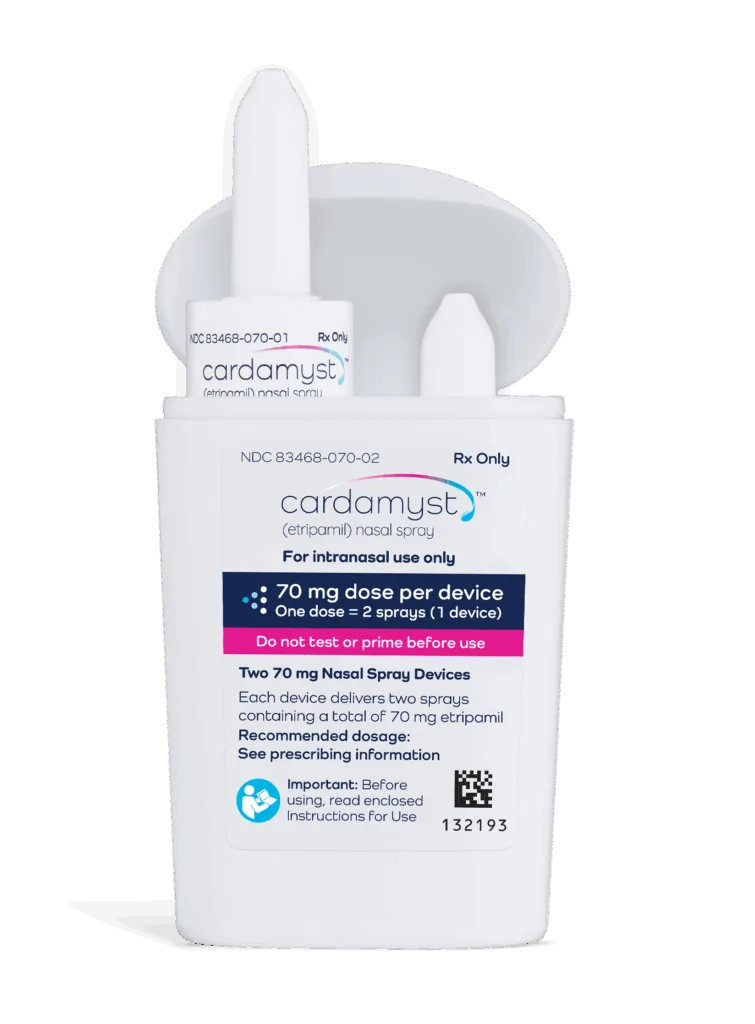
Milestone Pharmaceuticals Inc has received approval from the United States Food and Drug Administration for CARDAMYST (etripamil) nasal spray as the first self-administered treatment for acute episodes of paroxysmal supraventricular tachycardia in adults. This is the first new approved therapy in over three decades for this condition and marks a critical regulatory milestone for the Montreal and Charlotte-based biotech company.
The approval of CARDAMYST opens a new front in arrhythmia care by offering a route of administration that bypasses the emergency department, potentially redefining how more than two million Americans manage their PSVT episodes. Unlike the current standard of care that often involves intravenous administration or hospital visits, Milestone Pharmaceuticals’ nasal spray formulation of etripamil gives patients a means to intervene early, outside the clinical setting.
What this approval unlocks for cardiac arrhythmia treatment models
The self-administered nasal delivery of etripamil shifts the clinical conversation around arrhythmia management from reactive hospital-based care to proactive patient-led intervention. PSVT, a condition characterized by sudden episodes of abnormally fast heart rhythms, can be both distressing and debilitating. Patients frequently find themselves reliant on emergency departments for symptom resolution, often enduring repeated visits that are both expensive and disruptive.
Industry observers suggest that CARDAMYST directly challenges this model by placing therapeutic control in the hands of patients. By offering a portable, rapid-acting calcium channel blocker in nasal spray form, Milestone Pharmaceuticals provides an option that resembles the at-the-ready convenience of asthma inhalers but adapted for cardiovascular emergencies. This represents a novel paradigm in acute cardiovascular care, especially in a landscape where innovations in outpatient arrhythmia treatment have been sparse.
Clinical data from the Phase 3 RAPID trial, published in 2023 in The Lancet, demonstrated that patients using CARDAMYST were twice as likely to convert to sinus rhythm compared to those receiving placebo. The median time to conversion was 17 minutes, a significant improvement over the 54 minutes seen in the placebo group. These efficacy signals were consistent across patient subgroups, including those concurrently using beta blockers or oral calcium channel blockers.
Why this is a strategic inflection point for Milestone Pharmaceuticals
For Milestone Pharmaceuticals, this FDA approval elevates the company from a clinical-stage developer to a commercial-stage biotech with a first-in-class product. The approval also triggers strategic options beyond PSVT, as the company has already indicated plans to pursue a supplemental New Drug Application pathway for atrial fibrillation with rapid ventricular rate, commonly known as AFib-RVR. Based on promising Phase 2 ReVeRA data, Milestone Pharmaceuticals is preparing a registrational Phase 3 study to assess etripamil’s utility in this larger and more complex indication.
The strategic logic is clear. While PSVT affects an estimated two million Americans, AFib-RVR touches a far broader patient base. Nearly ten million people in the United States have atrial fibrillation, and approximately 30 to 40 percent of them experience at least one episode per year of symptomatic rapid ventricular rate. Milestone Pharmaceuticals estimates that by 2030, the target addressable market for etripamil in AFib-RVR could reach three to four million patients annually. This pipeline continuity enhances the commercial viability of CARDAMYST by framing it as the first node in a broader self-administered cardiovascular platform.
What sets CARDAMYST apart from existing PSVT interventions
Until now, the primary options available to clinicians managing PSVT were either intravenous adenosine in emergency settings or long-term control strategies, including catheter ablation for patients with recurrent episodes. Adenosine, while effective, is known for its abrupt and uncomfortable onset of action, often producing a sense of chest pressure or impending doom that some patients find intolerable. In contrast, the nasal formulation of etripamil is designed to be tolerable and manageable without clinical supervision, which could enhance patient confidence and adherence.
The administration route also eliminates the need for intravenous access, which is often a barrier in acute settings, particularly for patients who experience repeated episodes in non-clinical environments. This positions CARDAMYST not merely as a new molecule, but as a fundamentally different intervention model that integrates pharmacologic efficacy with behavioral and logistical ease.
Despite these advantages, some cardiologists remain cautiously optimistic, noting that real-world adoption will depend heavily on patient education, proper identification of PSVT episodes, and clinician willingness to prescribe a drug that shifts acute intervention responsibilities to the patient. A segment of the medical community may require longer-term post-market data to validate the safety and efficacy seen in controlled trials.
What this reveals about FDA’s evolving stance on self-managed acute therapies
Regulatory watchers point to CARDAMYST’s approval as evidence of a growing openness within the United States Food and Drug Administration to approve self-administered therapies for acute cardiovascular events. This reflects a broader trend toward decentralizing treatment models and empowering patients to manage intermittent but high-impact conditions.
The agency’s willingness to approve a nasal spray for a potentially serious arrhythmia suggests that the regulatory framework is evolving in response to both clinical need and patient behavior. With healthcare systems under pressure from rising costs and emergency department bottlenecks, interventions that reduce acute care demand are increasingly being viewed through a health system efficiency lens as well as a therapeutic lens.
That said, this shift introduces new oversight questions. There remains a need for strong pharmacovigilance programs to track inappropriate usage, dosing errors, or misuse in patients who may confuse PSVT with other arrhythmias that require different management strategies. Future post-marketing surveillance data will likely inform how regulators view the risk-benefit profile in broader populations.
What could limit real-world uptake despite strong clinical data
Even with robust trial results, commercial success for CARDAMYST is not guaranteed. Payers will want to see health economic data demonstrating that the nasal spray reduces emergency room utilization and hospitalization rates. Without this proof, there is a risk that insurance coverage could be slow to materialize or limited by restrictive reimbursement criteria.
The product’s early adoption curve will also depend on physician comfort levels and patient comprehension. While patients with experience managing chronic conditions like asthma or diabetes are familiar with self-treatment modalities, patients with cardiovascular disease may be less accustomed to managing acute episodes independently. This learning curve introduces variability that could slow initial uptake, especially in more conservative clinical settings.
Milestone Pharmaceuticals has acknowledged these challenges and has indicated that it is actively working to ensure insurance coverage and pharmacy-level distribution is in place for the Q1 2026 launch. Still, the success of CARDAMYST will hinge not just on market access, but on its integration into patient and clinician behavior patterns.
What clinicians and investors will be watching next
For clinicians, the next critical milestone is not just availability but clarity on how CARDAMYST fits into treatment algorithms. Will it be prescribed only for patients with confirmed recurrent PSVT? Will it replace vagal maneuvers as a first-line rescue option? And how will its cost compare to existing interventions?
For investors, much of the value creation now hinges on Milestone Pharmaceuticals’ ability to demonstrate that the same nasal platform can succeed in AFib-RVR. If the Phase 3 registrational trial delivers similarly strong outcomes, etripamil could emerge as a versatile acute arrhythmia therapy with multiple indications and scalable revenue potential. The forthcoming trial design, expected patient population, and regulatory endpoints will be scrutinized for their potential to accelerate or delay that second sNDA filing.
From a broader healthcare system perspective, the arrival of CARDAMYST could prompt new reimbursement codes, changes in clinical guidelines, and fresh debate on the role of patient-managed therapies in acute cardiovascular care.
Final outlook: A market-defining moment or a niche innovation?
Milestone Pharmaceuticals has succeeded in getting a first-of-its-kind therapy approved in a field that has seen little change in decades. CARDAMYST offers a new therapeutic mechanism, a new delivery format, and a new use case that could collectively challenge the traditional model of arrhythmia care. However, whether it becomes a market-defining product or remains a niche solution will depend on how quickly clinical practice, reimbursement systems, and patient behavior adapt to its use.
The real test lies not in the trial data, which is already compelling, but in the systemic readiness of the healthcare ecosystem to decentralize acute cardiac intervention. If successful, CARDAMYST could pave the way for a new category of self-managed emergency therapeutics—and perhaps spark similar innovation across other high-acuity specialties.