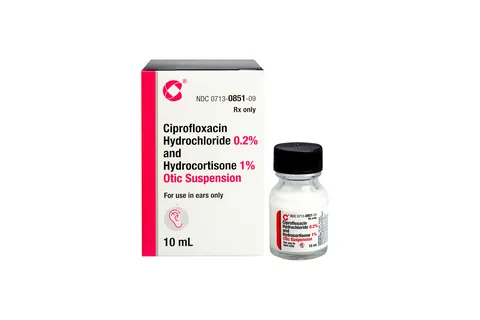
Cosette Pharmaceuticals, Inc. has received United States Food and Drug Administration approval for its Abbreviated New Drug Application covering the first generic version of ciprofloxacin 0.2 percent hydrochloride and hydrocortisone 1 percent otic suspension, alongside 180 days of Competitive Generic Therapy exclusivity, and has begun commercial shipments into the United States market.
That announcement, while modest in headline value, carries several deeper implications for the otic anti infective category, the economics of mature branded ear infection therapies, and the evolving role of the Competitive Generic Therapy pathway as a commercial lever for mid sized specialty generic manufacturers.
Why a first generic after more than two decades still matters in otic infections
The ciprofloxacin hydrocortisone otic suspension has been commercially available in the United States for more than 27 years, yet remained insulated from generic competition for nearly three decades. Industry observers note that this reflects a broader pattern in otic and ophthalmic products, where formulation complexity, sterility requirements, and relatively small market sizes often deter generic challengers despite long expired patents.
In acute otitis externa, treatment standards have been relatively stable, with topical antibiotic steroid combinations remaining the clinical mainstay. The lack of generic entry until now suggests that barriers were not scientific novelty but manufacturing execution and regulatory persistence. Cosette Pharmaceuticals’ approval therefore represents less a therapeutic breakthrough and more a signal that older niche products are increasingly vulnerable as regulatory incentives and manufacturing capabilities align.
For clinicians, the arrival of a lower cost, therapeutically equivalent option may not alter prescribing behavior dramatically, but it does introduce payer and formulary dynamics that can gradually reshape utilization. Over time, this can translate into faster generic substitution compared with categories where clinical differentiation is sharper.
What Competitive Generic Therapy exclusivity actually enables for Cosette
The 180 day Competitive Generic Therapy exclusivity attached to this approval is central to the strategic value of the launch. Under the Competitive Generic Therapy program, the Food and Drug Administration offers first generic applicants a defined exclusivity window in markets with limited or no competition, even when traditional patent exclusivities have long lapsed.
Regulatory watchers suggest that this exclusivity window is particularly valuable in smaller markets, where price erosion accelerates rapidly once multiple generics enter. With reported United States annual sales of roughly 18 million dollars prior to generic entry, the ciprofloxacin hydrocortisone otic suspension market is not large by industry standards. However, during a six month exclusivity period, pricing pressure is significantly muted, allowing the first generic entrant to capture a disproportionate share of the total annual value.
For Cosette Pharmaceuticals, this window provides a short but meaningful opportunity to recover development and manufacturing investments, while demonstrating execution capability to investors and potential partners. Industry analysts tracking private equity backed generic platforms note that repeated Competitive Generic Therapy wins can meaningfully enhance portfolio value even when individual products are not blockbuster scale.
Manufacturing execution as a differentiator, not a footnote
Cosette Pharmaceuticals has indicated that the product will be manufactured at its Lincolnton, North Carolina facility. While such statements often appear boilerplate, manufacturing location and capability are particularly relevant in sterile otic formulations, where consistency, compliance history, and supply reliability are scrutinized by regulators and customers alike.
In recent years, supply disruptions and quality related recalls across topical and liquid generics have made purchasers more sensitive to manufacturer track records. Industry observers believe that Cosette’s emphasis on in house manufacturing reflects an effort to position itself as a reliable supplier rather than a purely opportunistic filer.
This is especially relevant during the exclusivity period, where any supply interruption could permanently erode first mover advantage. Failure to meet demand in the first six months would create an opening for subsequent generic entrants to secure formulary placement once exclusivity expires.
How this compares with other otic and ophthalmic generic entries
Compared with high profile generic launches in ophthalmology or injectable anti infectives, the ciprofloxacin hydrocortisone otic suspension sits in a quieter corner of the market. However, the dynamics are similar. Products that combine antibiotics with steroids in topical formulations often face formulation stability challenges, particularly around suspension uniformity and shelf life.
Clinicians tracking otic infections note that therapeutic substitution is relatively straightforward once bioequivalence is established, unlike in ophthalmology where device compatibility and patient tolerance can complicate switching. This suggests that Cosette’s generic could see faster uptake than generics in adjacent sensory organ categories.
At the same time, the modest size of the market means that competitive intensity will likely escalate quickly after exclusivity ends. Other generic manufacturers with established otic or ophthalmic portfolios may already be positioned to file or receive approvals, compressing margins beyond the initial six month window.
What is genuinely new versus incremental in this approval
From a clinical standpoint, nothing about the therapy itself is new. The mechanism of action, indication, and dosing are well understood, and there is no reformulation or delivery innovation. The novelty lies entirely in regulatory execution and timing.
What is incremental is Cosette Pharmaceuticals’ growing pattern of securing Competitive Generic Therapy approvals. This approval marks the company’s fourth such launch in three years, a cadence that suggests a deliberate pipeline strategy rather than opportunistic filings.
Industry analysts believe this reflects a shift among private equity backed generic firms toward targeting under contested legacy products where development risk is manageable and regulatory incentives improve returns. In that sense, this approval is more revealing about Cosette’s corporate strategy than about the otic infection market itself.
Regulatory signals embedded in the FDA’s approval behavior
Regulatory watchers suggest that the Food and Drug Administration’s continued use of Competitive Generic Therapy exclusivity reflects an ongoing effort to stimulate competition in markets that have failed to attract generic challengers organically. By granting exclusivity even in relatively small markets, the agency reinforces the message that no category is too niche for scrutiny.
This has broader implications for sponsors holding long established branded products with limited competition. While the immediate revenue impact of a single generic entry may be modest, the symbolic impact is larger. It signals that regulatory inertia should not be mistaken for permanent protection.
For Cosette Pharmaceuticals, successful navigation of the Competitive Generic Therapy pathway also builds regulatory credibility that may ease future interactions, particularly for complex dosage forms or borderline bioequivalence cases.
Commercial risks that remain despite exclusivity
Despite the apparent advantages, several risks remain. The six month exclusivity window is finite and unforgiving. Any delays in payer coverage, wholesaler uptake, or supply chain execution will permanently reduce the value of the opportunity.
In addition, pricing strategy during exclusivity requires careful calibration. Aggressive discounting could accelerate substitution but reduce overall returns, while conservative pricing risks leaving volume on the table if payers anticipate imminent competition.
There is also the risk that demand for the branded reference product may already be structurally limited, either due to alternative therapies or prescribing inertia. Industry observers caution that historical sales figures do not always translate cleanly into generic uptake, particularly in outpatient settings where prescriber habits evolve slowly.
What clinicians and payers are likely to watch next
Clinicians are unlikely to view this launch as practice changing, but they will observe whether the generic demonstrates consistent supply and equivalent patient outcomes. Any perception of variability, even anecdotal, could slow substitution in a category where comfort and familiarity matter.
Payers, by contrast, will move quickly. Formulary placement decisions during the exclusivity window can lock in preferred status that persists even after additional generics enter. This makes the first six months commercially decisive beyond the immediate revenue impact.
Industry watchers will also track whether Cosette Pharmaceuticals can translate this approval into momentum across its broader pipeline, particularly in women’s health and dermatology, where similar dynamics around formulation complexity and limited competition apply.
What this signals about Cosette Pharmaceuticals’ longer term positioning
Taken in isolation, this approval is a modest commercial event. Taken in context, it reinforces Cosette Pharmaceuticals’ positioning as a disciplined, execution focused specialty generic manufacturer with a repeatable regulatory playbook.
For private equity backers, repeated Competitive Generic Therapy wins de risk the platform by demonstrating that growth is not reliant on a single asset. For potential acquirers or partners, it signals operational maturity in complex dosage forms.
Industry analysts suggest that if Cosette continues to layer such launches, the cumulative effect could be meaningful, even if individual products remain small. In a fragmented generic landscape increasingly defined by execution rather than scale, consistency may prove to be the most valuable differentiator.