Boehringer Ingelheim Pharmaceuticals Inc. has announced a major agreement with the Trump Administration that includes joining the direct drug purchasing platform TrumpRx.gov and committing $10 billion in U.S.-based R&D and pharmaceutical manufacturing investments through 2028. The pact effectively exempts the Germany-based biopharmaceutical company from future Section 232 tariff actions while aligning with the administration’s July 2025 mandate to lower medicine costs for American patients.
What this agreement reveals about the future of drug pricing policy in the United States
This announcement places Boehringer Ingelheim among the first major pharmaceutical players to publicly align with the Trump Administration’s post-2025 cost-reduction strategy. The introduction of TrumpRx.gov marks a notable shift in how drug prices could be negotiated in the future, bypassing traditional pharmacy benefit manager (PBM) models and leveraging direct manufacturer-to-patient purchasing pathways. While the pricing specifics remain undisclosed, the optics of participation send a strong market signal.
Industry observers suggest this may represent a tactical decision by Boehringer Ingelheim to preserve access to the U.S. market under favorable terms while avoiding punitive tariffs. Regulatory watchers note that the structure of the agreement resembles a voluntary compliance mechanism, not dissimilar to conditional waivers often seen in trade and defense procurement. As such, the deal could serve as a test case for broader industry participation or, conversely, a source of legal friction if seen as preferential treatment.
The TrumpRx model has drawn sharp commentary from policy circles, particularly around the lack of transparency in pricing structures and potential anti-competitive implications. However, Boehringer Ingelheim’s early adoption may incentivize other companies to negotiate their own carve-outs, potentially fragmenting existing supply chains.
What Boehringer’s investment signals about reshoring pharma manufacturing capacity
The $10 billion U.S. investment includes $1 billion in capital expenditures, signaling a strong commitment to domestic production capacity. This reinforces broader trends in pharmaceutical reshoring that began in the wake of pandemic-era supply chain disruptions and were subsequently accelerated by inflation-related cost pressures and geopolitical tensions.
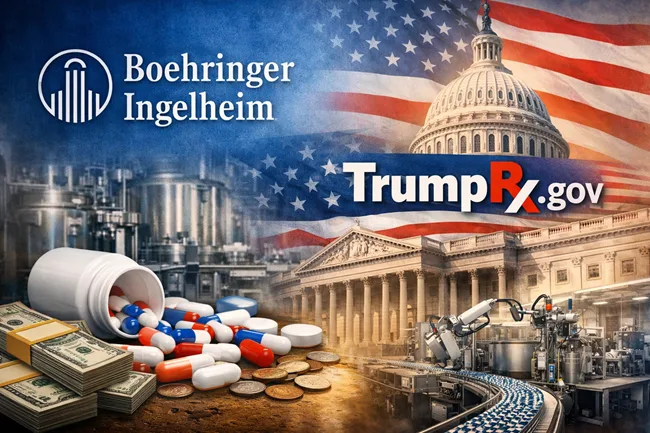
The company’s plan aligns with the U.S. government’s growing preference for domestically manufactured essential medicines. Boehringer Ingelheim’s 20-plus site footprint in the U.S. across R&D and manufacturing makes it a prime candidate for government support under supply chain resilience initiatives.
Analysts tracking infrastructure allocations within the pharmaceutical sector note that the real test will lie in Boehringer Ingelheim’s ability to scale production while maintaining margins, especially in therapeutic areas such as cardiovascular and renal disease, where generics and biosimilars are already creating downward pricing pressure.
Why this raises questions about competitive dynamics for firms not joining TrumpRx
The optics of this agreement may increase pressure on global competitors, especially those with limited U.S. manufacturing presence, to make similar commitments or risk tariff exposure. Companies such as Sanofi, Novo Nordisk, and AstraZeneca, which have historically relied on cross-border supply chains, may now face implicit regulatory and political incentives to reshuffle their asset base.
Some industry observers believe this deal could set a precedent for U.S. policymakers to apply similar pressure in areas like rare disease therapies, oncology, and vaccines. The risk here lies in how such deals may distort free-market pricing mechanisms and create tiers of compliance within the industry.
There is also ambiguity surrounding how PBMs and insurance providers will integrate with or compete against the TrumpRx platform, raising potential legal and antitrust questions. Companies participating in this platform could potentially gain faster market access or preferential reimbursement positioning, further complicating the pricing ecosystem.
What this changes for Boehringer’s therapeutic pipeline in the U.S. market
The company’s therapeutic focus on chronic, interconnected diseases—especially the cardio-renal-metabolic triad—positions it well to benefit from a more direct patient access model. With over 70 million Americans affected by cardiovascular and metabolic disorders, the ability to offer pricing relief while retaining innovative margins could unlock significant volume gains.
Boehringer Ingelheim’s immunology and rare disease pipeline could also benefit from the perception of domestic alignment. U.S. regulators have often accelerated review timelines or granted designations for companies that demonstrate public health alignment—particularly in categories that present systemic cost burdens, such as chronic kidney disease.
However, the success of this strategy will depend on Boehringer Ingelheim’s ability to maintain uninterrupted supply, navigate state-level reimbursement frameworks, and avoid reputational blowback from critics of the TrumpRx platform.
What risks remain around scalability, implementation, and political backlash
While the agreement offers tariff protection and market certainty, it also binds Boehringer Ingelheim to a highly politicized framework. Any shift in administration or legal challenge to TrumpRx.gov could destabilize the foundation on which this deal rests. Given the volatility of U.S. drug policy, the firm may need to invest in additional lobbying or contingency strategies to safeguard its position.
There are also open questions about the platform’s technology infrastructure, patient onboarding mechanics, and data privacy enforcement. Unlike traditional commercial or government distribution channels, TrumpRx lacks an established operational model, which could result in implementation delays or inconsistent fulfillment outcomes.
From a manufacturing perspective, Boehringer Ingelheim’s ability to scale U.S.-based production at speed without quality or compliance issues will be closely watched. Any failure in these areas could undermine both the cost-savings promise and the company’s broader reputation in the U.S. market.
What this reveals about long-term industry shifts in policy, pricing, and supply chain design
At a structural level, this agreement may mark the beginning of a broader realignment in how multinational pharmaceutical companies engage with evolving U.S. policy objectives. Historically, the industry has relied heavily on litigation, lobbying, and commercial trade groups to push back against cost-control measures proposed by Congress or federal agencies. However, Boehringer Ingelheim’s move reflects a potentially more pragmatic shift: securing market access and regulatory stability by aligning early with national industrial policy priorities, including job creation, reshoring, and direct-to-consumer affordability initiatives.
This signals a deeper repositioning away from the zero-sum stance of past drug pricing battles. Instead of defending globalized production footprints or complex rebate-driven pricing structures, companies may increasingly be rewarded for capital investment in domestic infrastructure and participation in government-mandated access programs. By negotiating tariff exemptions and preferred platform participation in exchange for long-term economic commitments, Boehringer Ingelheim is setting a precedent that combines regulatory compliance with industrial co-location—essentially treating supply chain localization as a bargaining chip in broader commercial strategy.
The implications extend beyond Boehringer. If other large-cap pharmaceutical players perceive similar deals as a viable workaround to future pricing pressures or trade risks, this could catalyze a wave of capital realignment, facility construction, and U.S.-based innovation clusters. Companies may begin to treat U.S. manufacturing not just as a supply chain necessity, but as a regulatory hedge and brand reputational tool. The risk, however, is that such deals could stratify the market, offering advantages only to firms large enough to absorb upfront investment burdens—potentially disadvantaging smaller biotech players or foreign generics manufacturers.
Whether this represents a one-off political accommodation or the emergence of a repeatable regulatory template remains to be seen. Much will depend on whether TrumpRx.gov proves technically and commercially viable, and if future administrations sustain or expand similar incentives. But for now, Boehringer Ingelheim’s deal illustrates a strategic pivot: that aligning with government goals, even through politically sensitive channels, may not only protect a company from future policy shocks—but also serve as a competitive differentiator in the world’s most complex and politically charged drug market.