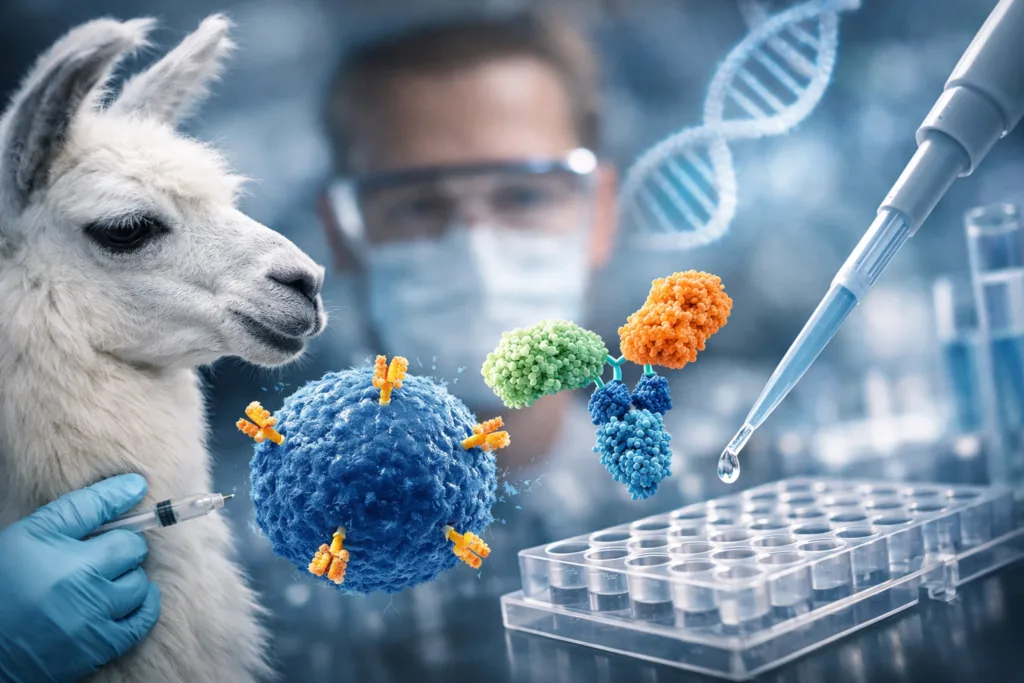
MindWalk Holdings Corp., a NASDAQ-listed bio-native AI company trading under the ticker HYFT, has announced B Cell Llama, a discovery platform designed to identify VHH nanobodies from immunised llamas for use as molecular building blocks in bispecific antibodies, multispecific therapeutics, and CAR-T cell therapies. The announcement is accompanied by a peer-reviewed study published in Biomacromolecules by the American Chemical Society, conducted in collaboration with Eindhoven University of Technology and Radboud University Medical Center, with MindWalk holding first rights to commercialise jointly developed intellectual property.
Why VHH nanobodies are becoming the preferred building block for bispecific drug design
The structural properties of VHH nanobodies have made them an increasingly attractive alternative to conventional antibody fragments in the engineering of bispecific and multispecific therapeutics. At roughly one-tenth the size of a full-length IgG, VHH domains offer superior tissue penetration, easier conjugation, and more predictable linker chemistry than traditional Fab or scFv formats. These properties matter disproportionately in bispecific design, where the act of physically linking two binding specificities in a single molecule introduces steric, stability, and manufacturability constraints that have stalled development programmes for years. The bispecific antibody market is widely projected to reach US$50 billion by 2030, with approved products including blinatumomab, faricimab, and amivantamab validating the class across oncology and ophthalmology, though the engineering challenge of producing them efficiently remains a genuine constraint on pipeline velocity.
VHH domains address the molecular engineering bottleneck by offering a naturally compact, stable scaffold that retains full binding function as a single domain. Because they originate from camelid heavy-chain antibodies, they lack the light-chain dependency that complicates bispecific assembly in conventional antibody platforms. This means two VHH domains targeting different antigens can be joined directly, with linker length and orientation as the primary tuning variables, rather than the complex chain pairing and mispairing problems that arise in bispecific IgG design. Industry observers note that this structural simplicity has driven increased interest in VHH-based building blocks from partnering programmes at large pharmaceutical companies, even though most approved bispecifics to date use non-VHH formats.
What the peer-reviewed ACS study adds and where its limitations still matter
The study published in Biomacromolecules provides three findings that MindWalk uses to anchor the platform launch. The first is a potency amplification result: nanobodies displayed in multivalent formats achieved sub-nanomolar binding, described as 10 to 25 times greater than the same nanobody in monovalent form. The second is a resistance-evasion finding: a trivalent VHH construct neutralised variants that escaped all monovalent VHH formats and outperformed two approved antibody therapies in the same assay. The third is a proposed immune-priming effect: VHH-nanoparticle complexes were preferentially internalised by immune cells associated with long-term memory, raising the possibility that certain VHH formats may prime adaptive immune responses beyond their immediate neutralising activity.
Taken individually, none of these findings is without precedent in the VHH literature, and their significance for B Cell Llama as a commercial platform depends heavily on context that the press release summary does not fully convey. The potency amplification result is consistent with well-documented avidity effects in multivalent antibody display and does not in itself differentiate VHH from conventional antibody fragments subjected to the same multimerisation. The resistance-evasion result is more notable because it demonstrates that rational reassembly of a single VHH building block can overcome escape from both monovalent VHH and approved antibody therapies simultaneously, which is a property with direct relevance to the design of next-generation SARS-CoV-2 or influenza therapeutics. The immune-priming observation is the most speculative and the most potentially significant: if it holds in in vivo models, it would represent a mechanism that is functionally distinct from neutralisation and could alter the risk-benefit calculus for prophylactic as well as therapeutic VHH applications. At this stage, however, the finding is described in vitro and is presented as a hypothesis rather than a validated mechanism.
The study’s methodology, conducted in a grant-funded academic collaboration, adds credibility to the data but also reflects the early-stage nature of the work. Academic collaboration studies of this type are typically exploratory and optimised for mechanistic insight rather than for translational readiness or regulatory clarity. The fact that the study was conducted in collaboration with two Dutch universities, rather than in a fully industry-controlled setting, is standard for this phase of platform development but worth noting when interpreting claims about commercial applicability.
Does the immune-priming finding represent a genuine therapeutic signal or an early-stage hypothesis?
The immune-priming finding, as described, centres on preferential internalisation of VHH-nanoparticle complexes by immune cell populations associated with long-term memory. This is a meaningful observation in the context of nanoparticle delivery research, where cell-type selectivity is an active area of investigation. However, the step from preferential internalisation to bona fide immune priming, defined as the generation of durable antigen-specific memory responses, requires in vivo validation that the current study does not provide.
Regulatory watchers suggest that any clinical programme built around an immune-priming mechanism would face a distinct and more demanding regulatory pathway than a straightforward neutralising antibody. The ability to demonstrate that a VHH format not only neutralises a pathogen but genuinely educates the adaptive immune system would require longitudinal in vivo studies, likely in non-human primates, and would need to meet established immunogenicity endpoints that go substantially beyond binding or neutralisation titres. That work does not yet appear to exist for B Cell Llama. The value of the finding at this stage is that it provides a scientific hypothesis worth investigating in preclinical models, not that it validates an immune-education claim for any current or near-term programme.
How B Cell Llama compares with synthetic libraries and transgenic platforms in the nanobody space
The broader VHH discovery landscape includes three main approaches: synthetic or semi-synthetic display libraries, genetically modified transgenic animals engineered to produce human-compatible VHH-like domains, and the natural immunisation of camelids followed by B cell isolation, which is the approach MindWalk is using with B Cell Llama. Each has a different profile of advantages and constraints. Synthetic libraries offer speed and the absence of animal handling requirements, but they are limited in the diversity and affinity maturation quality achievable through in vitro display. Transgenic platforms, which use genetically modified mice or llamas engineered to express humanised VHH scaffolds, offer improved translatability but are structurally constrained to the specific diversity accessible within the transgenic repertoire and typically require licensing arrangements that add cost and complexity.
Natural immunisation of llamas, followed by direct isolation of VHH-producing B cells, recovers antibodies that have undergone full in vivo affinity maturation against a defined immunogen. Industry observers note that this approach can produce candidates with binding and stability profiles that are difficult to replicate in vitro, particularly for conformationally complex or glycosylated targets. The primary disadvantages are time, which is tied to the immunisation and maturation schedule, and the additional layer of immunogenicity assessment required for VHH sequences of camelid origin when moving towards human clinical applications. MindWalk does not address the immunogenicity question in the announcement, which is a gap that clinical development partners would need to evaluate before advancing any candidate towards IND-enabling studies.
What the binding-versus-function gap means for AI-guided drug discovery workflows
One of the more analytically significant findings in the Biomacromolecules study is also the one that MindWalk uses to validate the role of its LensAI computational platform: the molecule with the strongest binding affinity in the study delivered zero functional activity. This is not a novel observation in antibody biology, the decoupling of binding affinity from functional potency is well documented across multiple target classes, but it is a finding with direct implications for how AI-guided discovery workflows are designed. Many high-throughput screening and computational ranking workflows use binding affinity, typically expressed as a dissociation constant, as the primary signal for candidate prioritisation. If the highest-affinity candidate is also functionally inert, an affinity-first ranking system will systematically advance the wrong molecules.
MindWalk positions LensAI as a platform designed to prioritise function directly rather than defaulting to binding metrics. This is a credible design objective, but the challenge of predicting functional activity from sequence and structure alone remains one of the harder open problems in computational drug discovery. Binding can be modelled with reasonable accuracy using structural and energetic methods; functional activity, which encompasses receptor signalling, conformational rearrangement, and in many cases cell-level or tissue-level effects, is considerably more difficult to predict in silico. The Biomacromolecules finding provides a concrete example of why the problem matters, but it does not validate that LensAI has solved it. The company’s disclosure note that some LensAI capabilities represent design intentions and have not all been fully integrated into current operational protocols, which is consistent with the early-stage positioning of the platform.
Which pipeline programs stand to benefit most from access to a native VHH repertoire
MindWalk’s disclosed pipeline includes dengue (covering all four serotypes, described as advancing to manufacturing), a universal influenza programme centred on a conserved cross-strain target, a GLP-1 and longevity programme described as a first-in-class dual-pathway regimen with IP protection initiated, and an ALK-1 programme spanning oncology and rare disease. Of these, dengue and influenza are the most directly served by VHH nanobody capabilities, given the well-established utility of broadly neutralising nanobodies against enveloped RNA viruses and the specific relevance of multispecific or multivalent VHH constructs for overcoming viral escape, which is precisely the resistance-evasion mechanism demonstrated in the published study.
The GLP-1 and longevity programme is less obviously suited to a VHH-first approach, since the primary clinical precedents in GLP-1 receptor agonism are peptide and small-molecule based, and the indication is not one where VHH’s tissue penetration or size advantages are most differentiating. The ALK-1 programme, which targets a receptor implicated in rare vascular conditions including hereditary haemorrhagic telangiectasia and in tumour angiogenesis, is a more natural fit for VHH given the existing clinical interest in ALK-1 inhibition and the theoretical benefits of small-format antibody fragments in vascular target access. How B Cell Llama will specifically accelerate any of these programmes beyond the platform announcement is not detailed in the current disclosure.
Regulatory and manufacturing questions that remain unresolved for nanobody-based multispecifics
Several regulatory and manufacturing questions relevant to VHH-based multispecific therapeutics remain unresolved regardless of platform approach, and B Cell Llama does not address them specifically. On the regulatory side, the primary question for nanobodies of camelid origin is immunogenicity: VHH sequences, while generally less immunogenic than rodent-derived antibody fragments, still carry camelid-specific residues that may need to be humanised before regulatory agencies accept them for chronic dosing indications. The degree of humanisation required, and the impact of humanisation on binding and stability, will need to be resolved on a candidate-by-candidate basis. The U.S. Food and Drug Administration and European Medicines Agency have approved one nanobody-derived therapeutic, caplacizumab, providing a regulatory precedent, but the field is still establishing norms for immunogenicity assessment in the context of multivalent and multispecific VHH constructs.
Manufacturing scalability for VHH-based biologics is generally considered more straightforward than for full-length bispecific IgGs, given the single-domain format and high bacterial or yeast expression yields. However, the assembly and quality control of multispecific VHH constructs, particularly those incorporating nanoparticle delivery vehicles, introduces complexity that is not trivially resolved at clinical or commercial scale. Industry observers note that the linker chemistry, aggregation profile, and particle size distribution of VHH-nanoparticle conjugates are properties that require careful process development and are not automatically transferred from discovery-scale preparation to GMP manufacturing. These are challenges that every platform in the space faces, and B Cell Llama’s ability to address them will depend on the specific construct architectures that emerge from partnering and internal development activities over the next two to three years.

MindWalk adds VHH capability as nanobodies gain ground in CAR-T and multispecific design added by Pallavi Madhiraju on
View all posts by Pallavi Madhiraju →