Medtronic plc announced on March 10, 2026 that it has entered into a definitive agreement to acquire Scientia Vascular, a Salt Lake City–based developer of neurovascular access technologies, for $550 million with additional milestone-based payments possible. The transaction aims to integrate Scientia Vascular’s guidewire and catheter technologies into Medtronic’s existing neurovascular portfolio, strengthening the medical device manufacturer’s capabilities across stroke and other complex neurovascular interventions.
Why control of neurovascular access technologies is becoming strategically critical in modern stroke intervention procedures
The strategic logic behind the deal reflects a broader shift in how major medical device companies are approaching neurovascular care. Over the past decade, innovation in stroke intervention has focused primarily on thrombectomy systems and embolization devices. However, clinicians performing these procedures have increasingly emphasized that the ability to reach the treatment site quickly and safely often determines whether a therapy succeeds. By acquiring Scientia Vascular, the Ireland-headquartered medical technology company is signaling that procedural access itself is becoming a competitive frontier in stroke treatment.

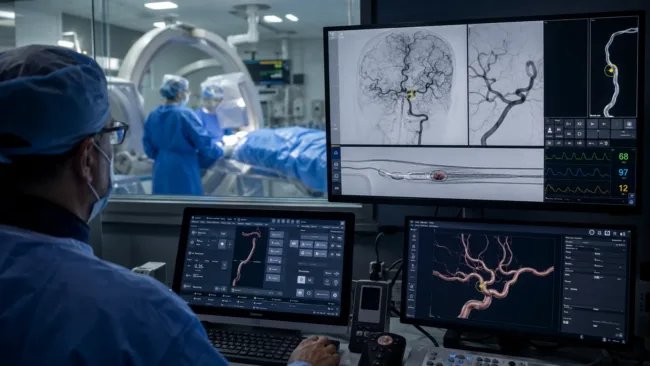
Neurovascular anatomy presents unique technical challenges that distinguish it from other vascular territories. Cerebral vessels are narrow, fragile, and often highly tortuous, meaning that navigating devices through them requires exceptional precision and flexibility. Physicians treating ischemic stroke, cerebral aneurysms, or arteriovenous malformations must first reach the target location before deploying therapeutic devices such as stent retrievers, aspiration catheters, or embolization coils. Any difficulty during this initial access phase can extend procedure time and increase clinical risk.
What Scientia Vascular’s guidewire and catheter technologies potentially change for navigation in complex cerebral anatomy
This dynamic has increasingly drawn attention to guidewires and microcatheters, components historically considered secondary to therapeutic devices but now recognized as essential enablers of procedural success. Industry observers note that improvements in navigability, torque control, and vessel tracking have the potential to influence procedure outcomes as much as the thrombectomy technology itself. The acquisition of Scientia Vascular therefore represents more than a simple portfolio expansion. It reflects an attempt to control a critical upstream step in the neurovascular treatment pathway.
Scientia Vascular has built its reputation around access technologies designed to navigate complex vascular anatomy more reliably. The Utah-based device developer’s guidewire and catheter platforms focus on improving trackability and reducing friction during navigation through tortuous vessels. For neurointerventionalists, these characteristics can translate into faster procedural setup and more predictable device placement, particularly in difficult stroke cases involving distal or anatomically challenging occlusions.
How integrating access platforms into Medtronic’s device ecosystem could reshape neurovascular procedural workflows
From a strategic perspective, integrating these technologies into Medtronic’s existing neurovascular device ecosystem could allow the multinational medical technology manufacturer to offer a more comprehensive procedural solution. Medtronic already markets a range of thrombectomy devices, embolization systems, and related neurovascular tools. Adding access technology that is specifically optimized for these procedures could enable the company to streamline the workflow from vascular entry to therapy deployment.
This type of vertical integration has become increasingly common across the medical device sector. Companies that control multiple stages of a procedure often gain advantages in physician preference, procurement decisions, and clinical training. Hospitals frequently prefer integrated device ecosystems that reduce compatibility issues and simplify inventory management. By owning both the access platform and the therapeutic devices used later in the procedure, a device manufacturer can position itself as a full procedural partner rather than simply a supplier of individual tools.
Why stroke treatment market expansion is pushing device manufacturers toward procedural efficiency innovations
The timing of the acquisition also reflects growing commercial momentum in the neurovascular market. Stroke remains one of the leading causes of death and disability globally, and advances in endovascular therapy have dramatically expanded the number of patients eligible for treatment. Mechanical thrombectomy in particular has become a standard of care for large vessel occlusion strokes, supported by strong clinical trial evidence demonstrating improved patient outcomes when blood flow is restored quickly.
However, as thrombectomy adoption has increased, clinicians have begun to identify procedural bottlenecks that can limit treatment speed. Access to the occlusion site is one such constraint. Even when advanced thrombectomy devices are available, navigating through the brain’s vascular network to reach the clot can consume valuable minutes. Because neurological damage progresses rapidly during ischemic stroke, reducing procedural time remains a critical objective for device innovation.
What clinicians and industry observers expect from next generation neurovascular navigation technologies
Clinicians tracking the field believe that access technology improvements could play an important role in addressing this challenge. Guidewires and microcatheters that navigate difficult anatomy more efficiently may reduce procedure duration and improve the likelihood of successful clot retrieval on the first attempt. These incremental improvements can translate into meaningful clinical benefits when applied across thousands of stroke interventions annually.
The acquisition also underscores the competitive dynamics among major neurovascular device manufacturers. Companies such as Stryker Corporation, Penumbra, Inc., and Johnson & Johnson’s medical device division have invested heavily in stroke intervention technologies. Many of these firms are expanding beyond thrombectomy devices into adjacent procedural components, including aspiration systems, catheters, and support devices.
How Medtronic’s Scientia Vascular acquisition reflects intensifying competition across the neurovascular device landscape
In this context, Medtronic’s purchase of Scientia Vascular can be interpreted as a defensive as well as offensive strategy. By strengthening its access technology capabilities, the company reduces the risk that competitors could differentiate themselves through superior navigation tools. At the same time, it creates opportunities to enhance performance across its existing device portfolio.
Regulatory considerations appear relatively straightforward for this type of transaction. Both companies operate within established regulatory pathways for neurovascular devices, which are typically cleared through mechanisms such as the U.S. Food and Drug Administration’s 510(k) process when they demonstrate substantial equivalence to existing technologies. Because the acquisition involves commercialized devices rather than investigational products, regulatory uncertainty around the transaction itself is likely limited.
What operational and adoption challenges could still emerge as Medtronic integrates Scientia Vascular’s technology platform
Nevertheless, integrating a smaller device innovator into a large multinational organization presents operational challenges. Scientia Vascular’s product development culture and engineering expertise will need to be preserved while aligning with Medtronic’s broader manufacturing and commercialization infrastructure. Industry observers often note that maintaining innovation momentum after an acquisition can be difficult if the acquired company’s design teams become absorbed into larger corporate structures.
Commercial execution will also be closely watched. While guidewires and catheters may appear less technologically complex than therapeutic devices, they are highly specialized tools whose adoption often depends on physician familiarity and training. Convincing neurointerventionalists to switch access platforms can require extensive clinical education and procedural demonstrations.
Manufacturing scalability represents another potential consideration. High-performance neurovascular access devices require precise materials engineering and quality control to ensure consistent navigational performance. As Medtronic integrates Scientia Vascular’s technologies into its portfolio, maintaining these manufacturing standards while expanding production capacity could become an important operational priority.
Why end-to-end procedural ecosystems may define the next competitive phase in neurovascular device innovation
For clinicians, the acquisition highlights the continuing evolution of stroke intervention technology. Early breakthroughs in mechanical thrombectomy dramatically improved patient outcomes by enabling rapid clot removal. The next phase of innovation may increasingly focus on procedural efficiency, device compatibility, and workflow integration.
Industry observers suggest that the companies best positioned to succeed in this environment will be those capable of delivering end-to-end procedural solutions. Rather than competing solely on individual devices, manufacturers are building integrated platforms that encompass access, therapy delivery, and procedural support technologies. This shift reflects the complex nature of neurovascular interventions, where multiple tools must function seamlessly together.
Ultimately, the acquisition of Scientia Vascular suggests that Medtronic sees access technology not as a peripheral component but as a strategic foundation for future neurovascular innovation. By strengthening its ability to navigate the brain’s intricate vascular network, the medical device manufacturer aims to position itself more firmly within the rapidly expanding stroke treatment landscape.
For regulators, clinicians, and industry competitors, the key question will be whether this integration delivers measurable improvements in procedural efficiency and patient outcomes. If access technologies prove capable of shortening procedure times and simplifying navigation in difficult cases, the strategic importance of this segment could grow significantly across the neurovascular device market.
The coming years will therefore reveal whether Medtronic’s move represents a tactical portfolio expansion or a deeper shift toward controlling the entire neurovascular treatment pathway from initial access to final therapy delivery.