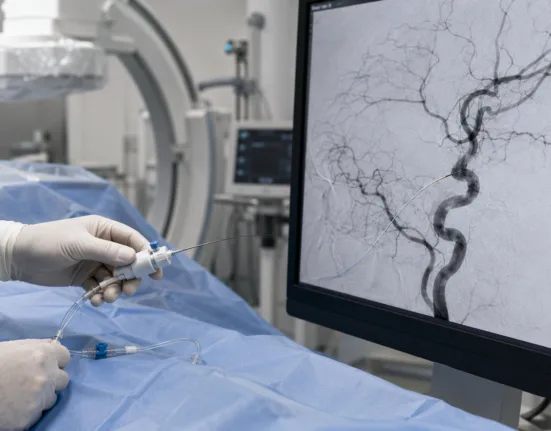
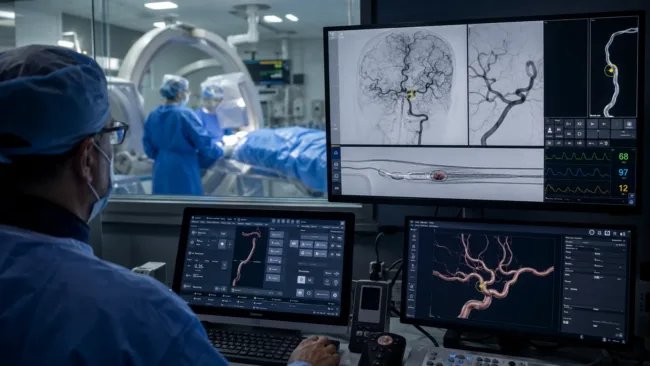
Rapid Medical has reported 90-day outcomes from the DISTALS randomized clinical trial showing that TIGERTRIEVER 13 safely restored blood flow and produced encouraging recovery signals in patients with distal and medium vessel occlusion stroke. The data, presented at the 11th European Stroke Organisation Conference in Maastricht, strengthen the medical device manufacturer’s case for pursuing United States Food and Drug Administration clearance in a stroke segment where treatment options have historically been narrower than in large vessel occlusion care.
Why Rapid Medical’s DISTALS trial may matter for the future of distal stroke thrombectomy
The significance of the DISTALS trial is not simply that TIGERTRIEVER 13 improved reperfusion metrics. The more important industry signal is that Rapid Medical is trying to establish a dedicated evidence base for mechanical thrombectomy in distal and medium vessel occlusion stroke rather than extending assumptions from large vessel stroke intervention into smaller and more fragile anatomy.
That distinction matters because distal and medium vessel occlusions occupy an awkward clinical middle ground. These strokes can be disabling, yet their vessels are smaller, more tortuous and more vulnerable to procedural injury than the proximal arteries historically targeted by thrombectomy systems. Clinicians have therefore faced a difficult trade-off. Medical management may leave patients with persistent neurological deficits, while intervention with devices not purpose-built for distal anatomy may raise safety concerns.

TIGERTRIEVER 13 is positioned around that gap. Its value proposition rests on controlled vessel engagement, visibility and the ability to adapt to vessel anatomy during the procedure. If the device can show that reperfusion can be achieved without materially increasing symptomatic intracranial bleeding, Rapid Medical may have a stronger argument that distal stroke intervention should be evaluated as its own therapeutic category rather than as a marginal extension of existing thrombectomy practice.
The unresolved issue is whether the clinical outcome signal is strong enough to drive a broad shift in practice. The reported 90-day outcomes showed higher rates of little or no disability compared with medical therapy alone, but the absolute difference in modified Rankin Scale 0 to 1 outcomes was modest at 41.2 percent versus 38.2 percent. That does not negate the clinical relevance of the trial, but it makes patient selection, endpoint interpretation and subgroup performance central to how regulators and clinicians read the data.
How the 90-day TIGERTRIEVER 13 data changes the clinical conversation around recovery
The stronger signal in the DISTALS readout appears to come from the recovery pattern among patients with moderate to severe baseline disability. In that group, 69 percent of patients treated with TIGERTRIEVER 13 improved by at least one level of disability compared with 56 percent in the control arm. For stroke specialists, that type of functional shift can matter because recovery is not always captured fully by a binary success measure such as full independence versus residual disability.
This is where the trial may carry more practical relevance than the headline mRS 0 to 1 comparison alone. Distal and medium vessel occlusion stroke patients are not a uniform population. Some may have relatively mild deficits, while others may have symptoms that significantly affect speech, vision, cognition, movement or daily function. A device that improves the probability of moving patients from more severe impairment toward a better functional category could still be clinically meaningful, even if the cleanest disability endpoint shows only a narrow separation.
The quality-of-life signal also deserves attention. Rapid Medical reported that more than twice as many TIGERTRIEVER 13-treated patients returned to normal quality of life. In stroke care, this type of outcome can carry weight because physician-assessed disability scores may not fully reflect how patients experience recovery. A patient who moves from dependence to partial independence, or from persistent limitation to normal perceived quality of life, may represent a meaningful clinical gain even where conventional endpoint margins remain numerically tight.
However, quality-of-life and functional recovery outcomes will need careful scrutiny when regulators and clinicians assess the full dataset. The key questions are whether these benefits are consistent across imaging profiles, baseline severity, clot location, operator experience and anesthesia strategy. If the strongest findings are concentrated in specific subgroups, TIGERTRIEVER 13 may still have a viable regulatory and commercial path, but adoption could begin in narrower patient populations rather than across all distal occlusion cases.
Why safety may be the decisive factor for small-vessel stroke intervention
Safety is the most important strategic layer in the TIGERTRIEVER 13 story because distal vessel thrombectomy is not just a question of whether a clot can be removed. It is a question of whether restoring blood flow can be done without turning a smaller-vessel stroke into a procedural complication.
Rapid Medical reported no symptomatic brain bleeding in the TIGERTRIEVER 13 treatment group and similar 90-day survival rates between the treatment and control groups. That safety profile is central to the company’s case because distal and medium vessels are anatomically less forgiving than large vessel targets. In this setting, even a technically successful procedure can face skepticism if it is associated with vessel injury, perforation, hemorrhage or worsening neurological status.
The DISTALS findings therefore support a more nuanced clinical argument. The trial does not merely suggest that mechanical intervention is feasible in smaller vessels. It suggests that device design and procedural technique may allow some patients to receive active intervention without the safety penalties that have historically limited enthusiasm for distal thrombectomy.
Still, the safety discussion cannot end with a single trial readout. Interventional stroke outcomes are influenced by operator training, imaging selection, time to treatment, anesthesia protocols, hospital workflow and device familiarity. A controlled trial setting may not perfectly mirror real-world community stroke networks, especially if adoption expands beyond high-volume neurointerventional centers. For Rapid Medical, the next challenge is likely to be proving that safety is not just reproducible in expert hands, but scalable across the types of hospitals that may ultimately treat distal and medium vessel occlusion stroke.
What the DISTALS trial reveals about device-specific evidence in neurovascular medicine
One of the more important industry implications is that neurovascular device makers may no longer be able to rely solely on large-vessel thrombectomy logic when pursuing smaller-vessel indications. DISTALS appears designed to create a more direct evidence bridge between device engineering, vessel anatomy and patient outcomes.
That is relevant because distal stroke intervention is not a simple matter of shrinking existing thrombectomy devices. Smaller vessels introduce different mechanical constraints, different procedural risks and different outcome expectations. A device intended for distal occlusion must balance clot engagement with vessel preservation. It must also give the operator enough procedural control to avoid excessive traction or trauma.
TIGERTRIEVER 13’s adjustable design is commercially relevant in this context because it gives Rapid Medical a differentiated device story. The medical device manufacturer can argue that the system is not merely a smaller tool, but a platform designed around the anatomy and procedural demands of distal and medium vessel occlusions. That positioning may matter in physician education, trial interpretation and eventual sales strategy if clearance is secured.
The limitation is that device differentiation only creates durable market advantage if clinical workflows change around it. Stroke teams must be convinced that distal occlusion intervention is worth mobilizing resources, that imaging can reliably identify suitable patients, and that the procedural risk-benefit balance holds in everyday practice. Without that broader workflow adoption, TIGERTRIEVER 13 may remain a specialist tool rather than a category-expanding platform.
Why anesthesia findings may become an important adoption question for clinicians
The reported finding that outcomes were stronger among patients treated under general anesthesia adds a practical and potentially controversial layer to the DISTALS data. In stroke intervention, anesthesia strategy is not a minor operational detail. It can influence procedural stability, treatment speed, blood pressure control and neurological assessment.
Industry observers tracking neurointervention may view this as a reminder that the device alone does not determine outcomes in distal stroke thrombectomy. Technique, imaging selection, anesthesia management and operator judgment all interact with device performance. If general anesthesia appears to support better outcomes in certain distal occlusion procedures, hospitals may need to reassess protocols rather than simply add a new device to the shelf.
That could strengthen the clinical relevance of the DISTALS findings by pointing toward an optimized procedural model. It may also complicate adoption. General anesthesia requires coordination, resources and confidence that procedural benefits outweigh any delay or physiological risk. Stroke centers vary widely in their anesthesia availability and workflow speed, especially outside major academic and comprehensive stroke centers.
For Rapid Medical, this creates both opportunity and complexity. The medical device manufacturer can support clinicians with a more refined treatment approach, but broader commercialization may require training programs, real-world registries and center-level workflow guidance. The device may be ready for the anatomy, but the market must also be ready for the procedural discipline that the data appear to reward.
How FDA clearance could shape Rapid Medical’s commercial path in stroke devices
Rapid Medical’s plan to pursue FDA clearance based on DISTALS is the next major strategic inflection point. A positive regulatory pathway would potentially give TIGERTRIEVER 13 stronger positioning in the United States neurovascular market, where stroke device adoption is closely tied to evidence quality, reimbursement logic and institutional protocol development.
Regulatory watchers are likely to focus on whether the totality of the evidence supports a favorable benefit-risk profile in distal and medium vessel occlusion stroke. The trial has a meaningful strength in being randomized, which is particularly important in a field where procedural enthusiasm can sometimes move faster than definitive outcome evidence. The reperfusion improvement and safety findings create a strong foundation, while the 90-day functional outcomes provide a more layered picture that regulators will need to interpret carefully.
Commercially, clearance would not automatically guarantee rapid adoption. Stroke intervention markets are evidence-sensitive, but they are also workflow-sensitive. Hospitals must decide whether they can identify eligible patients quickly, mobilize neurointerventional teams efficiently and justify procedural intervention in a population that can present with variable symptom severity.
Reimbursement will also matter. If distal thrombectomy is treated as a narrower procedural extension rather than a clearly defined care pathway, adoption may be slower. If the clinical community and payers begin to view distal and medium vessel occlusions as a distinct interventional opportunity, Rapid Medical could benefit from being early with purpose-built data. The tension is clear: regulatory clearance may open the door, but workflow economics will decide how wide that door becomes.
What clinicians and industry observers will watch after the DISTALS readout
The next phase of scrutiny will likely focus on granularity. Clinicians will want to understand which patients benefited most, how outcomes varied by occlusion location, how quickly treatment was delivered, what imaging criteria were used, and whether the safety findings remained consistent across operators and centers.
This matters because distal stroke is not one market. It is a collection of anatomies, severities and treatment windows. A patient with a disabling distal occlusion and salvageable brain tissue may represent a very different intervention case from a patient with mild symptoms or uncertain tissue-at-risk. TIGERTRIEVER 13’s clinical future may therefore depend less on whether it works in the abstract and more on whether Rapid Medical and investigators can define where it works best.
Industry observers will also watch whether competing neurovascular device makers respond with dedicated distal occlusion strategies. If DISTALS helps validate the category, it could encourage broader investment in small-vessel thrombectomy systems, distal-access tools, imaging selection software and procedural training models. That would be a competitive win for the field, but it would also increase pressure on Rapid Medical to convert early clinical momentum into durable physician trust.
The most realistic interpretation is that TIGERTRIEVER 13 has strengthened the case for distal and medium vessel occlusion thrombectomy, but it has not removed all uncertainty. The device has shown encouraging safety and recovery signals in a difficult treatment segment. The next test is whether regulators, clinicians, hospitals and payers see enough consistency, reproducibility and practical value to move small-vessel stroke intervention from selected specialist use toward a more defined treatment pathway.