C2N Diagnostics, a United States–based specialty diagnostics company, has partnered with BeauBrain Healthcare to introduce its PrecivityAD2 blood test in South Korea, expanding access to blood-based diagnostics designed to detect amyloid pathology associated with Alzheimer’s disease. The test is intended for patients aged 50 and older who show symptoms of mild cognitive impairment or dementia and aims to support earlier and more accessible clinical diagnosis.
Beyond the announcement itself, the partnership reflects a broader structural shift underway in Alzheimer’s disease diagnostics. The field is increasingly moving away from expensive imaging modalities toward scalable blood biomarker platforms that can support earlier detection, broader screening, and more efficient clinical decision-making. For health systems facing rising dementia prevalence and limited imaging capacity, this transition may prove pivotal.
Why expanding blood-based Alzheimer’s diagnostics into Asia highlights the global shift toward scalable early detection tools
Alzheimer’s disease has historically been difficult to diagnose with certainty during its early stages. For decades, physicians relied primarily on clinical assessment and cognitive testing, which often detect the disease only after substantial neurodegeneration has already occurred. More definitive diagnostic confirmation typically required amyloid positron emission tomography imaging or cerebrospinal fluid testing, both of which present accessibility challenges.
Amyloid PET imaging remains expensive and geographically concentrated in specialized centers. It also exposes patients to radiation and is rarely available in primary care settings. These limitations have created a long-standing gap between the number of patients experiencing cognitive symptoms and the number receiving definitive biomarker confirmation.
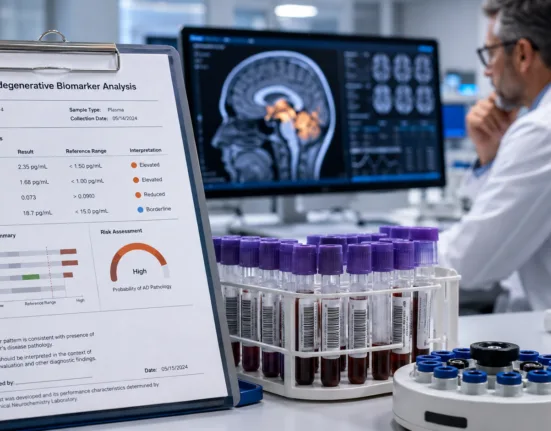
Blood-based diagnostics such as the PrecivityAD2 test are designed to address that gap by offering a less invasive and potentially more scalable alternative. The test evaluates biomarkers linked to amyloid plaque formation in the brain, enabling physicians to estimate the probability that Alzheimer’s pathology is present.

Industry observers note that the ability to detect amyloid pathology using a simple blood draw could dramatically expand access to biomarker testing, particularly in regions where advanced imaging infrastructure remains limited.
What PrecivityAD2’s biomarker design reveals about the scientific direction of Alzheimer’s diagnostics
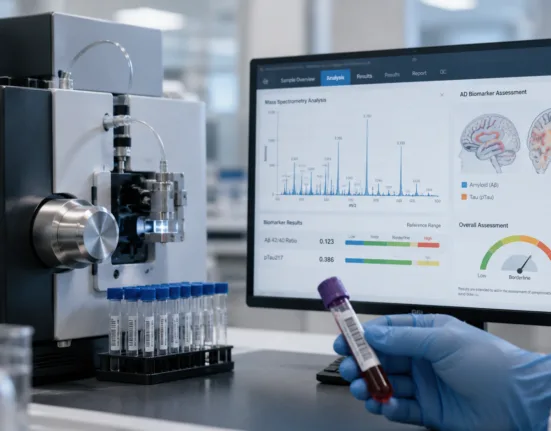
A key feature of the PrecivityAD2 test is its reliance on quantitative biomarker analysis, including the %p-tau217 biomarker associated with Alzheimer’s pathology. The biomarker is measured using high-resolution mass spectrometry techniques that aim to provide a reproducible indicator of amyloid plaque presence.
Research referenced in connection with the test indicates that the biomarker may be less influenced by certain biological confounding factors such as renal function, body weight, and anemia compared with some immunoassay-based approaches.
If validated across diverse clinical populations, this relative stability could become an important advantage for blood-based diagnostics. Biomarkers used in real-world clinical environments must perform reliably in patients with multiple comorbidities, which is common in older populations.
Clinicians tracking the field note that many early biomarker candidates showed promise in controlled research settings but struggled with reproducibility when applied broadly. As a result, diagnostic developers are placing increasing emphasis on assays that maintain accuracy across heterogeneous patient populations.
Why diagnostic accuracy claims remain under close scrutiny across Alzheimer’s biomarker platforms
Published research cited in connection with the PrecivityAD2 test reported diagnostic performance metrics including approximately 91 percent overall accuracy, with sensitivity around 90 percent and specificity around 92 percent when compared with amyloid PET imaging.
While these figures are competitive with other emerging blood biomarker assays, experts caution that performance metrics must be interpreted carefully. Diagnostic accuracy in Alzheimer’s testing often varies depending on patient population, disease stage, and clinical setting.
Primary care environments present a particularly complex challenge because patients often arrive with heterogeneous cognitive symptoms and overlapping neurological conditions. Tests validated in specialty memory clinics may show different performance characteristics when applied to broader populations.
Regulatory watchers also point out that blood biomarker tests must demonstrate consistent performance across multiple independent studies before becoming standard clinical tools. Longitudinal evidence showing how test results influence treatment decisions will likely play a major role in determining long-term adoption.
What the South Korean launch reveals about the growing importance of early Alzheimer’s detection infrastructure
South Korea represents an important test market for emerging Alzheimer’s diagnostics because of its rapidly aging population and strong healthcare infrastructure. The country has already begun expanding national dementia programs aimed at earlier detection and care coordination.
Survey data referenced in the partnership announcement suggests that a significant proportion of South Korean physicians would be willing to adopt blood-based Alzheimer’s diagnostics once available, including neurologists, psychiatrists, and primary care physicians.
That level of interest reflects a growing recognition among clinicians that earlier detection may soon play a larger role in dementia care. As disease-modifying therapies targeting amyloid pathology continue to enter clinical practice, physicians may require reliable biomarker confirmation before initiating treatment.
Regulators in both the United States and South Korea have approved therapies aimed at addressing the biological mechanisms underlying Alzheimer’s disease. These approvals have created a new clinical incentive for earlier and more precise diagnosis because treatment eligibility often depends on confirmation of amyloid pathology.
How the commercialization pathway for blood-based Alzheimer’s diagnostics may reshape clinical workflows
The emergence of blood biomarker testing has the potential to alter how patients move through the Alzheimer’s diagnostic pathway. Rather than referring every patient with cognitive symptoms directly for imaging, physicians could first use blood tests as a screening tool.
In this model, only patients with positive or ambiguous blood biomarker results would proceed to more expensive imaging confirmation. Such triage strategies could significantly reduce healthcare costs while increasing diagnostic coverage.
However, implementation challenges remain. Clinicians will need clear guidelines on how to interpret biomarker results, particularly when probabilities fall into intermediate ranges. Diagnostic developers may also need to demonstrate that test results lead to meaningful improvements in clinical outcomes.
Industry observers also note that laboratory capacity and standardization will be critical. High-volume blood biomarker testing requires reliable assay reproducibility across multiple laboratories, which historically has been a challenge for complex protein measurements.
What industry observers are watching next as blood-based Alzheimer’s testing expands globally
The expansion of the PrecivityAD2 test into South Korea is likely to be viewed as part of a broader global competition among diagnostic developers to establish leadership in Alzheimer’s biomarker testing.
Several biotechnology firms and diagnostic companies are pursuing similar blood-based assays targeting phosphorylated tau proteins and other neurodegeneration markers. Competition in this area is expected to intensify as clinical evidence accumulates and regulators begin defining formal diagnostic standards.
Clinicians tracking the field are particularly focused on whether blood biomarker tests can consistently predict amyloid pathology across different ethnic populations and healthcare systems. Validation in diverse international cohorts will likely play an important role in determining which platforms achieve global adoption.
Another key question involves integration with emerging digital and imaging diagnostics. BeauBrain Healthcare has positioned its platform around combining blood biomarkers with cognitive testing, imaging analysis, and digital assessment tools.
If such integrated diagnostic ecosystems prove effective, Alzheimer’s detection may evolve into a multi-modal process that combines biomarker testing with artificial intelligence–assisted imaging and digital cognitive monitoring.
Why the long-term impact of blood-based Alzheimer’s diagnostics will depend on clinical and regulatory alignment
Ultimately, the success of blood biomarker diagnostics will depend on how regulators, clinicians, and healthcare systems incorporate them into formal diagnostic frameworks. Tests that show strong research performance must still demonstrate clinical utility in real-world care settings.
Regulatory clarity will also influence adoption. Diagnostic developers are likely to pursue expanded regulatory designations and approvals that support broader clinical use beyond research or specialized memory clinics.
At the same time, reimbursement policies will determine whether physicians can integrate these tools into routine practice. Even highly accurate diagnostic tests can face adoption barriers if healthcare systems do not establish clear payment pathways.
For now, the entry of C2N Diagnostics into the South Korean market underscores the accelerating global push toward earlier Alzheimer’s detection. As disease-modifying therapies advance and dementia prevalence continues to rise, scalable diagnostics capable of identifying pathology before severe cognitive decline may become one of the most important tools in the neurological care landscape.