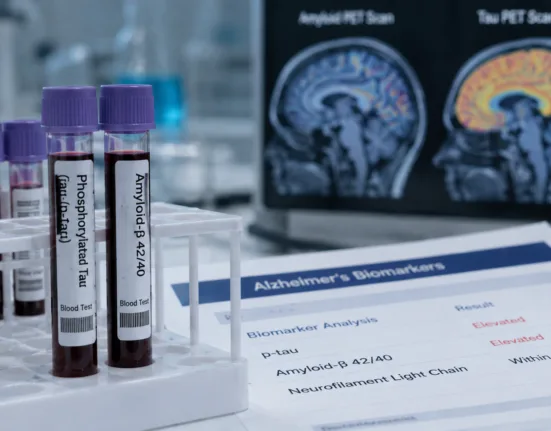
Spear Bio, a Massachusetts-based biotechnology company focused on ultrasensitive protein biomarker detection, unveiled three new SPEAR UltraDetect immunoassays at the International Conference on Alzheimer’s and Parkinson’s Diseases (AD/PD 2026) in Copenhagen: a brain-derived phosphorylated tau 217 assay (BD-pTau 217), along with two new synuclein tests targeting alpha-synuclein (a-syn) and phospho-Ser129-alpha-synuclein (pS129-a-syn). The launches coincide with the company’s shift to direct-to-customer distribution in North America and Europe, a structural move that removes distributors from the sales chain for research laboratories investigating neurodegenerative proteinopathies.
What the brain-derived pTau 217 distinction reveals about where the assay field is heading
The framing of the BD-pTau 217 assay around brain-derived signal is analytically significant and deserves careful examination. Most plasma pTau 217 assays on the market measure total circulating phosphorylated tau, which includes tau originating from peripheral tissues rather than the brain. The claim that SPEAR UltraDetect BD-pTau 217 is the only assay to achieve 100% quantifiability in both healthy and diseased plasma samples at a functional lower limit of quantification of 25 femtograms per millilitre points to a precision advantage that would be particularly consequential in preclinical cohorts, where tau concentrations in cognitively unimpaired individuals are vanishingly low.
The broader competitive context matters here. The blood-based Alzheimer’s biomarker field reached a regulatory milestone in May 2025 when the FDA cleared Fujirebio’s Lumipulse G pTau217/beta-Amyloid 1-42 Plasma Ratio as the first in vitro diagnostic device for amyloid detection in symptomatic adults. That clearance was built on Simoa and Lumipulse platforms that have accumulated large, peer-reviewed validation datasets across thousands of clinical samples. Spear Bio’s platform is entering a space that is already occupied by well-characterised, clinically validated technology. The Lumipulse assay reported concordance rates of 91.7% positive and 97.3% negative against amyloid PET and CSF biomarker reference standards in the FDA validation study. Published head-to-head comparisons of Lumipulse and the ALZpath Simoa assay have shown broadly comparable performance across European memory clinic cohorts, suggesting diminishing returns from marginal analytical sensitivity improvements in symptomatic populations.
Where Spear Bio’s sensitivity argument carries more weight is in preclinical research and longitudinal study design. The Alzheimer’s Association’s first clinical practice guideline, released in 2024, set sensitivity and specificity thresholds of at least 90% and 75% for triage use of blood-based biomarker tests. Meeting those thresholds in symptomatic populations is achievable with existing platforms; meeting them reliably in cognitively normal individuals at risk is substantially harder. A functional lower limit of quantification that maintains precision in healthy plasma represents a genuine analytical advantage for researchers running long-term cohort studies or screening preclinical trial populations, where detecting tau signal before symptom onset is precisely the scientific challenge.
Why homogeneous wash-free format on qPCR instruments changes the laboratory access equation
The SPEAR platform’s reliance on standard quantitative PCR instruments rather than proprietary analysers is a distribution advantage that should not be dismissed as a secondary feature. Simoa, while analytically excellent, requires access to the HD-X or SP-X platforms manufactured by Quanterix, instruments that cost several hundred thousand dollars and are concentrated in well-resourced academic and commercial research centres. Lumipulse uses Fujirebio’s G600II automated platform. Both represent capital expenditures that restrict access to laboratories with dedicated infrastructure budgets. A wash-free assay that runs on qPCR hardware already present in most molecular biology laboratories fundamentally broadens the potential user base, particularly in clinical pharmacology, contract research, and smaller academic institutions.
The 1 microlitre sample volume requirement compounds this advantage in a specific and commercially important way. Biobanked longitudinal samples collected years or decades ago often exist in limited quantities, and researchers running multi-analyte panels face genuine constraints on how much plasma they can allocate to each assay. A test that consumes 1 microlitre of diluted sample rather than 50 to 100 microlitres allows investigators to run Spear Bio assays alongside existing platform measurements in the same sample set, enabling direct comparison studies without sacrificing sample integrity. This is not merely a convenience feature; it is a genuine enabler for retrospective cohort research and for biomarker co-development studies attached to therapeutic trials.
What the alpha-synuclein assay introduction means for Parkinson’s disease biomarker research
The addition of a-syn and pS129-a-syn assays to the SPEAR portfolio represents an entry into arguably a more contested and scientifically challenging space than Alzheimer’s diagnostics. While plasma pTau 217 has a well-defined clinical validation pathway and an FDA-cleared comparator, synuclein biomarkers for Parkinson’s disease and related synucleinopathies remain in a substantially earlier stage of clinical maturation. The field is currently debating which synuclein species carry the most diagnostic and prognostic signal: total a-syn, oligomeric forms, or specific post-translational modifications such as phosphorylation at serine 129. Spear Bio’s assays claim the ability to quantify monomeric, oligomeric, and post-translationally modified synuclein species simultaneously at low-femtogram concentrations, which would be analytically unusual if validated at scale.
The lack of a regulatory-cleared comparator in the plasma synuclein space means that Spear Bio faces both a market opportunity and a validation burden. There is no Lumipulse equivalent for alpha-synuclein against which clinical performance can be directly benchmarked in peer-reviewed literature. Researchers adopting these assays early will be working in a less standardised environment, and the company’s poster data from AD/PD 2026 will need to be scrutinised closely for cohort size, sample type, confirmation methodology, and pre-analytical variables. Cerebrospinal fluid alpha-synuclein measurement has well-known challenges related to sample handling sensitivity; whether plasma synuclein measurement by immunoassay avoids those pitfalls or inherits them in modified form is a question that independent validation studies will need to answer.
How direct distribution changes Spear Bio’s commercial risk profile and laboratory reach
The shift to direct-to-customer operations in North America and Europe is a meaningful commercial pivot for a company that was founded in 2021 and closed a $45 million Series A round in 2024 with Bio-Techne Corporation as a participant. Spear Bio announced a distribution partnership with Bio-Techne in July 2025, positioning it as the route-to-market for the initial SPEAR assay portfolio. The establishment of direct customer access alongside that arrangement raises questions about channel strategy: whether the direct operations are intended to supplement, complement, or eventually displace the Bio-Techne distribution relationship in key markets is not clarified in the company’s announcement. Industry observers will watch whether the dual-channel approach creates pricing alignment challenges or customer confusion between the two procurement routes.
Direct customer engagement for a research-use-only assay platform carries a different commercial logic than clinical diagnostics distribution. Research laboratories evaluate reagents through peer-reviewed performance data, technical application support, and ease of integration with existing workflows. Spear Bio’s investment in AD/PD 2026 as a platform sponsor, with multiple poster presentations and a dedicated product theatre, signals an intent to build credibility within the neuroscience research community through scientific rather than purely commercial means. That approach is appropriate for the stage the company is at, but it also means that the next twelve months of published validation data will be as commercially consequential as any distribution arrangement.
Regulatory pathway and clinical adoption risks that remain unresolved for SPEAR assays
All SPEAR UltraDetect assays are currently classified as research use only, which means they cannot be used for clinical diagnosis and are not reimbursed through standard payer pathways. The company received FDA Breakthrough Device Designation for its pTau 217 blood test in January 2025, a designation that accelerates review timelines and provides access to early FDA interaction but does not constitute clearance or approval. The distance between breakthrough designation and cleared clinical use is substantial, as the Lumipulse pathway illustrates: Fujirebio’s test carried breakthrough designation before proceeding through a 510(k) premarket notification process underpinned by a multicentre clinical study of 499 samples. Spear Bio has not publicly disclosed a timeline for seeking regulatory clearance or the specific clinical validation studies that would support a 510(k) or de novo submission.
For the Alzheimer’s Association guideline thresholds to apply to a Spear Bio assay, the platform would need independent validation data showing sensitivity and specificity performance in clinically characterised cohorts using CSF or amyloid PET as the reference standard. The existing SPEAR data showing area under the curve values of 0.984 to 0.989 for distinguishing AD from non-AD plasma samples is methodologically promising, but those figures reflect relatively small combined cohorts and have not yet been replicated in the large, multicentre real-world studies that regulatory reviewers and clinical guideline bodies require. The indeterminate rate, which affects clinical utility in practice, has not been extensively reported for the SPEAR platform in publicly available literature. For clinical adoption at scale to occur, all of these gaps will need to be systematically addressed.
What clinicians and trial sponsors should watch as the SPEAR assay evidence base develops
For clinical trial sponsors considering SPEAR assays as screening or stratification tools, the key near-term question is whether the platform’s sensitivity advantage in preclinical populations translates into measurable improvements in trial enrichment efficiency. Anti-amyloid therapies such as lecanemab have established that selecting participants with confirmed amyloid pathology using biomarker pre-screening improves treatment response rates. A plasma assay that more precisely identifies preclinical amyloid burden could in principle reduce the proportion of participants who screen positive by plasma but test negative by PET, reducing screen failure rates and study costs. Whether the SPEAR BD-pTau 217 assay’s 25 fg/mL detection floor delivers this enrichment benefit over the current Lumipulse and Simoa benchmarks is a hypothesis that will require prospective trial data to test, not retrospective cohort analysis.
Memory clinic physicians and neurologists operating in settings where FDA-cleared blood-based testing is now available will not adopt SPEAR assays for patient care until regulatory clearance is obtained. The research use only classification is not a temporary formality; it reflects a fundamentally different evidentiary standard and liability framework. The more immediate near-term audience is the research community: biobanking studies, natural history cohorts, drug development programmes, and biomarker standardisation initiatives. In that context, Spear Bio’s combination of high analytical sensitivity, minimal sample volume, and instrument accessibility positions the SPEAR platform as a credible entrant, provided that the validation data presented at AD/PD 2026 holds up under peer review and independent replication. The next inflection point will be when the poster datasets clear journal review and enter the published literature, where the scientific community can assess them on standardised terms.