Alpha Cognition Inc. has received U.S. Patent No. 12,589,099 covering the use of ALPHA-1062 for treating traumatic brain injury, extending patent protection around this program into the next decade while broadening the company’s post-Alzheimer’s narrative beyond its already approved drug ZUNVEYL. The announcement matters because Alpha Cognition is trying to convert a commercial-stage Alzheimer’s platform into a wider neurodegenerative and neuro-injury franchise, even though the traumatic brain injury program remains far earlier than its marketed asset and still faces major clinical and regulatory uncertainty.
Why this patent matters more for strategic positioning than for near-term clinical de-risking
For Alpha Cognition, the patent is not merely an intellectual property housekeeping event. It is a signal that the U.S.-based neurodegenerative disease specialist wants investors and industry observers to view ALPHA-1062 as a platform molecule rather than a single-indication asset. That distinction matters because ZUNVEYL, approved by the U.S. Food and Drug Administration in 2024 for mild to moderate dementia of the Alzheimer’s type in adults, gives the group a commercial foothold, but not yet the breadth that larger CNS players typically need to command sustained strategic attention. A TBI patent helps create that breadth on paper, even if the science is still at a translational stage.
What is genuinely new here is not proof that ALPHA-1062 works in traumatic brain injury. It is the formal conversion of a development concept into a stronger protected claim set. Alpha Cognition had already disclosed work around intranasal ALPHA-1062 for mild traumatic brain injury and concussion-related cognitive impairment, and prior company materials showed TBI-related patent filings and preclinical activity. The newly issued patent therefore adds legal defensibility and potentially improves partnering optics, but it does not resolve the larger question that matters to clinicians and regulators: whether this cholinergic mechanism can translate into meaningful, reproducible functional benefit in a notoriously heterogeneous brain injury population.
Why traumatic brain injury remains one of the hardest CNS markets to convert from theory into approved therapy
The company is right to frame traumatic brain injury as a major unmet need. That part is easy. The harder part is everything that comes after. TBI has defeated many development programs because it is less a single disease than a clinical umbrella spanning concussion, repetitive blast injury, moderate trauma, severe trauma, variable timing of intervention, and widely different neurological outcomes. In that setting, a patent can protect an idea, but it cannot simplify the biological messiness that has repeatedly undermined drug development in the field.
That is why this announcement should be read as strategically useful but clinically preliminary. A large addressable market and lack of approved therapies can sound compelling in corporate messaging, yet experienced CNS drug developers know that “no approved therapies” can reflect not just unmet need, but also a graveyard of difficult endpoints, inconsistent patient selection, and weak signal detection. Industry observers tracking CNS development often view TBI as one of the most attractive markets conceptually and one of the most punishing operationally. Alpha Cognition’s challenge will be to show that ALPHA-1062 can generate measurable benefits on outcomes that regulators regard as clinically interpretable rather than merely pharmacologically interesting. The gap between those two standards is where many programs fail.
How ALPHA-1062’s mechanism could create differentiation, but only if delivery and endpoint logic hold up
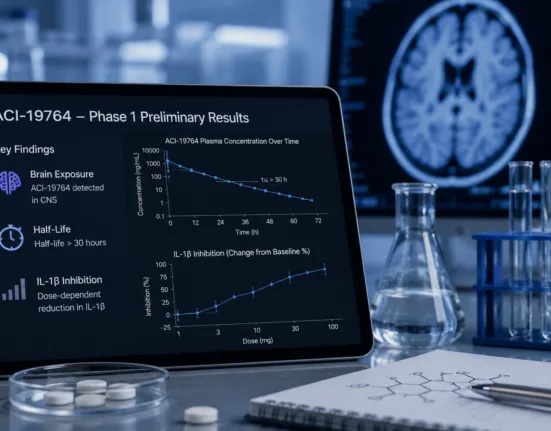
ALPHA-1062 is central to Alpha Cognition’s broader thesis because it is also the precursor molecule behind ZUNVEYL. The company describes the TBI version as an intranasal formulation and has highlighted preclinical data suggesting higher brain exposure compared with oral galantamine. If that delivery advantage proves real in human studies, it could become the most important differentiator in the entire TBI program. In acute or subacute brain injury, route of administration is not a side issue. It affects onset, practicality, tissue exposure, and the plausibility of early intervention.
Still, mechanistic plausibility is not the same as clinical relevance. Cholinergic modulation has a logical role in cognition and neuronal signaling, but TBI treatment requires more than symptomatic cognitive improvement claims. Regulators are likely to scrutinize whether the product is intended for acute neuroprotection, functional recovery, cognitive impairment after injury, or some combination of those categories. Each path carries different trial design demands, patient selection rules, and endpoint expectations. A drug aimed at suspected or confirmed TBI also raises practical questions around treatment window, diagnosis certainty, and real-world emergency deployment. The more ambitious the label aspiration, the more demanding the evidence burden becomes.
What the patent says about Alpha Cognition’s lifecycle strategy after ZUNVEYL’s launch
The timing of the patent is important because it arrives while Alpha Cognition is still proving the commercial viability of ZUNVEYL. In its fiscal 2025 update released in late March 2026, the company reported fourth-quarter ZUNVEYL net product revenue of $2.5 million and full-year 2025 total revenue of $10.2 million, with bottle volumes increasing through the year. That suggests the Alzheimer’s launch is gaining traction, but it does not yet establish the kind of scale that would remove financing or execution concerns for a small-cap CNS company.
Seen through that lens, the TBI patent performs a second function. It helps Alpha Cognition tell a lifecycle management story at a time when single-product commercial narratives can look fragile. ZUNVEYL remains the revenue engine, but a protected TBI program gives management another lever for valuation, business development, and future capital market positioning. That is especially relevant for a Nasdaq-listed biotech with a market capitalization a little above $100 million, where intellectual property breadth can influence how investors frame optionality.
Why regulators and clinicians will still need evidence that goes far beyond patent scope and preclinical signal
No matter how broad the claims, the patent does not answer the questions that will define eventual regulatory credibility. Clinicians watching this space are likely to ask whether ALPHA-1062 will be tested in mild traumatic brain injury, repetitive blast injury, post-concussive cognitive impairment, or a broader mixed TBI cohort. They will also want to know whether trial endpoints emphasize cognition, daily functioning, symptom resolution, or biomarker-based effects. CNS history suggests that broad initial narratives often narrow sharply once real study design begins.
Regulatory watchers are likely to focus on two issues. First, whether Alpha Cognition can create a clean development path in a field where diagnosis and severity classification are often inconsistent. Second, whether the company can generate data robust enough to separate placebo effects, recovery variability, and supportive care confounders from true treatment benefit. The fact that the company has discussed military-relevant repetitive blast models may give it a differentiated angle, but translating preclinical military relevance into civilian regulatory success is not automatic.
What the market is likely to watch next as Alpha Cognition tries to turn IP protection into a pipeline asset
The next meaningful catalyst is not another patent headline. It is evidence of a workable development plan. Investors and industry observers will be looking for clearer disclosure on formulation readiness, IND-enabling or clinical timelines, target population, and whether the company intends to pursue the asset internally or through partnership. Earlier company materials indicated an out-licensing orientation for some TBI applications, and that history matters because it suggests management may see external development support as the more realistic route.
That may ultimately be the most pragmatic reading of this announcement. The patent increases bargaining power more than it increases clinical certainty. For Alpha Cognition, that is still useful. A small commercial-stage company with one approved CNS product needs protected adjacency opportunities, and traumatic brain injury offers a large enough white space to justify the effort. But until the company produces human data and a more precise regulatory blueprint, this remains an intellectual property milestone with strategic value, not a therapeutic breakthrough.
In that sense, the patent strengthens Alpha Cognition’s long-term franchise architecture more than its near-term risk profile. It tells the market that ALPHA-1062 is not finished after Alzheimer’s, and it gives the company a stronger story around durability, optionality, and future partnering leverage. What it does not yet tell the market is whether Alpha Cognition can succeed where so many TBI programs have struggled: converting mechanistic promise into clinically persuasive outcomes.