IASO Biotechnology has signed a technology licensing agreement with Instituto Butantan for the local development of a CAR-T cell therapy for hematological cancer in Brazil, with development and manufacturing planned at the Nutera-SP Advanced Therapies Center in São Paulo. The deal matters because it targets one of the biggest barriers in cell therapy adoption, namely cost and access, and positions a major Brazilian public institution at the center of an effort to move CAR-T beyond the private healthcare market.
Why this partnership could matter far more for healthcare access than for simple geographic expansion
The immediate headline is that IASO Bio is extending its international footprint into Brazil. The more important industry takeaway is that this is not just another licensing transaction designed to collect royalties from a new territory. It is a test of whether a public-sector manufacturing and development model can make one of oncology’s most expensive treatment categories more viable in a middle-income healthcare system with universal coverage ambitions.
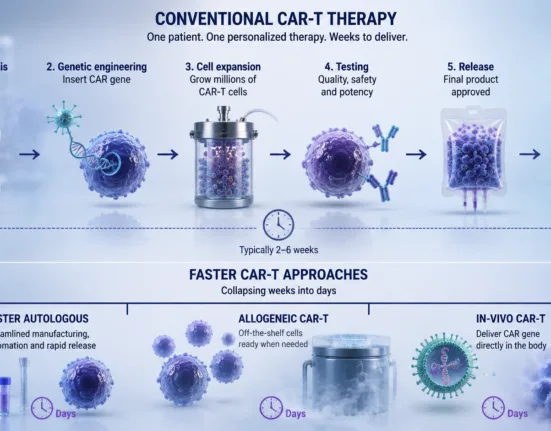
That distinction matters because CAR-T has long been one of the most clinically transformative but structurally exclusionary modalities in hematologic oncology. Autologous cell therapy has delivered deep responses in certain blood cancers, particularly in heavily pretreated populations, but the category has also become synonymous with manufacturing complexity, long vein-to-vein timelines, specialized center requirements, and price tags that can overwhelm payers. In that sense, the IASO Bio and Instituto Butantan agreement speaks less to scientific novelty than to a commercialization and access problem the sector still has not solved cleanly.
Brazil is a particularly revealing market for that experiment. It has a large population, a sophisticated academic and public health infrastructure in selected regions, and a public health system that, in theory, can absorb innovative therapies if economics and logistics become manageable. Yet CAR-T remains largely confined to the private system because the therapy is too expensive, too specialized, and too operationally demanding for broad routine deployment. That makes local development more than a patriotic manufacturing story. It becomes a pricing, sovereignty, and system-design question.
What this agreement reveals about the next phase of CAR-T competition beyond the United States and Europe
The global CAR-T market has entered a more complicated phase than the early excitement suggested. The first wave was about proof of concept and regulatory legitimacy. The next wave is about who can industrialize the model, reduce costs, shorten production times, and bring advanced cell therapy to healthcare systems that do not resemble the reimbursement environment of the United States.
In that context, IASO Bio’s move is notable because Chinese cell therapy developers are increasingly looking outward not just as science exporters, but as architects of alternative development and supply models. That has competitive significance. Western biopharma groups established the early commercial framework for CAR-T, but Chinese developers have often emphasized manufacturing pragmatism, speed, and partnership-led geographic expansion. A Brazil-focused licensing arrangement with a public institution suggests the field is widening from product competition to delivery-model competition.
Instituto Butantan also changes the character of the transaction. This is not a private hospital chain or a narrowly commercial CDMO arrangement. Butantan is a public institution with deep standing in vaccines and biologics production in Brazil, and that gives the agreement a different strategic flavor. It hints at an industrial-policy angle, where advanced therapies are increasingly viewed not just as imported premium medicines but as capabilities that countries may want to localize for strategic and health-equity reasons.
Why local manufacturing may be the only credible path to lower-cost CAR-T in Brazil’s public system
The press release frames lower cost as a major goal, and that is credible in principle, but it should not be mistaken for automatic affordability. CAR-T costs are driven by more than the licensing fee or the geographic origin of the technology. The economics reflect individualized cell collection, manufacturing quality controls, specialized handling, inpatient monitoring, toxicity management, and the institutional readiness required to deliver therapy safely.
Still, local manufacturing could remove some of the cost layers that make imported autologous therapies exceptionally difficult to scale. Cross-border logistics for living cell products are expensive and operationally fragile. Exchange-rate exposure matters in Brazil. Local production may also allow adaptation to domestic treatment pathways and could eventually support a public-sector pricing logic more compatible with incorporation into the Unified Health System. That is where this partnership could become genuinely consequential.
Nutera-SP’s role is therefore central, not incidental. If the facility can develop robust manufacturing workflows and support reproducibility, Brazil may begin building the institutional muscle required for broader cell therapy delivery. But if local production ends up lowering only a fraction of total treatment costs, the access thesis becomes weaker. The difference between a scientifically impressive pilot and a scalable public-health platform will come down to whether the economics hold after considering the full care pathway, not just the manufactured product.
What clinicians and regulators are likely to watch as the project moves from licensing to execution
For clinicians following the field, the scientific category is already validated. The key question is not whether CAR-T can work in hematological malignancies, but whether this specific locally developed program can be translated into a reliable and clinically usable treatment option in Brazil. That means attention will shift quickly from partnership headlines to operational and regulatory milestones.
Regulatory watchers are likely to focus first on how clearly the development path is defined. The announcement describes a licensing agreement for local development, but it does not specify the exact product profile, target indication, stage of prior clinical validation, bridging requirements, or anticipated regulatory route in Brazil. Those missing details matter. Even when a platform has known biological rationale, local regulators still need evidence on consistency, safety, and manufacturing comparability.
Clinicians will also watch for practical issues that often get less press attention than response rates. Which patients will be prioritized first? Will the program target relapsed or refractory populations where unmet need is high and benefit-risk tradeoffs are more favorable? How will referral pathways work? Which centers will manage cytokine release syndrome and neurotoxicity risk? A fancy licensing deal is the easy part. Building a referral-and-treatment network for cell therapy is where the real grind begins.
Why the partnership is strategically attractive but still carries execution and reimbursement risk
This is the kind of announcement that can sound almost too neat. A Chinese cell therapy company contributes the platform. A respected Brazilian public institution contributes local development and manufacturing capacity. Patients who do not respond to conventional treatment may eventually gain broader access. On paper, that is excellent strategic alignment. In practice, several blind spots remain.
The first is reimbursement realism. Lowering cost does not necessarily mean reaching a price that public systems can absorb at meaningful volume. CAR-T may still remain a highly selective therapy even with local production. The second is manufacturing scale and consistency. Cell therapy is not like producing conventional biologics at industrial volume. Maintaining quality across individualized batches is one of the hardest parts of the model. The third is institutional concentration. Advanced therapies often start in flagship centers, but public-health impact requires broader diffusion, which is much harder.
There is also a timing risk. The oncology field is moving quickly, and CAR-T itself faces competition from bispecific antibodies and other off-the-shelf or less logistically demanding immunotherapy approaches in some hematologic settings. If a locally developed CAR-T program takes too long to become clinically available, its eventual value proposition may face tougher comparisons than it would today. That does not eliminate the opportunity, but it raises the bar for speed and clarity.
What this could enable for Brazil’s biotech ecosystem and Latin America’s advanced therapy ambitions
Even if the first impact is limited to a narrow patient subset, the strategic implications could stretch beyond one product. A successful public-institution model for cell therapy development would give Brazil something more important than a single oncology asset. It would create know-how in manufacturing, regulation, hospital coordination, and workforce training that could support future advanced therapies. That is the kind of infrastructure effect that tends to matter more over time than the original press release.
For Latin America more broadly, the partnership could become a reference case for regional capability-building. The advanced therapy market has often looked concentrated in a few wealthy geographies, but that concentration is not sustainable if global cell therapy adoption is supposed to broaden. Countries with large public health systems need models that fit their economics and institutional design. If Brazil can demonstrate a workable local path, others may pursue similar licensing and development structures.
That is why this agreement deserves attention despite the limited product-specific detail disclosed so far. It is less about a single commercial launch and more about whether advanced cancer therapy can be localized in a way that preserves clinical rigor while improving affordability. Industry observers tracking the field are likely to judge success not by the signing ceremony, but by the next set of evidence: product specifics, regulatory progress, manufacturing readiness, cost benchmarks, and eventual patient access through Brazil’s public system. Until those pieces become clearer, the IASO Bio and Instituto Butantan partnership stands as a strategically smart move with real promise, but not yet a proven solution to CAR-T’s hardest problem.