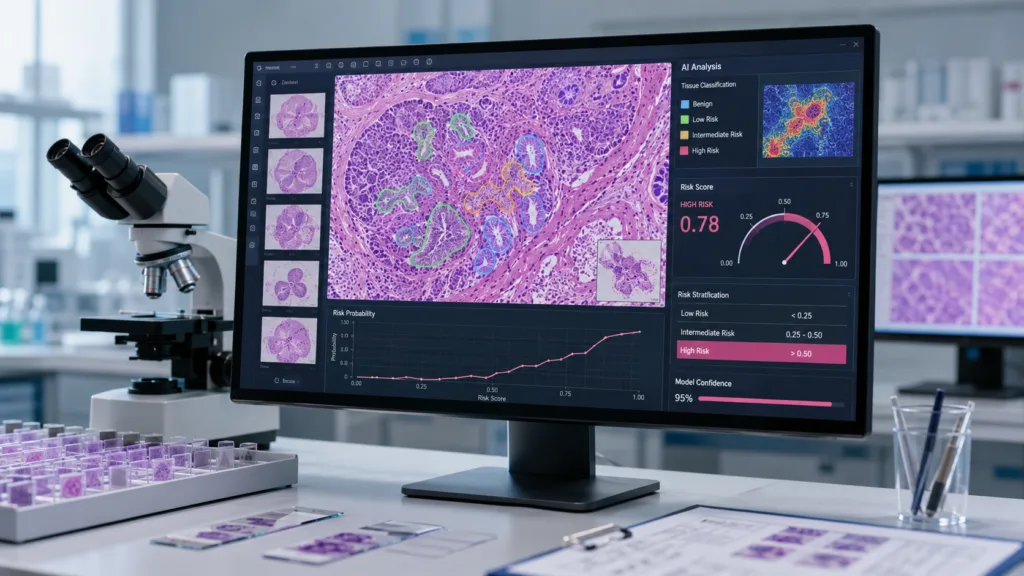
Artera has received U.S. Food and Drug Administration clearance for ArteraAI Breast, a digital pathology-based risk stratification tool for patients with early-stage, hormone receptor-positive, HER2-negative invasive breast cancer. The clearance makes ArteraAI Breast the first FDA-cleared pathology-based risk stratification tool for breast cancer and moves the U.S.-based precision oncology firm deeper into regulated AI decision-support territory at a time when clinicians are seeking faster ways to personalize adjuvant treatment decisions.
Why ArteraAI Breast could change how pathology data enters breast cancer treatment decisions
The significance of ArteraAI Breast is not simply that another artificial intelligence tool has reached the breast cancer market. The more important shift is that routine pathology images, long used primarily for diagnosis and classification, are being positioned as a regulated source of prognostic intelligence. In early-stage hormone receptor-positive, HER2-negative breast cancer, treatment intensity often depends on estimating recurrence and distant metastasis risk with enough confidence to balance benefit against overtreatment. A tool that can convert digitized histopathology images and clinical variables into a predefined risk category could bring pathology closer to the center of therapy planning.
That creates a genuine workflow distinction from many established breast cancer risk tools. Genomic assays such as Oncotype DX and MammaPrint have shaped treatment decision-making by analyzing gene expression signatures and supporting chemotherapy discussions in defined patient populations. ArteraAI Breast instead leans on digital pathology and clinical inputs, potentially giving oncology teams a faster and more operationally integrated way to assess risk if the necessary slide digitization infrastructure is already in place. The unresolved question is whether speed and workflow convenience will be enough to change clinical behavior in a field where oncologists are already accustomed to genomic recurrence scores, guideline-driven criteria, and multidisciplinary tumor board review.
The bigger clinical test will be whether ArteraAI Breast can avoid being viewed as another layer of information that complicates an already crowded decision pathway. Clinicians may welcome same-day or near-diagnosis risk stratification, but only if the result is interpretable, reproducible, and clearly useful alongside grade, tumor size, nodal status, age, endocrine therapy plans, and genomic testing where applicable. Risk tools succeed not because they generate scores, but because they help physicians and patients make difficult trade-offs with greater confidence.
What this clearance reveals about the next phase of AI in oncology diagnostics
The FDA clearance also reveals how oncology AI is maturing beyond image detection. Much of the early attention around medical AI focused on finding lesions, triaging scans, or improving radiology productivity. ArteraAI Breast sits in a different category because it uses pathology data to support prognosis and risk stratification after cancer has already been diagnosed. That distinction matters because the commercial value proposition is not just operational efficiency, but the possibility of influencing treatment intensity.
For diagnostics companies, this is a more ambitious and more demanding lane. A breast cancer risk tool must fit into clinical decisions that can affect chemotherapy discussions, endocrine therapy planning, patient anxiety, payer scrutiny, and long-term follow-up strategy. Industry observers are likely to see the clearance as a validation of digital pathology’s move from image archive infrastructure into active clinical decision support. However, they will also watch whether the evidence base can keep pace with the expectations created by regulatory clearance.
Regulatory clearance does not automatically settle the questions that drive adoption. Hospitals and cancer centers will still evaluate how the model performed across diverse patient populations, how it handles slide quality variability, whether it maintains performance across scanners and laboratory workflows, and how easily clinicians can explain the result to patients. In oncology, trust is earned through repeated clinical usefulness, not through novelty alone. ArteraAI Breast has cleared an important regulatory threshold, but its broader influence will depend on how convincingly it performs in real-world care settings.
Why hormone receptor-positive, HER2-negative breast cancer is a high-stakes proving ground
Early-stage hormone receptor-positive, HER2-negative breast cancer is one of the most commercially and clinically important settings for risk stratification because many patients have favorable outcomes, yet a subset remains at meaningful risk of distant recurrence. That creates a central treatment dilemma. Too little therapy may leave higher-risk disease undertreated, while too much therapy can expose lower-risk patients to unnecessary toxicity and cost. Any tool entering this space must therefore prove that it helps refine decisions rather than merely segment patients into broad categories.
ArteraAI Breast’s focus on distant metastasis risk is clinically relevant because distant recurrence is the outcome that most directly shapes long-term prognosis and treatment concern. A low-risk or high-risk output may help frame discussions around adjuvant strategy, especially when used within established clinical decision frameworks. The limitation is that binary or cutoff-based risk stratification can sometimes compress biological complexity into categories that feel cleaner than the underlying disease actually is. Clinicians will need to understand what the score adds, where it is strongest, and where conventional clinical judgment remains decisive.
This is also why the tool’s eventual positioning against genomic assays will matter. It may not need to replace existing molecular tests to be commercially useful. It could function as an earlier risk filter, a complementary pathology-based input, or a workflow tool in settings where genomic testing is delayed, costly, or selectively ordered. The challenge is that reimbursement and guideline adoption often depend on demonstrating not only analytical or prognostic performance, but also clinical utility. In plain English, the market will ask whether using the tool changes decisions in a way that improves care, reduces unnecessary treatment, or makes the system more efficient.
How digital pathology infrastructure could shape adoption more than the algorithm itself
The commercial success of ArteraAI Breast will depend heavily on the readiness of pathology infrastructure. Digital pathology adoption has accelerated, but many clinical laboratories still operate with mixed workflows, variable slide scanning capacity, uneven integration with laboratory information systems, and budget constraints. A pathology-based AI tool can sound elegant at the platform level, but it becomes practical only when tissue processing, slide digitization, image quality control, data transfer, reporting, and clinician access all work smoothly.
This creates a two-speed adoption scenario. Large academic cancer centers, integrated health systems, and digitally mature pathology networks may be better positioned to test and implement ArteraAI Breast quickly. Smaller hospitals or laboratories without robust digital pathology infrastructure may face higher friction, even if the clinical concept is attractive. For Artera, the clearance opens the door, but scaling will require the less glamorous work of workflow integration, laboratory partnerships, payer engagement, and clinician education.
There is also a reimbursement question hiding beneath the technology story. Precision oncology tools often face a gap between regulatory clearance and routine payment. Payers may ask whether pathology-based AI risk stratification reduces the need for other tests, improves decision confidence, lowers downstream costs, or produces measurable clinical value. If the tool is positioned as complementary rather than substitutive, reimbursement arguments may require stronger evidence of incremental value. If it is positioned as an alternative in certain cases, it will need to show why clinicians should trust pathology-derived AI risk assessment in a space long influenced by molecular signatures.
Why Artera’s prostate cancer experience gives it a platform advantage but not a free pass
Artera’s prior FDA De Novo authorization for ArteraAI Prostate gives the diagnostics-focused firm a meaningful platform credibility advantage. It suggests that Artera is not attempting a one-off breast cancer product, but building a broader multimodal artificial intelligence oncology platform across disease areas. For investors, partners, and health systems, that matters because platform companies can potentially reuse technical, regulatory, and commercial capabilities across indications.
However, prostate cancer and breast cancer are not interchangeable markets. Breast cancer has deeply embedded treatment pathways, mature genomic testing options, active guideline debates, and a large ecosystem of oncologists, surgeons, pathologists, and payers with established views on recurrence risk assessment. Artera’s experience in prostate cancer may help with regulatory strategy and physician engagement, but breast cancer adoption will require evidence and messaging tailored to a different clinical culture.
The competitive question is therefore not whether Artera can build regulated AI tools. The company has already shown it can move in that direction. The harder question is whether ArteraAI Breast can become part of routine breast cancer decision-making rather than a promising software layer used selectively by early adopters. That will depend on prospective evidence, payer traction, integration into clinical pathways, and whether physicians see the result as actionable rather than merely interesting.
What clinicians, regulators, and diagnostics companies will watch next
Clinicians tracking this field are likely to focus on validation depth, patient subgroup performance, and how ArteraAI Breast interacts with existing recurrence risk tools. Regulators may pay close attention to algorithm performance monitoring, software updates, data drift, and whether the tool maintains reliability across different real-world pathology environments. Diagnostics companies will watch whether this clearance accelerates a broader shift from molecular-only risk stratification toward hybrid models that combine images, clinical variables, and eventually multiomic data.
The biggest risk is not that artificial intelligence fails to find patterns in pathology images. The risk is that the clinical system may struggle to determine when those patterns should alter treatment decisions. A prognostic score is valuable only when it is tied to a decision point that clinicians trust and payers recognize. Without that link, even sophisticated AI can remain a specialist tool rather than a standard-of-care component.
ArteraAI Breast therefore represents a meaningful step for breast cancer digital pathology, but not the end of the adoption story. Its clearance marks a new regulatory foothold for pathology-based risk stratification in breast cancer. The next phase will test whether regulated AI can move from technical validation into daily oncology practice, where evidence, reimbursement, workflow, and physician confidence decide which innovations actually change care.