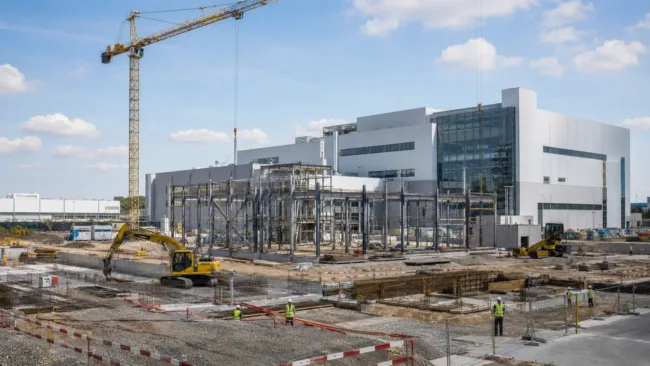
Curia Global, Inc. has completed a $4 million upgrade of two aseptic API suites at its Valladolid facility in Spain, strengthening sterile manufacturing capabilities through a transition to fully closed processing. The investment aligns the site more closely with EU GMP Annex 1 expectations and includes upgrades to isolators, HVAC, pharmaceutical utilities, automation and sterilization-in-place systems.
Why Curia’s Valladolid upgrade matters for sterile API manufacturing capacity
Curia’s Valladolid upgrade matters because sterile API manufacturing is becoming one of the more demanding segments of pharmaceutical outsourcing. The confirmed development is a relatively targeted facility investment, but the wider significance lies in the type of capacity being strengthened. Sterile API production is not simply another manufacturing service. It requires strict contamination control, validated systems, advanced engineering, trained operators and regulatory discipline across every step of the process.
For biopharma sponsors, the pressure is clear. More pipelines include complex sterile products, high-potency compounds, injectable therapies and niche programs that need reliable sterile drug substance support. As these programs move from development into clinical and commercial phases, sponsors need CDMO partners that can offer sterile capabilities without creating quality risk or schedule instability. Curia’s investment in Valladolid speaks directly to that demand by modernizing the infrastructure behind aseptic API production.
The limitation is that capital upgrades alone do not guarantee market advantage. Aseptic manufacturing credibility depends on sustained performance, clean regulatory history, batch success, deviation control, environmental monitoring, operator discipline and customer confidence. The Valladolid project strengthens the physical platform, but Curia will still need to demonstrate that the upgraded suites translate into reliable execution across different sterile API programs.
How fully closed processing changes the contamination-control equation
The central feature of the upgrade is the move toward a fully closed system. That is strategically important because contamination control remains the defining challenge in aseptic manufacturing. Open or partially open processes increase the number of interventions, contact points and environmental exposure risks. Closed processing aims to reduce those vulnerabilities by keeping materials and operations better contained from the surrounding environment.
In sterile API manufacturing, this can make a meaningful difference. The fewer manual interventions required, the lower the potential for microbiological contamination, particulate risk and operator-related variability. Closed systems can also support more consistent process control, especially when combined with modern isolators, automation and sterilization-in-place capabilities. For CDMOs, the commercial benefit is not only improved quality assurance. It is also stronger customer confidence when handling sensitive or complex sterile programs.
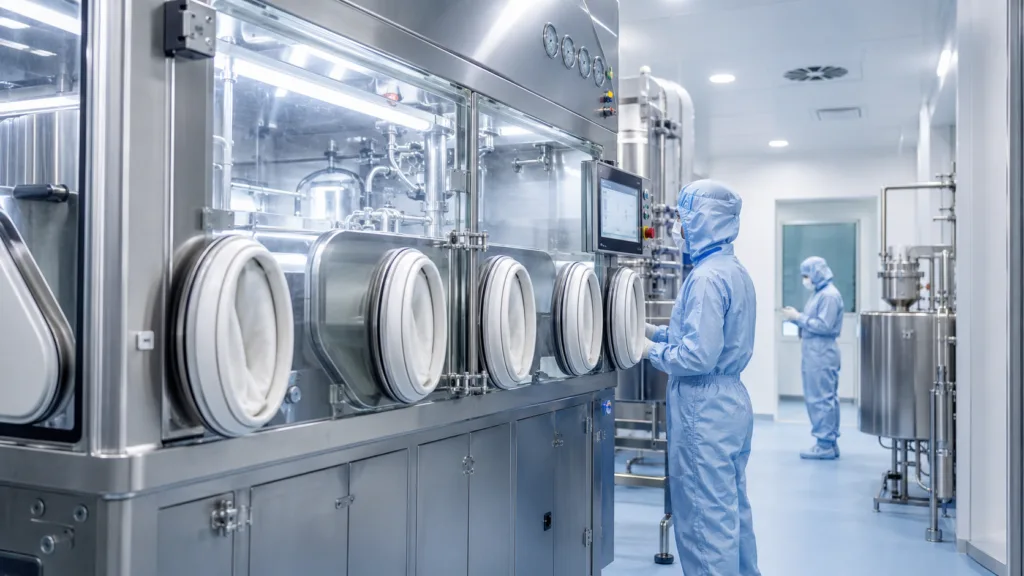
The risk is that closed processing creates its own validation and operational burden. Manufacturers must prove that the system remains closed under real production conditions, that cleaning and sterilization processes are effective, and that operators can manage interventions when needed without compromising sterility assurance. A closed system can reduce risk, but it does not eliminate the need for rigorous process understanding and quality oversight.
Why EU GMP Annex 1 alignment is now a strategic manufacturing issue
The upgrade’s alignment with EU GMP Annex 1 is a major part of the story. Annex 1 has raised industry attention around contamination control strategy, quality risk management, cleanroom design, barrier technology, monitoring and aseptic process control. For sterile manufacturers, Annex 1 is not merely a regulatory checklist. It is reshaping expectations around how sterile production systems should be designed, operated and documented.
Curia’s investment therefore reflects a broader industry shift. CDMOs that serve global sponsors cannot afford to treat regulatory modernization as optional. Sponsors want partners that can support filings, inspections and quality audits across major markets. A facility that demonstrates stronger Annex 1 alignment may be more attractive to customers developing sterile products for Europe and other highly regulated markets.
The unresolved issue is that Annex 1 readiness is measured in execution, not declarations. Regulators and customers will look at contamination control strategies, environmental monitoring data, process simulations, personnel qualification, cleaning validation, deviation handling and documented risk assessments. Curia’s upgrades provide the technical foundation, but the site’s competitive position will depend on how well those systems are embedded into daily operations.
What isolator upgrades reveal about the future of aseptic manufacturing
The installation of advanced isolators is particularly relevant because isolator technology has become central to modern aseptic processing. Isolators create a physical barrier between operators and sterile operations, reducing contamination risk when compared with conventional cleanroom-dependent approaches. In API aseptic suites, isolators can support more controlled handling of sterile materials and better separation between human activity and critical process zones.
This matters because regulators and sponsors increasingly favor designs that reduce reliance on operator behavior. Human intervention remains one of the most persistent risks in sterile manufacturing. Even highly trained operators can introduce variability, especially during complex or repeated manual steps. Isolators help move the process toward engineering-led control rather than personnel-dependent control.
The limitation is that isolators are not plug-and-play solutions. They require careful integration with transfer systems, cleaning cycles, sterilization methods, monitoring systems, maintenance routines and operator workflows. If poorly designed or poorly operated, isolators can introduce bottlenecks or ergonomic challenges. Curia’s upgrade will be judged by whether the isolator-based setup improves control while still supporting flexible and efficient sterile API production.
Why HVAC, utilities and automation upgrades are as important as headline equipment
It is easy to focus on isolators because they are visible and easy to explain, but the HVAC, utility, automation and sterilization-in-place upgrades may be just as important. Aseptic manufacturing depends on controlled environments, reliable utilities, validated air handling, pressure cascades, temperature control, clean steam, water systems and consistent process automation. Weakness in any of these areas can compromise the entire sterile control strategy.
The Valladolid project’s broader engineering scope suggests that Curia is modernizing the manufacturing ecosystem rather than simply adding a single piece of equipment. That matters because sterile API production requires the facility to behave as an integrated system. HVAC supports environmental control. Utilities support process consistency. Automation reduces manual variability. Sterilization-in-place supports repeatable contamination control. Together, these upgrades can strengthen the site’s ability to handle demanding programs.
The risk is that integrated systems require integrated validation. A change to HVAC, automation or sterilization can affect process qualification, cleaning strategy, monitoring expectations and standard operating procedures. Facility upgrades can temporarily improve capability but also increase complexity if users are not fully trained or if system interactions are not well understood. Curia’s challenge is to convert upgraded infrastructure into predictable routine performance.
How the Valladolid investment could affect Curia’s CDMO positioning
For Curia, the Valladolid upgrade supports a broader CDMO positioning strategy. The company operates across research, development and manufacturing services, and sterile API capability can help deepen relationships with customers that need both technical development and reliable production support. In a crowded CDMO market, specialized sterile capacity can be a differentiator, particularly when sponsors are dealing with complex molecules or regulated global supply needs.
The commercial context is favorable. Biopharma companies continue to outsource specialized manufacturing where internal capacity is limited, capital-intensive or difficult to qualify. Sterile manufacturing is one of those areas where sponsors may prefer experienced CDMO partners rather than building expensive in-house infrastructure for every program. Curia’s Valladolid site can therefore become more relevant if the upgraded suites provide flexibility, speed and regulatory confidence.
The limitation is that CDMO competition is intense. Sponsors compare vendors on quality record, technical depth, capacity availability, cost, project management, regulatory support and reliability. A $4 million upgrade is meaningful, but it is not a mega-expansion. Curia’s advantage will depend on how the upgraded suites fit within its wider network and whether they solve specific customer pain points better than competing sterile API providers.
Why sterile API manufacturing is becoming more difficult to scale
Sterile API manufacturing is difficult to scale because it combines chemistry, aseptic control, facility engineering and regulatory documentation. Unlike non-sterile drug substance production, sterile API work must maintain microbiological control while also meeting chemical purity, potency and process consistency expectations. That dual burden makes scaling more demanding, particularly when products are complex, low-volume or high-value.
This is one reason CDMO investments in sterile infrastructure deserve attention even when the dollar value is modest compared with large biologics expansions. The limiting factor in sterile production is often not floor space alone. It is qualified, compliant, contamination-controlled capacity that can run reliably without excessive deviations. Sponsors care about whether a CDMO can execute, not simply whether it has nominal capacity.
The risk for the industry is that demand for specialized sterile manufacturing may grow faster than high-quality capacity. If too few sites can support complex sterile APIs under modern regulatory expectations, sponsors may face longer lead times, higher costs and fewer fallback options. Curia’s Valladolid upgrade helps address part of that capacity challenge, but the broader market still faces a shortage of deeply experienced sterile manufacturing infrastructure.
What customers are likely to watch after the aseptic suite upgrade
Customers evaluating the upgraded Valladolid site will likely focus on practical performance indicators. They will want to understand batch success rates, environmental monitoring trends, sterility assurance strategy, process simulation outcomes, deviation rates, changeover efficiency and technology-transfer timelines. They will also assess whether Curia can support documentation needs for regulatory submissions and inspections.
For sponsors, speed matters, but quality matters more. A sterile API program that moves quickly but generates deviations can create regulatory and clinical supply problems. Conversely, a facility that is highly controlled but slow or inflexible may not meet the needs of fast-moving development programs. The most valuable CDMO sites are those that combine quality discipline with operational responsiveness.
The unresolved question is how flexible the upgraded Valladolid suites will be across different customer programs. Sterile API manufacturing can involve varied batch sizes, process chemistries, containment needs and regulatory expectations. Curia’s investment will create the most value if the suites can support multiple program types without repeated, burdensome requalification or excessive operational downtime.
Why operator ergonomics and data integrity could quietly shape outcomes
Earlier coverage of the Valladolid upgrade highlighted ergonomic improvements and additional automatic controls tied to data integrity expectations. These details matter because sterile manufacturing is performed by people operating within highly controlled systems. Better ergonomics can reduce intervention strain, improve operator consistency and lower the risk of mistakes during long or complex operations.
Data integrity is equally important. Modern GMP operations require reliable records, controlled access, audit trails and defensible electronic data. If automation upgrades support stronger data capture and control, the facility may be better positioned for customer audits and regulatory inspections. In sterile manufacturing, data integrity is not a back-office issue. It is part of proving that the process remained controlled.
The limitation is that automation and data systems must be governed carefully. Electronic controls require validation, cybersecurity awareness, access management, backup procedures and change control. If systems are overly complex or poorly maintained, they can create compliance vulnerabilities. Curia’s upgraded automation should therefore be viewed as a quality enabler, provided the supporting governance is strong.
Why this upgrade is incremental but strategically useful for sterile manufacturing
Curia’s Valladolid aseptic suite upgrade is incremental in scale but strategically useful in direction. It does not transform the global sterile API market overnight. It does, however, address some of the exact capabilities that sponsors and regulators increasingly value: closed processing, isolator technology, contamination control, Annex 1 alignment, automation and more robust sterile manufacturing infrastructure.
What is genuinely new is the completion of a targeted modernization effort at two aseptic API suites in Spain. What is broader and more important is the signal it sends about where CDMO investment is moving. Sterile manufacturing is shifting toward more contained, more automated, more data-controlled and more risk-managed production models. Facilities that cannot keep pace may become less attractive for complex sterile programs.
The next signals to watch will be customer uptake, regulatory inspection outcomes, program transfers into the upgraded suites and Curia’s ability to demonstrate improved flexibility, reliability and speed. If the Valladolid site performs well, the upgrade could strengthen Curia’s role in sterile API supply for complex and critical programs. If execution falls short, the investment will remain a facility improvement rather than a competitive differentiator.
For now, the project highlights a simple reality in pharmaceutical manufacturing. The future of sterile APIs will not be won only by capacity expansion. It will be won by contamination control, validated closed systems, reliable operators, clean data and the ability to manufacture complex products without turning every batch into a quality-risk exercise. Curia’s Valladolid upgrade is aimed squarely at that pressure point.