Coredio has received U.S. Food and Drug Administration Breakthrough Device Designation for its Cardiac Performance Simulation Engine, an artificial intelligence-driven software-as-a-medical-device platform designed to assess heart failure hemodynamics using consumer smartwatches and standard blood pressure cuffs. The digital health platform has also been accepted into the FDA Total Product Life Cycle Advisory Program, positioning it for closer regulatory interaction as Coredio works toward a future 510(k) submission.
Why Coredio’s AI heart failure platform matters for post-discharge monitoring beyond hospital walls
The regulatory milestone matters because heart failure care still suffers from a visibility problem. Clinicians can gather rich hemodynamic data in hospitals, catheterization labs, and specialist imaging environments, but patients spend most of their lives outside those settings. The gap becomes especially important after discharge, when fluid shifts, pressure changes, medication adjustments, and early decompensation can evolve before symptoms become obvious enough to trigger intervention.
Coredio’s Cardiac Performance Simulation Engine is aimed directly at that weak point in the care pathway. Rather than positioning artificial intelligence as a general wellness layer, the platform is designed to estimate clinically relevant hemodynamic status using signals from consumer wearables and standard blood pressure cuffs. That distinction is important because the heart failure market does not need another passive dashboard unless it changes clinical decision-making. The more meaningful opportunity lies in converting ordinary home measurements into information that resembles the type of insight usually associated with invasive or hospital-based assessment.
The unresolved question is whether the software can produce reliable, reproducible, and clinically actionable outputs across the full diversity of heart failure patients. Heart failure is not a single disease pattern. Patients may have reduced ejection fraction, preserved ejection fraction, right-sided congestion, renal complications, obesity, arrhythmias, device implants, or multiple comorbidities that distort signals. If Coredio can demonstrate robust performance across these subgroups, the platform could become a meaningful remote monitoring tool. If performance varies too widely, adoption may remain limited to carefully selected patients under specialist oversight.
What makes catheterization-comparable hemodynamic assessment a difficult clinical benchmark for AI software
The phrase “catheterization-comparable” creates both the clinical promise and the regulatory burden for Coredio. Cardiac catheterization remains a high-value reference point because it directly measures pressures and flow-related parameters that guide diagnosis, risk assessment, and treatment adjustment. A noninvasive platform that can approximate those insights from wearable and cuff-derived data would address a clear unmet need, especially in outpatient and transitional care settings.
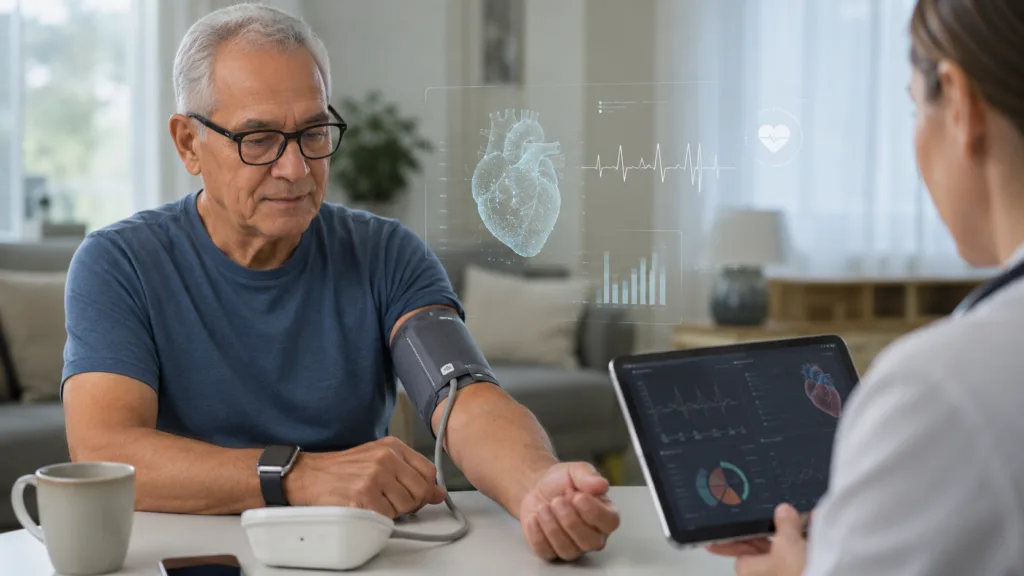
However, approximating invasive hemodynamics is not the same as replacing invasive testing. Regulators, clinicians, and payers will likely focus on how the Cardiac Performance Simulation Engine performs against reference standards, how often it produces uncertain or discordant outputs, and whether those outputs change management in a way that improves outcomes. The four parameters highlighted by Coredio, left ventricular end-diastolic pressure, central venous pressure, systemic vascular resistance, and cardiac index, are not casual wellness metrics. They influence how clinicians think about congestion, perfusion, afterload, and deterioration risk.
The clinical challenge is that these variables interact dynamically. A patient may have elevated filling pressures without obvious symptoms, low cardiac index despite seemingly stable blood pressure, or systemic vascular resistance changes tied to medication effects. A software platform built around physics-based modeling and machine learning must therefore do more than classify a patient as stable or unstable. It must generate information that clinicians trust enough to incorporate into medication titration, follow-up scheduling, escalation decisions, or additional testing.
How digital twins and machine learning could reshape remote cardiac monitoring workflows
Coredio’s use of a personalized cardiovascular digital twin gives the platform a more sophisticated positioning than many conventional remote monitoring tools. A digital twin approach attempts to model the patient’s cardiovascular system rather than simply detect deviations from a population-level threshold. When paired with machine learning trained on clinical data, the model may be able to translate relatively accessible measurements into estimates of deeper physiological behavior.
This hybrid approach is strategically important because pure machine learning models can face skepticism in medicine when outputs are difficult to explain or validate. A physics-informed architecture may offer clinicians a more intuitive bridge between data input and clinical interpretation. In heart failure, where pressure, flow, vascular resistance, and chamber filling are interdependent, a model grounded in cardiovascular mechanics could be easier to evaluate than a black-box risk score.
The limitation is that personalization itself can become an operational hurdle. If the platform requires an initial clinical calibration step, adoption will depend on how simple, fast, and scalable that step is. Hospitals and physician practices already face staffing constraints, fragmented data systems, and alert fatigue from remote monitoring programs. For Coredio to move from regulatory milestone to clinical utility, the workflow must fit into care teams without creating a new layer of administrative burden.
Why FDA breakthrough designation strengthens Coredio’s pathway but does not remove evidence risk
Breakthrough Device Designation gives Coredio a stronger regulatory position, but it should not be confused with market clearance. The designation is intended to support more efficient development and review of technologies that may address serious or life-threatening conditions, but the platform must still satisfy the evidentiary standards required for authorization. That distinction matters in digital health, where the market has seen repeated gaps between early regulatory momentum and broad clinical adoption.
Acceptance into the FDA Total Product Life Cycle Advisory Program is also meaningful because it can provide more structured engagement with the agency. For an artificial intelligence-based software platform, early and recurring regulatory interaction can help clarify study design, endpoints, performance expectations, usability questions, and post-market considerations. This is particularly relevant for products that may evolve through software updates or algorithm refinement.
The risk is that regulatory acceleration does not automatically solve the validation burden. Coredio will need evidence showing that its estimates are accurate enough, that clinicians can interpret them consistently, and that the platform performs safely across real-world use conditions. The more ambitious the clinical claim, the more regulators and physicians will expect rigorous comparison against accepted standards. In that sense, the designation improves the pathway but also raises the visibility of the next proof points.
How Coredio compares with implantable hemodynamic sensors and conventional cardiac imaging
Coredio is entering a field where remote monitoring already has several established or emerging approaches. Implantable hemodynamic sensors can provide direct pressure-related data for high-risk patients, but they require procedures, specialist infrastructure, and careful patient selection. Echocardiography and other imaging tools remain central to cardiac assessment, but they are usually episodic and tied to clinical visits. Consumer wearables offer scale and convenience, but many remain strongest in rhythm monitoring rather than advanced hemodynamic interpretation.
The Cardiac Performance Simulation Engine attempts to occupy the space between these categories. Its software-only, device-agnostic positioning could make it more scalable than implantable approaches if it proves clinically reliable. It could also provide more frequent insight than standard imaging, especially during periods when patients are recovering after hospitalization or undergoing therapy adjustment. For health systems, that combination is attractive because the most expensive failures in heart failure care often emerge when deterioration is missed between scheduled visits.
The competitive issue is that “noninvasive” alone is not enough. Clinicians will compare the platform with existing workflows, not with an idealized version of heart failure management. If a cardiology team already uses nurse-led calls, weight tracking, blood pressure logs, diuretic protocols, implanted devices for select patients, and periodic imaging, Coredio must show where it adds incremental value. The strongest case would be earlier detection of hemodynamic deterioration that leads to timely intervention and fewer avoidable hospital visits.
What clinicians and payers may need before adopting AI-based heart failure assessment
Clinical adoption will likely depend on whether the platform can answer practical questions rather than merely generate impressive physiology estimates. Does it help identify patients who need diuretic adjustment? Does it reduce unnecessary emergency department visits? Does it support safer post-discharge management? Does it allow clinics to prioritize patients most at risk of deterioration? These are the questions that determine whether a digital health platform becomes embedded in care or remains a specialist curiosity.
Payers will also look beyond technical accuracy. Heart failure is costly, but reimbursement decisions require evidence that a tool reduces utilization, improves outcomes, or enables more efficient care delivery. A platform that adds monitoring without changing downstream care may struggle. A platform that demonstrably supports earlier intervention, fewer readmissions, or better allocation of specialist attention would have a stronger health economics argument.
The adoption challenge is compounded by the realities of remote monitoring. Patients must use devices consistently. Data must flow reliably. Clinicians must not be overwhelmed by ambiguous signals. Care pathways must define who reviews the output, how frequently, and what action follows an abnormal result. Coredio’s commercial future will therefore depend not only on algorithm performance but on workflow design, reimbursement strategy, patient adherence, and integration into cardiology practice.
What the next phase could reveal about AI, wearables, and the future of heart failure care
Coredio’s milestone reflects a broader shift in cardiovascular medicine. Artificial intelligence is moving from image interpretation and arrhythmia detection into more complex physiological modeling. Heart failure is a logical target because it is common, costly, heterogeneous, and heavily dependent on timely assessment. The field needs better ways to understand patient status between hospital visits, and wearable-based hemodynamic intelligence is one of the more ambitious answers.
The opportunity is significant because the platform does not require a new implant, a specialist imaging appointment, or a hospital visit for every assessment. If validated, that could expand advanced heart failure monitoring to a wider population, including patients who are not currently eligible for or able to access invasive monitoring technologies. It could also support care models in which cardiologists, heart failure nurses, and primary care teams share a clearer view of patient status after discharge.
The caution is equally important. Advanced heart failure assessment is not a consumer wellness category. False reassurance could delay care, while false alerts could increase workload and anxiety. The next stage for Coredio will therefore be judged on evidence quality, regulatory progress, clinical workflow fit, and the ability to demonstrate that AI-derived hemodynamic insight can change decisions safely. The FDA designation gives Coredio a valuable opening. The real test is whether the Cardiac Performance Simulation Engine can turn home-based signals into information that cardiology teams trust when the patient is no longer in front of them.

FDA breakthrough status gives Coredio’s AI heart failure platform a faster regulatory path added by Pallavi Madhiraju on
View all posts by Pallavi Madhiraju →