Biozen, LLC has received U.S. Food and Drug Administration 510(k) clearance for the BP1000 Ultra-Compact Fingertip Blood Pressure Monitor, a cuffless, calibration-free blood pressure device designed for adult spot-check measurement using fingertip photoplethysmogram and pressure signals. The clearance gives the Oklahoma City-based digital health company a regulated entry point into home blood pressure monitoring at a time when hypertension management remains limited by low measurement frequency, cuff discomfort, and workflow friction.
Why Biozen’s FDA-cleared cuffless blood pressure device could change home monitoring economics
For years, cuffless blood pressure monitoring has sat in the awkward space between obvious clinical need and difficult technical execution. The consumer health market has shown that people are willing to track steps, heart rate, sleep, oxygen saturation, and rhythm alerts, but blood pressure has remained harder to pull into the same lightweight daily routine because accuracy requirements are unforgiving. Biozen’s BP1000 matters because it does not merely promise another wellness-oriented estimate. It has entered the U.S. market through a regulated clearance pathway for spot blood pressure measurement, which changes the conversation from possibility to adoption risk.
The commercial argument is straightforward. A blood pressure cuff works, but many people do not use it often enough. It is bulky, uncomfortable for some users, and poorly aligned with the behavioral patterns that have made wearables successful. Biozen is betting that a small fingertip device can reduce that friction and make blood pressure checks feel closer to a quick biometric scan than a formal measurement session. That could have implications for remote patient monitoring, primary care follow-up, hypertension screening, and cardiometabolic care programs where adherence is often as important as device capability.
The unresolved question is whether convenience can translate into repeatable clinical behavior outside controlled use cases. A spot-check device is only valuable if users position their finger correctly, apply pressure consistently, follow app guidance, and understand the reading in the right clinical context. That means Biozen’s next challenge is not simply selling a cleared device. It must prove that its user interface, training model, and clinical partnerships can convert technical clearance into reliable real-world measurement habits.
How BP1000’s fingertip measurement approach differs from indirect blood pressure estimation
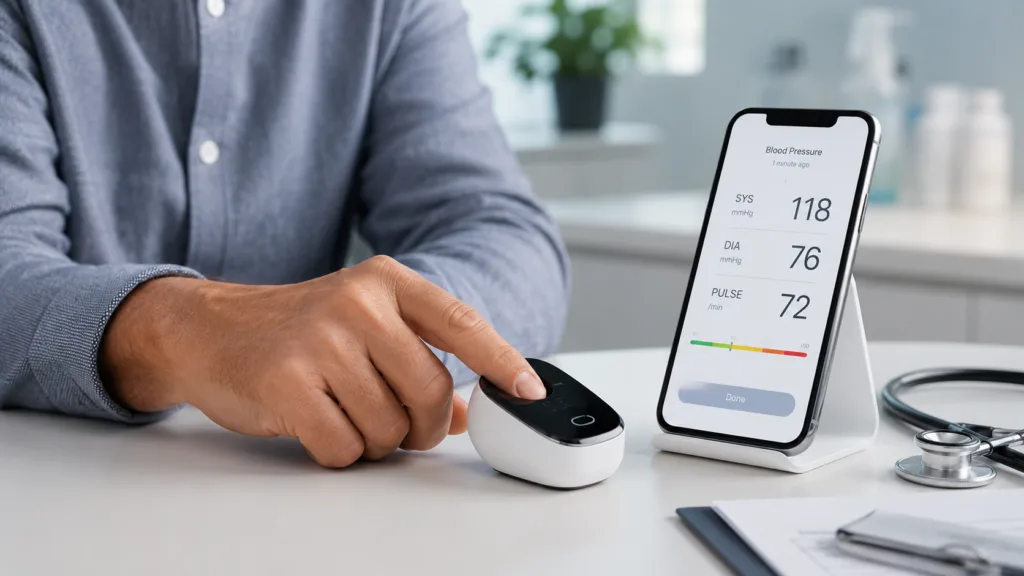
The most important technical distinction in Biozen’s pitch is that BP1000 is designed to measure blood pressure through fingertip-applied pressure and photoplethysmography rather than estimating blood pressure from indirect wearable signals alone. The user presses down on the device’s sensors while following visual guidance in the companion app. The system then identifies arterial occlusion and computes blood pressure using pressure sensing, optical blood-volume signals, and physiologically informed algorithms.
That difference matters because much of the skepticism around cuffless blood pressure has focused on estimation methods that rely heavily on correlations, pulse wave timing, or signal patterns that can drift across physiology, posture, vascular stiffness, age, skin characteristics, and disease states. Biozen is positioning BP1000 closer to the measurement logic of a cuff, but in a miniaturized fingertip form. This gives the device a clearer clinical narrative than products that ask clinicians to trust a purely algorithmic surrogate.
However, the distinction also raises adoption questions. BP1000 is not a passive watch-based device that silently collects continuous blood pressure in the background. It is a spot-check monitor that requires an active user action. That may make it more clinically defensible, but less seamless than the long-term consumer dream of continuous, effortless blood pressure tracking. In practical terms, BP1000 may be best understood as a cuff alternative rather than a full replacement for ambulatory monitoring or continuous cardiovascular surveillance.
What the FDA clearance means for digital hypertension care and remote patient monitoring
The FDA clearance gives Biozen an important regulatory signal in a category where clinical credibility is everything. Blood pressure readings influence diagnosis, medication titration, cardiovascular risk assessment, and follow-up decisions. For clinicians, payers, and remote monitoring vendors, a convenient device without a robust regulatory and validation story would be a non-starter. BP1000’s clearance therefore gives Biozen a stronger foundation for clinical conversations than many earlier cuffless blood pressure concepts.
The remote patient monitoring market could be one of the more interesting channels. Hypertension management depends on repeated readings over time, not isolated clinic measurements. A portable fingertip monitor that logs readings through a companion app could fit neatly into digital care pathways, especially where providers want structured home measurements without shipping larger cuff-based kits. It may also support more frequent readings among patients who avoid traditional cuffs because of discomfort, size, or inconvenience.
Still, reimbursement and workflow integration will determine how far this opportunity goes. Remote patient monitoring is not just a device sale. It requires data capture, clinician review, alert thresholds, electronic health record integration, patient onboarding, billing logic, and liability management. If Biozen wants BP1000 to move beyond an early-adopter device, the company will need partnerships that place it inside care pathways rather than leaving it as another standalone app-linked gadget.
Why the adult-use limitations matter for clinicians and commercial partners
Biozen’s stated user population is adults aged 22 to 59 who do not have active arrhythmias such as atrial fibrillation, peripheral artery disease, or pregnancy. That is a commercially meaningful but clinically bounded population. It allows Biozen to target a large segment of adults who need more accessible blood pressure measurement, while avoiding groups where vascular irregularities, rhythm disturbances, or physiological changes could complicate signal interpretation.
For clinicians, these boundaries are not a minor footnote. Many patients at highest cardiovascular risk are older than 59, may have arrhythmias, vascular disease, diabetes-related circulation issues, or complex comorbidities. That means BP1000’s initial market may be strongest in prevention, early hypertension management, wellness-adjacent clinical monitoring, and lower-complexity home measurement rather than the sickest cardiovascular populations.
From a commercial standpoint, the limitation is both a risk and a sensible regulatory sequencing strategy. It narrows the immediate addressable label, but it may also protect Biozen from overextending claims before real-world data matures. The company can build post-clearance experience, refine user training, deepen clinician confidence, and potentially expand evidence generation in more complex populations over time. The market will watch whether future studies support broader use or whether BP1000 remains best suited to a defined adult home-monitoring segment.
How Biozen could position BP1000 against cuffs, wearables, and clinical-grade monitors
Biozen is entering a market with three overlapping competitive reference points. Traditional automated arm cuffs remain the clinical default for home blood pressure measurement. Wearables have consumer momentum but face accuracy and regulatory hurdles when moving from wellness metrics to diagnostic-grade blood pressure. Clinical-grade monitors have trust, but not always convenience. BP1000’s strategic opening is to sit between these categories, offering a cuffless form factor with a regulated spot-check measurement claim.
That positioning could be powerful if Biozen can convince clinicians that the device improves measurement adherence without sacrificing reliability. In hypertension care, more frequent validated readings can be more useful than occasional perfect readings. A small device that users carry easily and use more often could produce a richer longitudinal view of blood pressure patterns, especially when combined with digital logs and structured care review.
The competitive risk is that consumers may compare BP1000 with wearables and expect passive monitoring, while clinicians may compare it with cuffs and demand equivalent ease of interpretation. Biozen therefore has to educate two audiences at once. It must explain why BP1000 is more clinically serious than many cuffless concepts, while also explaining why an active fingertip measurement is still worth adopting in a world increasingly conditioned to passive sensors.
What industry observers will watch before Biozen’s broader late-2026 rollout
Biozen is taking a phased U.S. market introduction, with broader commercial launch planned for late 2026. That gives the diagnostics-focused digital health company time to scale manufacturing, build early-access feedback loops, and form clinical or commercial partnerships before wider availability. For a device category where trust can be won slowly and lost quickly, a staged launch is arguably the right playbook.
Industry observers will likely focus on several practical signals. The first is whether early clinical users report consistent usability across different home environments. The second is whether Biozen can support manufacturing quality at scale without compromising sensor reliability. The third is whether care providers see meaningful improvements in patient measurement frequency. The fourth is whether payers and digital health platforms view the device as a reimbursable care-enabling tool or mainly as a consumer gadget with clinical branding.
The bigger strategic question is whether BP1000 becomes a category-opening device or a niche tool. If Biozen proves that cuffless, calibration-free spot measurement can be clinically trusted and behaviorally easier, it could reshape how hypertension monitoring is packaged for home care. If real-world use reveals friction, variability, or narrow applicability, the market may remain anchored to cuff-based devices while waiting for the next generation of passive or semi-passive technologies.
Why this clearance is important but not the final test for cuffless blood pressure monitoring
The Biozen BP1000 clearance is a meaningful milestone because it moves cuffless blood pressure monitoring from a frequently hyped idea toward a more regulated and clinically credible product category. It also highlights a more disciplined path for medtech innovation. Instead of asking regulators and clinicians to accept a black-box estimate, Biozen is emphasizing direct physiological measurement principles, validation, and defined use conditions.
That does not mean the cuff disappears. Traditional cuffs are inexpensive, familiar, validated, and deeply embedded in care pathways. Hospitals, clinics, and many home users will continue relying on them. The more realistic near-term opportunity is not replacement everywhere, but substitution where cuffs reduce adherence and portability matters. BP1000 could be particularly relevant where the barrier is not whether a patient can measure blood pressure, but whether the patient will measure it consistently.
The next phase will decide whether Biozen has created a clever cleared device or a scalable shift in hypertension care. FDA clearance opens the door. Commercial execution, clinician trust, usability, reimbursement logic, and post-market evidence will decide how far BP1000 walks through it. For a category that has promised cuffless blood pressure for years, that is exactly where the real test begins.