PeproMene Bio, Inc. has announced that updated phase 1 clinical data for PMB-CT01, its investigational BAFF-R-directed autologous CAR T-cell therapy, will be presented at the 2026 European Hematology Association Congress. The data cover relapsed or refractory B-cell non-Hodgkin lymphoma, including patients whose disease had progressed after prior CD19-directed CAR T-cell therapy, placing the program directly inside one of the most difficult treatment gaps in lymphoma care.
Why BAFF-R CAR T therapy is gaining attention as lymphoma treatment moves beyond CD19
The strategic importance of PMB-CT01 lies less in the conference slot and more in the biological question behind the therapy. CD19-directed CAR T-cell therapies have already altered the treatment landscape for aggressive B-cell malignancies, but relapse after CD19 targeting remains a persistent clinical problem. In some cases, malignant cells retain CD19 but evade immune pressure through other mechanisms. In other cases, tumor cells reduce or lose CD19 expression, leaving clinicians with fewer obvious CAR T-based options.
That is where BAFF-R becomes interesting. BAFF-R, or B-cell activating factor receptor, is closely tied to B-cell survival biology. A CAR T approach aimed at BAFF-R is therefore not merely another attempt to swap one surface marker for another. The clinical hypothesis is that a target connected to B-cell function and survival may be harder for malignant cells to discard without paying a biological cost. That makes BAFF-R a potentially attractive target in settings where CD19 loss, CD20 loss, or prior targeted treatment exposure has weakened the available therapeutic sequence.
The risk is that attractive biology does not automatically translate into broad clinical utility. BAFF-R expression must be sufficiently present and consistent across patient subtypes, manufacturing must remain feasible in heavily pretreated patients, and early efficacy must hold up as enrollment expands beyond the first small cohort. PMB-CT01 is still in phase 1 development, so the current signal should be read as hypothesis-strengthening rather than practice-changing.

What the phase 1 signal suggests about safety, durability, and early clinical relevance
The most notable feature of the updated PMB-CT01 data is the combination of complete responses and a manageable early safety profile. In the dose-escalation portion involving nine treated patients, PeproMene Bio reported no dose-limiting toxicities, no cytokine release syndrome above grade 1, and no immune effector cell-associated neurotoxicity syndrome above grade 1. Seven of nine patients achieved complete response, and responses were still ongoing at the latest data cutoff, with the longest response exceeding three years.
That matters because CAR T therapies are judged not only by whether they can produce deep responses, but also by whether those responses can be achieved without toxicity that limits use outside specialised centres. Cytokine release syndrome and neurotoxicity remain central concerns for clinicians, payers, and hospitals evaluating cellular therapy pathways. A low-grade toxicity profile, if reproduced in larger cohorts, could improve the clinical and operational case for BAFF-R CAR T therapy.
However, the limitation is obvious and important. A nine-patient dose-escalation dataset cannot establish the true toxicity profile of a therapy, especially when rare severe events may only appear in larger populations. The absence of high-grade cytokine release syndrome or neurotoxicity is encouraging, but it is not yet definitive. Regulators and clinicians will need more patients, longer follow-up, and clearer subgroup analysis before concluding that PMB-CT01 has a meaningfully differentiated safety profile compared with existing CAR T approaches.
How PMB-CT01 could fit into the post-CD19 CAR T treatment sequence
The post-CD19 CAR T setting is becoming one of the most important battlegrounds in lymphoma drug development. Patients who relapse after CD19-directed CAR T therapy often have aggressive disease biology, limited salvage options, and variable eligibility for further intensive treatment. Current strategies may involve bispecific antibodies, antibody-drug conjugates, additional chemotherapy, clinical trials, stem cell transplantation in select cases, or another cellular therapy approach where available.
PMB-CT01’s positioning is therefore potentially valuable because it offers a mechanistically distinct CAR T option rather than a simple retreatment strategy against the same target. For patients whose disease has escaped CD19 pressure, a BAFF-R-directed therapy could theoretically restore antigen-specific immune targeting. The first expansion-phase patient with transformed follicular lymphoma who achieved complete response after prior CD19 CAR T progression adds an early signal in exactly the type of setting that the field is trying to solve.
The unresolved question is whether that signal will remain consistent across lymphoma subtypes. Mantle cell lymphoma, large B-cell lymphoma, follicular lymphoma, marginal zone lymphoma, and transformed follicular lymphoma are biologically and clinically different diseases, even though they sit under the broader B-cell lymphoma umbrella. A therapy that performs strongly in one subtype may not show the same durability, persistence, or safety profile in another. The expansion cohorts will therefore matter more than the headline response rate from the initial dose-escalation phase.
Why minimal residual disease negativity strengthens the signal but does not remove uncertainty
The report that responding patients achieved minimal residual disease-negative status adds an important layer to the PMB-CT01 story. In hematologic malignancies, minimal residual disease negativity can suggest a deeper treatment response than conventional imaging or clinical assessment alone. For a cellular therapy, this can be particularly relevant because durable remission depends not only on initial tumor clearance but also on sustained control of residual malignant cells.
That said, minimal residual disease findings must be interpreted within the specific disease setting, assay methodology, timepoint, and sample size. MRD negativity is more established as a decision-making marker in some hematologic cancers than others. In relapsed or refractory B-cell non-Hodgkin lymphoma, especially across mixed subtypes, its meaning can vary depending on how it is measured and how it correlates with long-term outcomes such as progression-free survival and overall survival.
For PMB-CT01, MRD negativity strengthens the narrative that responses may be biologically deep, not merely cosmetic. However, the field will still want to see whether MRD-negative responses translate into durable remission across broader populations. The longer response exceeding three years is meaningful, but the program needs more patients reaching later follow-up windows before durability can be separated from early responder selection.
What makes the BAFF-R strategy different from existing cell therapy and bispecific antibody approaches
Existing lymphoma treatment innovation has largely concentrated around CD19, CD20, and antibody-based redirection of T cells. CD19 CAR T therapies have demonstrated high clinical impact, while CD20-targeting bispecific antibodies have become increasingly relevant because they offer off-the-shelf administration without individualised cell manufacturing. PMB-CT01 sits in a different category because it combines personalised autologous CAR T manufacturing with a target that may remain relevant after CD19-directed therapy has failed.
That distinction could be commercially important if the therapy continues to show durability in heavily pretreated patients. A successful BAFF-R CAR T product would not need to displace first-generation CAR T therapies immediately to matter. It could first carve out a role in patients with prior CD19 CAR T failure, CD19-negative relapse, or disease biology suggesting antigen escape. From there, the clinical question could move into earlier treatment lines or combination strategies.
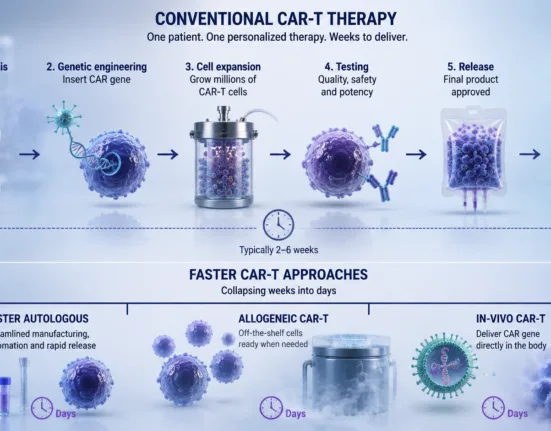
The challenge is that autologous CAR T therapy is inherently more complex than off-the-shelf approaches. Manufacturing timelines, patient fitness, leukapheresis quality, hospital capacity, payer coverage, and centre experience all influence real-world adoption. Even a strong efficacy signal may face practical barriers if the target population progresses too quickly to wait for manufacturing or if competing off-the-shelf agents deliver sufficient disease control with simpler logistics.
Why outpatient potential is attractive but still needs stronger operational proof
PeproMene Bio has connected the favourable safety profile observed so far with the possibility of future use closer to community-based outpatient oncology. That is an important aspiration because CAR T therapy remains concentrated in specialised centres, partly due to monitoring requirements around cytokine release syndrome, neurotoxicity, infection risk, cytopenias, and post-infusion complications. A safer CAR T profile could expand access and reduce system burden.
However, outpatient CAR T delivery is not determined by early safety alone. It requires predictable toxicity timing, reliable patient monitoring, rapid hospital access if complications emerge, trained clinical teams, payer alignment, and standardised care pathways. Even low-grade cytokine release syndrome can create operational strain if patients need close observation, repeat visits, or rapid escalation protocols.
For PMB-CT01, the outpatient angle should be treated as a future development thesis rather than a current commercial conclusion. If larger studies confirm low rates of severe cytokine release syndrome and neurotoxicity, PeproMene Bio may be able to argue for a broader site-of-care model. Until then, the near-term value of the safety data is more about de-risking continued clinical development than proving real-world decentralisation.
How regulators are likely to view the next stage of PMB-CT01 development
The regulatory path for PMB-CT01 will depend on whether PeproMene Bio can define a high-need population, demonstrate reproducible response durability, and generate safety data strong enough to justify advancement beyond early-phase testing. In cell therapy, regulators are typically attentive to dose selection, manufacturing consistency, long-term follow-up, severe immune-mediated toxicity, insertional risks, and the durability of clinical benefit.
The current phase 1 design is appropriately focused on safety, dose finding, and early signs of activity. The next challenge is building a dataset that can support a clearer registrational strategy. That may require expansion within specific lymphoma subtypes rather than relying on a mixed B-cell lymphoma population. It may also require clearer positioning in patients with prior CD19 CAR T failure, where unmet need is high and the biological rationale is strongest.
The key limitation is that a high complete response rate in a small cohort may not be enough to guide regulatory confidence. The program will need to show that responses are not confined to unusually favourable patients, that manufacturing works reliably in the intended population, and that benefit persists beyond early response assessments. Regulators will also want evidence that BAFF-R expression testing can be standardised if target expression becomes part of eligibility or treatment selection.
What clinicians and industry observers will watch after the EHA 2026 presentation
The EHA 2026 presentation will likely be judged on detail rather than headline numbers. Clinicians will look for baseline patient characteristics, prior therapy exposure, lymphoma subtype mix, duration of response by patient, CAR T expansion and persistence, cytopenia patterns, infection rates, B-cell aplasia signals, and any late-emerging safety concerns. These details will determine whether PMB-CT01 looks like a broadly promising platform or a still-fragile early signal.
Industry observers will also watch whether PeproMene Bio can move from academic proof-of-concept into scalable clinical development. The CAR T field rewards strong science, but it also punishes weak execution. Manufacturing, trial site activation, patient recruitment, and capital efficiency can become as important as target selection, especially for smaller clinical-stage biotechnology firms competing against larger cell therapy players and rapidly advancing bispecific antibody developers.
The biggest opportunity is clear. PMB-CT01 could become part of a new class of alternative-target CAR T therapies designed for patients who relapse after CD19-directed treatment. The biggest risk is equally clear. Early complete responses may narrow as the dataset grows, while logistical and competitive pressures may limit the therapy’s eventual reach. For now, the updated data make BAFF-R one of the more credible targets to watch in the next wave of lymphoma cell therapy, but the next expansion cohorts will decide whether PMB-CT01 is a compelling clinical program or simply another promising early CAR T signal searching for a durable place in practice.