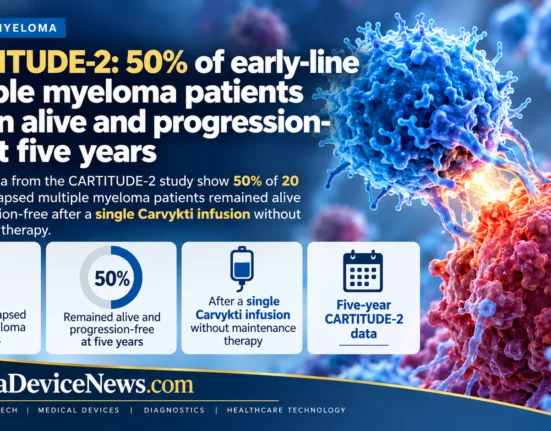
Johnson & Johnson has released updated data from the Phase 3 CARTITUDE-4 study indicating that 80 percent of standard-risk patients with relapsed or refractory multiple myeloma who received CARVYKTI (ciltacabtagene autoleucel) as early as second-line remained progression- and treatment-free at 30 months after a single infusion. The data, presented at the 2025 American Society of Hematology Annual Meeting, add weight to the company’s strategy of positioning CARVYKTI for use earlier in the treatment continuum of multiple myeloma, a disease historically dominated by long-term, multi-agent regimens.
Why the new data could shift CAR-T timing in myeloma treatment
The headline durability shown in CARTITUDE-4 builds on a growing body of evidence that CAR-T therapies may deliver their greatest benefit when administered earlier, before patients experience multiple relapses and associated immune exhaustion. Originally approved for use in patients who had failed at least four prior therapies, CARVYKTI has since gained regulatory backing for second-line use in both the United States and the European Union.
The latest update from CARTITUDE-4 pushes this shift further. In standard-risk patients, progression-free survival at 30 months plateaued at 80.5 percent. Even more notably, all patients in the cohort who achieved a minimal residual disease-negative complete response at 12 months remained disease-free at the 2.5-year mark. For a condition with a typical pattern of relapse, this kind of remission durability following a single treatment event is an outlier and invites reconsideration of how multiple myeloma is staged and sequenced.
What biomarker insights reveal about immune fitness and response durability
The CARTITUDE program includes robust translational analysis that strengthens the rationale for earlier use. In particular, biomarker data from both CARTITUDE-1 and CARTITUDE-4 show a clear correlation between T-cell health and long-term outcomes. Patients who received CARVYKTI earlier—after one or two prior lines of therapy—exhibited stronger immune fitness profiles, including higher levels of CD4⁺ naïve T cells, when compared to patients who had received three or more prior regimens.
This improved immunological landscape may explain the greater durability of responses observed in earlier-line settings. These insights are particularly relevant as cell therapy moves beyond single-agent efficacy questions toward optimized patient selection and biological stratification. Observers in the clinical community suggest that pairing immune biomarker testing with second-line CAR-T decisions could refine both patient eligibility and reimbursement frameworks.
Why oral regimens may face increasing competition in second-line care
The clinical impact of CARTITUDE-4 is not isolated. With CARVYKTI now directly compared against commonly used second-line combinations like pomalidomide plus bortezomib and dexamethasone, the therapy is increasingly positioned as a viable alternative to standard-of-care regimens. While oral agents offer logistical advantages and are well tolerated, they are rarely associated with the depth or duration of response seen in this latest dataset.
That said, cell therapy still faces meaningful barriers to becoming the default option in earlier lines. The infrastructure, lead times, and specialized clinical management required to deliver CARVYKTI limit its reach, especially in community oncology settings. In addition, most second-line regimens do not require bridging therapy, cryopreservation, or inpatient management of adverse events such as cytokine release syndrome. These differences are material, particularly in under-resourced markets or among patient populations with limited mobility.
How regulators and payers may interpret the expanded evidence base
The recent approvals of CARVYKTI for earlier-line use by both the U.S. Food and Drug Administration and the European Medicines Agency reflect growing regulatory comfort with high-cost therapies that show clear incremental benefit. Importantly, these decisions were informed by CARTITUDE-4’s robust trial design and clinically meaningful endpoints, including overall survival and minimal residual disease negativity.
However, pricing models for CAR-T therapies remain a source of friction. Because CARVYKTI is administered as a one-time treatment with potential for multi-year remission, payers are being asked to cover significant upfront costs with the promise of deferred savings on long-term care. In the absence of clear risk-sharing mechanisms, this reimbursement disconnect could limit access even in markets where the drug is approved.
Payers may also look to emerging biomarker data to support outcomes-based contracts. If predictive immune profiles can be validated in real-world populations, manufacturers may be able to justify tiered pricing strategies based on patient risk or response likelihood. Such developments would mirror recent trends in gene therapy pricing and could offer a pathway to broader adoption without breaking health system budgets.
What safety and logistics risks remain in real-world deployment
While CARVYKTI has demonstrated a relatively consistent safety profile across trials, its use outside academic centers continues to raise concerns. Adverse events such as cytokine release syndrome, immune effector cell-associated neurotoxicity syndrome, and prolonged cytopenias require infrastructure that is not universally available. Some community centers may hesitate to implement CAR-T programs without guarantees of clinical support, intensive care unit availability, or specialist oversight.
Additionally, autologous cell manufacturing presents logistical risks. Any delay in production, shipment, or re-infusion can disrupt treatment plans and strain clinician-patient trust. Although Johnson & Johnson has significantly expanded its manufacturing footprint through its partnership with Legend Biotech, capacity constraints remain a limiting factor in some regions. These risks are heightened in time-sensitive relapsed disease, where waiting several weeks for infusion may not be feasible.
Why real-world data is now more important than new trial wins
More than 9,000 patients have now been treated with CARVYKTI globally, a number that allows for meaningful real-world pattern recognition. Johnson & Johnson continues to track outcomes beyond the trial setting, and these post-commercial data will be central to refining guidelines, optimizing patient selection, and driving payer confidence.
In particular, consistent remission durability across different health systems and patient subtypes would build the case for widespread second-line use. On the other hand, variability in outcomes—especially if tied to delivery settings or comorbidity burden—may suggest that CARVYKTI is best deployed within specific centers of excellence.
Clinicians increasingly want to understand not just whether a patient can receive CARVYKTI, but whether the surrounding system can support the full treatment cycle, including patient education, acute adverse event management, and post-remission surveillance. For now, tertiary care centers are best equipped to meet these needs, but scaling will require investment in training, infrastructure, and supply chain resilience.