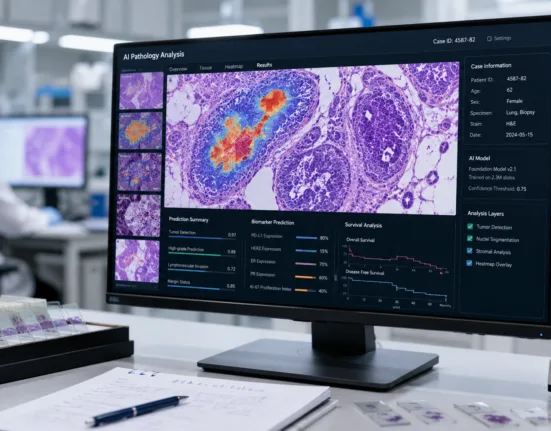
Tempus AI, Inc. has launched the next generation of Lens, its agentic artificial intelligence platform designed to support oncology drug development and research workflows. The expanded platform connects Tempus AI’s multimodal real-world data, oncology foundation models, computational infrastructure and specialised AI agents to help biopharma teams design trials, analyse patient subgroups and generate evidence faster.
The strategic significance is not simply that another healthcare technology company has attached agentic artificial intelligence to an existing product. The more important point is that Tempus AI is trying to move artificial intelligence deeper into the operational layer of cancer drug development, where decisions about biomarkers, patient eligibility, cohort feasibility and trial design can determine whether a programme advances cleanly or burns capital for years. In oncology, where drug development is expensive, timelines are long and patient populations are increasingly molecularly segmented, a platform that can compress analytical work from weeks to minutes could become more than a workflow tool. It could become a decision infrastructure layer for biopharma.
That is also where the risk sits. Oncology drug development is not just a data retrieval problem. It is a scientific, clinical, regulatory and commercial judgment problem. Lens may make it easier for drug development teams to query large datasets and generate code-backed analyses, but industry adoption will depend on whether users trust the provenance of the data, the transparency of the analytical logic, the reproducibility of outputs and the suitability of those outputs for decisions that may eventually influence trial strategy. The platform is commercially available and already used by a large biopharma customer base, but the next phase will test whether agentic AI can move from impressive interface to validated enterprise infrastructure.

Why does Lens matter as oncology drug development becomes more biomarker-driven and data-heavy?
The timing matters because oncology research has become more dependent on precise patient stratification. Cancer drug developers are no longer only asking whether a molecule works against a broad tumour type. They are asking whether it works in a defined molecular subgroup, whether a biomarker can identify likely responders, whether a comparator arm is feasible, whether recruitment will be realistic and whether real-world evidence can help explain treatment pathways beyond controlled trial settings. That complexity has made oncology fertile ground for multimodal data platforms, but it has also made the data problem harder to manage.
Tempus AI’s claim to relevance rests on its ability to combine clinical, molecular and longitudinal real-world data with artificial intelligence models and agentic workflows. The platform’s next-generation design suggests a shift from static data access toward guided scientific analysis. Instead of asking users to manually move between datasets, statistical tools, internal coding resources and evidence-generation teams, Lens is positioned as a more integrated environment where research questions can be translated into analysis plans, executed against large datasets and reviewed through transparent outputs.
For biopharma teams, this could reduce friction in early development decisions. A clinical scientist exploring a biomarker hypothesis may not need to wait for multiple handoffs between data science, informatics and medical teams before seeing a first-pass analysis. A translational team assessing a patient subgroup may be able to test feasibility assumptions earlier. A development strategist thinking about trial design may be able to explore real-world patient distributions before protocol design becomes too rigid. This does not eliminate the need for expert review. It changes where expert review enters the process, ideally moving it closer to interpretation rather than data assembly.
The unresolved question is whether speed creates confidence or simply more outputs. Faster evidence generation is valuable only if the underlying data are representative, the analytical assumptions are visible and the system can show why it reached a conclusion. Oncology is full of false signals, confounding variables and real-world data gaps. If agentic AI accelerates poor assumptions, the risk is not just wasted time. It is faster movement in the wrong direction.
What is genuinely new in the Lens expansion versus another AI interface for biopharma?
The most notable element is the platform’s multi-agent structure. Lens is being positioned around co-scientist agents that can understand project context, generate research plans, execute analyses and support specific drug development use cases such as biomarker validation and trial design. That moves the product beyond a search layer or dashboard and into a more active analytical assistant role.
This distinction matters because many life sciences artificial intelligence tools still function as better interfaces wrapped around existing data infrastructure. Those products can be useful, but they often leave the hard work of hypothesis formulation, cohort selection, analysis execution and interpretation with human teams. Tempus AI is attempting to build a system where the agent can take a plain-language scientific question, convert it into a structured analysis plan, run code against de-identified multimodal records and present results in an auditable way.
The code-backed and reproducible intelligence element is especially important. In regulated and scientifically rigorous environments, black-box outputs are a weak foundation for drug development decisions. If Lens allows users to inspect the underlying analytical logic, export projects for further validation and share interactive reports across teams, it could address one of the biggest barriers to enterprise artificial intelligence adoption in biopharma: the need to prove not only what the system produced, but how it produced it.
Still, this is where the commercial promise and implementation challenge collide. A system that can produce an analysis plan is not automatically a system that can define a clinically meaningful endpoint, resolve bias in real-world datasets or satisfy internal governance standards. Biopharma companies will likely treat Lens as a decision-support environment rather than a decision-maker. That distinction will remain critical as agentic AI enters workflows connected to trial design and evidence generation.
How could agentic AI reshape clinical trial design and patient subgroup selection?
Clinical trial design is one of the clearest use cases for Lens because oncology trial complexity has increased sharply. Many cancer programmes now depend on narrower molecular segments, previous lines of therapy, resistance mechanisms, companion diagnostics and evolving standards of care. Trial sponsors need to understand not just whether a subgroup exists, but whether enough patients can be found, whether the subgroup is clinically meaningful and whether the design can support a compelling regulatory and commercial case.
Lens could help by allowing teams to query de-identified patient records and explore how potential criteria affect eligible populations. That can be valuable before protocols are finalised. A seemingly logical biomarker cut-off may look very different when tested against a large real-world population. A proposed trial design may become difficult if prior therapy patterns, testing rates or disease-stage distributions reduce the available patient pool. Earlier visibility into those constraints can help sponsors refine inclusion criteria, reduce recruitment surprises and make more realistic assumptions about study execution.
This is commercially meaningful because failed or delayed oncology trials can destroy value quickly. Even before a study reads out, poor enrolment, misjudged eligibility criteria or weak biomarker rationale can extend timelines and increase costs. A platform that improves trial feasibility analysis could therefore influence resource allocation across pipelines, especially for companies with multiple competing oncology assets.
However, real-world data cannot fully substitute for prospective clinical evidence. Patient records may be incomplete. Testing patterns may vary by institution, geography and payer environment. Real-world treatment pathways may reflect access issues rather than ideal clinical decision-making. If Lens is used to support trial design, sponsors will still need rigorous clinical, statistical and regulatory review before converting platform-generated insights into protocol decisions.
Why does real-world multimodal data give Tempus AI a stronger position in biopharma analytics?
Tempus AI’s competitive advantage is tied to the scale and structure of its data assets. In oncology, multimodal data can include clinical records, genomic profiles, pathology information, imaging-related inputs, treatment histories and outcomes. When connected properly, these data types can help researchers understand cancer biology and treatment response in ways that single-modality datasets cannot.
For drug developers, the value is not only the size of a dataset. It is whether the data can answer practical questions. A large dataset that lacks longitudinal structure, clean molecular annotations or usable clinical context may be less valuable than a smaller but better-curated resource. Tempus AI’s proposition is that its oncology-focused infrastructure gives biopharma teams a more direct route from hypothesis to evidence because the data, models, agents and workflows are part of the same environment.
That integrated positioning could matter as biopharma companies try to avoid fragmented vendor stacks. Many sponsors already use separate providers for real-world evidence, trial feasibility, molecular profiling, informatics, analytics and artificial intelligence experimentation. Lens appears designed to reduce that fragmentation by creating a single platform for multiple translational and development workflows. If it works, the product could deepen customer relationships and make Tempus AI harder to displace once embedded in R&D processes.
The limitation is that platform depth can also create dependence. Biopharma customers will need clarity on data rights, exportability, audit trails, model validation, privacy safeguards and how easily Lens outputs can fit into existing internal systems. Enterprise adoption in drug development rarely depends only on product capability. It depends on governance, interoperability and whether scientific teams can defend the platform’s role in major programme decisions.
What does this reveal about Tempus AI’s broader strategy beyond diagnostics?
Lens also reinforces the dual identity of Tempus AI. The U.S.-based healthcare technology company is often viewed through the lens of precision diagnostics, but its long-term strategy increasingly depends on turning data generated across clinical and molecular workflows into higher-value software, analytics and life sciences products. That is where Lens fits strategically.
The near-term revenue story still includes diagnostics scale, but the investor narrative becomes more interesting if Tempus AI can expand the contribution of data and applications. A platform such as Lens may support higher-margin, recurring or enterprise-style relationships with biopharma customers, provided adoption continues and customers treat the product as central to development workflows rather than a supplementary research tool. For a publicly listed company still being judged on growth, losses and operating leverage, that distinction matters.
Tempus AI’s latest quarterly performance gives this story additional context. Revenue growth remains strong, and the business has continued to raise expectations around its full-year outlook. At the same time, the stock remains sensitive to questions around profitability, cash burn, competition and whether healthcare artificial intelligence platforms can scale without heavy spending. The share price has shown meaningful investor interest in the artificial intelligence and precision medicine narrative, but the negative earnings profile keeps sentiment from becoming uncomplicated.
For investors, Lens is therefore not just a product announcement. It is a signal about where Tempus AI wants its margin structure and strategic value to move over time. If biopharma customers increasingly use Lens for drug development decisions, the platform could strengthen the data and applications side of the business. If adoption remains broad but shallow, the market may treat Lens as another promising healthcare AI product that still needs proof of durable economic impact.
What adoption barriers could slow Lens despite strong biopharma interest in AI?
The biggest adoption barrier is trust. Drug development organisations may be enthusiastic about artificial intelligence, but they are conservative when decisions affect trial design, patient stratification and regulatory strategy. Internal teams will want to know whether Lens outputs are reproducible, whether analytical assumptions can be challenged, whether data limitations are clearly identified and whether the platform can withstand scrutiny from medical, statistical, legal and compliance teams.
A second barrier is workflow integration. Biopharma companies already have complex internal systems for data management, evidence generation, protocol design and governance. Even a powerful platform can struggle if it sits outside established processes. Lens will need to prove that it can fit into how clinical development, translational medicine, real-world evidence and data science teams actually work. The easier it is to export, audit, share and extend analyses, the more likely it is to become embedded.
A third barrier is regulatory uncertainty around artificial intelligence in healthcare and life sciences. Lens is not being positioned as a direct patient-care diagnostic product in this announcement, but its outputs may influence upstream development decisions. Regulators are still evolving their expectations for artificial intelligence, real-world evidence and model transparency. Biopharma sponsors using Lens will need to separate internal decision support from evidence intended for regulatory submissions, unless the analytical pathway is sufficiently validated for that purpose.
Competition will also intensify. Large technology vendors, contract research organisations, real-world evidence specialists, electronic health record analytics companies and diagnostics firms all want a role in AI-enabled drug development. Tempus AI’s oncology focus and data depth are advantages, but the market will reward platforms that can prove reliability, not just ambition.
What should clinicians, regulators and industry observers watch next?
Clinicians will likely watch whether platforms such as Lens ultimately improve the design of studies that reach patients. Better subgroup selection and stronger biomarker logic could make trials more efficient and potentially more relevant to real-world oncology practice. However, clinicians will remain cautious if platform-generated insights are not clearly linked to clinically meaningful outcomes.
Regulators will watch the boundary between exploratory analysis and evidence used to support development claims. Real-world data and artificial intelligence can help generate hypotheses, support feasibility work and contextualise patient populations, but they do not automatically replace controlled trial evidence. The more Lens is used in decisions that shape study design, the more important transparency and validation will become.
Industry observers will watch whether Tempus AI can convert its data advantage into platform economics. The company has a strong narrative in precision medicine, a large oncology data footprint and growing biopharma relevance. Lens gives that strategy a clearer software expression. The next test is whether customers use it repeatedly for high-value development decisions and whether that usage translates into durable revenue quality.
A neutral reading suggests that Lens is strategically important, but not risk-free. It reflects a credible shift toward agentic AI in biopharma research, especially in oncology, where data complexity creates real operational pain. Yet the market should avoid treating agentic AI as a magic shortcut. The platform’s long-term value will depend on validation, governance, workflow fit and whether biopharma teams trust it when the stakes move from analysis speed to development strategy.
The more interesting possibility is that Lens becomes a bridge between precision diagnostics and drug development infrastructure. If Tempus AI can use its real-world multimodal data to help biopharma companies make better trial and biomarker decisions, it may occupy a valuable position between clinical data generation and therapeutic innovation. That is a compelling strategic lane. It is also a demanding one, because in oncology, being fast is useful, but being right is what ultimately matters.