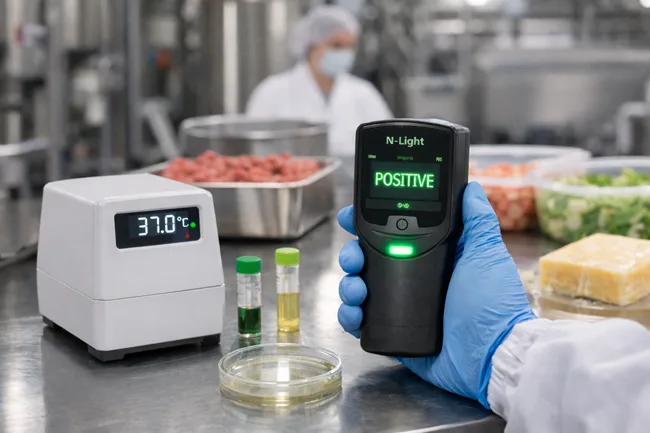
Hardy Diagnostics has announced an exclusive strategic partnership with Switzerland-based NEMIS Technologies to distribute the latter’s N-Light pathogen detection system across North America. The agreement introduces chemiluminescence-based, on-site testing capabilities for foodborne pathogens into Hardy Diagnostics’ portfolio, targeting real-time contamination risk reduction in food manufacturing and environmental testing operations.
What this changes for food safety diagnostics in North America
The deal introduces a new technological modality to the North American hygiene monitoring space—one that has already seen traction in Europe but remains underutilized in the United States and Canada. NEMIS Technologies’ N-Light platform uses proprietary chemiluminescent substrates to signal the presence of specific pathogens, including Listeria monocytogenes, at the point of contamination risk. Its selling point is speed: actionable results can be achieved in a few hours without requiring complex sample handling or laboratory infrastructure.
The ability to deploy such systems directly on-site gives food manufacturers an operational advantage, allowing for faster corrective actions in hazard analysis and critical control point protocols. Compared to traditional culture-based testing or PCR workflows, which typically require central lab turnaround of 24 to 72 hours, the N-Light approach promises near-immediate feedback. For sectors like ready-to-eat meats, dairy, and high-throughput food packaging, this could compress decision-making cycles from days to hours.
Hardy Diagnostics’ role is not merely as a reseller. The U.S.-based diagnostics manufacturer is expected to act as the commercialization engine, leveraging its logistics reach, laboratory relationships, and technical support infrastructure to scale NEMIS’s technology. The company’s addition of N-Light to its food microbiology catalog signals a deliberate move to tap into a growing market segment where detection time, ease of use, and frontline accessibility are becoming decisive differentiators.
Why industry observers see this as more than a niche play
Industry observers believe this partnership may carry broader strategic implications for pathogen surveillance practices, especially in light of evolving FDA food safety modernization efforts and growing regulatory pressure on traceability. Rapid diagnostics have long been a goal in environmental monitoring, but consistent barriers in cost, technical training, and false-positive risk have limited mass adoption of emerging tools. NEMIS Technologies appears to be positioning its platform as a middle ground between lab-grade accuracy and field-level simplicity.
Unlike traditional culture-based workflows that require enrichment, incubation, and downstream testing, the N-Light assay consolidates these steps into a self-contained protocol. Chemiluminescence is used not just for speed but also for sensitivity, and the technology’s design appears focused on delivering reliable, binary outputs that operators with minimal technical training can interpret.
For Hardy Diagnostics, the deal helps differentiate its food safety offering beyond commodity test kits and culture media. While the company has a strong presence in microbiology, most of its solutions have traditionally catered to centralized lab testing environments. With the NEMIS partnership, Hardy Diagnostics is signaling its intent to operate in faster, more distributed settings—closer to the plant floor or processing facility—where real-time feedback can shape compliance decisions and prevent recalls.
What this reveals about the evolution of on-site testing technologies
The growing emphasis on preventive, not reactive, food safety strategies is driving innovation in environmental monitoring. On-site detection tools have long promised to decentralize pathogen surveillance, but scaling them across diverse industrial environments has remained elusive. This is partly because many startups in the field lack the distribution muscle or regulatory know-how to get traction in legacy-dominated markets.
The NEMIS Technologies–Hardy Diagnostics alliance addresses that friction by combining Swiss-origin innovation with American scale and familiarity. It is a model that mirrors several recent diagnostics partnerships aimed at accelerating time-to-adoption, where regional leaders act as deployment platforms for novel but untested modalities.
From a technical standpoint, the N-Light platform’s promise lies in simplifying the last mile of food pathogen surveillance. If successful, it could move more of the microbiological decision-making from labs to line operators and quality assurance managers. However, adoption will likely depend on real-world performance in high-volume, contamination-prone environments—especially across meat, seafood, dairy, and ready-to-eat segments.
Clinicians and food safety professionals note that the barrier to widespread use will not only be accuracy but also consistency across workflows and regulatory acceptance. Integration with existing protocols and acceptance by third-party auditors or regulatory inspectors will play a key role in how fast N-Light can achieve mainstream relevance.
What could limit adoption or introduce risk for stakeholders
Despite the promise, several challenges remain. First is the regulatory environment in North America, which tends to be conservative when it comes to approving novel diagnostic formats for compliance purposes. For a test to be used as an official monitoring tool under FDA or USDA protocols, it must undergo validation according to strict AOAC or ISO standards.
While NEMIS Technologies has experience with European compliance frameworks, translating that validation into the U.S. context may require additional investment and study. Second, the issue of cost-effectiveness versus scale remains unresolved. While rapid tests often promise lower cost per decision when factoring in time saved, their upfront unit costs can still deter smaller or mid-sized facilities.
Third, chemiluminescence-based detection, while sensitive, may still be challenged by environmental noise, sample handling variability, and matrix effects in complex food systems. Reliability in harsh industrial settings—where cross-contamination, humidity, and high microbial loads are frequent—will ultimately determine the technology’s staying power.
For Hardy Diagnostics, this partnership could enhance its profile in innovation-focused accounts, but it also puts the company in a more active validation role. If customer expectations around turnaround time or accuracy are not met, reputational risks may arise, particularly in segments where foodborne illness outbreaks can result in brand damage or legal consequences.
Why this signals deeper changes in food manufacturing quality strategies
The broader implication of this partnership is the reorientation of food diagnostics toward field-deployable, fast-response systems. With global supply chains under increasing scrutiny for hygiene lapses and post-pandemic demand for traceability rising, diagnostics companies are under pressure to provide technologies that shorten the window between contamination and response.
In this light, the Hardy Diagnostics–NEMIS Technologies alliance is not just about distributing a new device. It represents an early indicator that pathogen detection may follow a similar trajectory to point-of-care diagnostics in human health—moving closer to the source of risk, emphasizing real-time outputs, and empowering non-laboratory personnel to make informed decisions.
Educational components like the NEMIS Academy may also prove critical. By offering structured training modules and certification options, the companies are attempting to de-risk adoption and address the operator confidence gap that often accompanies novel diagnostics.
Ultimately, success will depend on whether the platform can prove its value across different facility types, geographies, and use-case complexities. If it does, it could catalyze a new class of industrial hygiene diagnostics that move faster, require less interpretation, and reduce the cost of maintaining compliance.