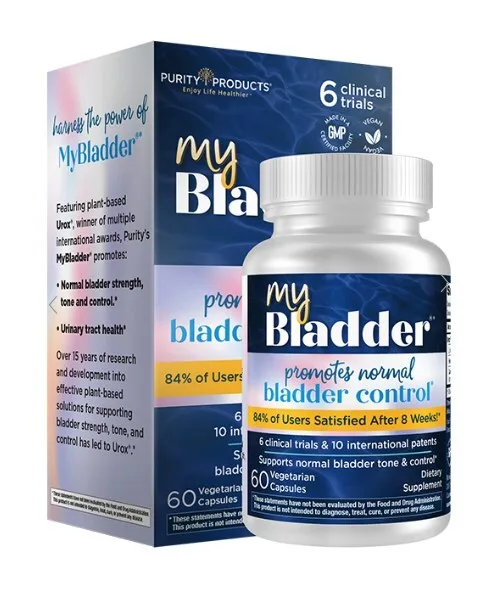
Purity Products, a U.S.-based nutritional supplement company, announced it is expanding the commercial presence of its targeted urological product, MyBladder, built on the proprietary UROX botanical blend. The company confirmed that full Kosher certification is underway for 2026, reflecting increased consumer demand for bladder wellness products with clinical backing and accessibility features.
What this reveals about the new validation threshold for bladder health supplements
Unlike conventional over-the-counter solutions or broad-spectrum urinary health blends, MyBladder signals a pivot toward more evidence-rooted nutraceuticals. Its core active, UROX, combines Cratevox (stem bark extract), Horsetail aerial parts extract, and Lindera root — three botanicals traditionally used in Asian and Western herbal medicine. What distinguishes this formula is not the plant origin, but the fact that UROX has been subjected to structured clinical studies showing statistically significant outcomes in bladder control support. According to internal trial data referenced by Purity Products, 84% of participants reported satisfaction after eight weeks of use.
While these results have yet to be published in a high-impact peer-reviewed journal, the reliance on structured ingredient-level testing reflects a maturing mindset in the supplement industry. Industry analysts note that products like MyBladder are no longer positioning themselves as vague wellness boosters, but rather as condition-adjacent solutions that can fit into lifestyle-driven chronic care support — particularly for aging adults and menopausal women facing reduced bladder tone.
What this changes for consumer expectations in the urinary health segment
Traditionally, urinary tract health supplements have been crowded with cranberry-based products and generic d-mannose formulations. These ingredients still dominate shelf space but increasingly suffer from mixed clinical evidence and consumer fatigue. The emergence of UROX—and its commercial embodiment in MyBladder —presents a differentiated narrative built around muscle tone, bladder wall integrity, and nervous system balance.
For consumers, particularly older women with stress incontinence or men with mild lower urinary tract symptoms (LUTS), there is rising awareness of the need for bladder-specific muscle support rather than kidney-cleansing or pH-balancing claims. MyBladder aligns with this shift, offering a formulation that focuses on mechanical and neurological aspects of bladder control. If this positioning is sustained, it could mark the beginning of a therapeutic narrative in OTC urinary products that mimics how joint health supplements evolved from glucosamine to collagen- and MSM-based formulations with clinical endpoints like WOMAC scores.
What could go wrong as Purity Products targets scaled growth and wider acceptance
Despite its clinical framing, MyBladder remains a dietary supplement and is not FDA-approved for treating or preventing any medical condition. Regulatory watchdogs will continue to scrutinize claims—especially if marketing drifts into language implying disease modification or treatment equivalence. Analysts also point out that product growth could outpace data transparency, a frequent issue in the supplements sector. If Purity Products fails to publish full clinical study details or relies on non-peer-reviewed data, it may lose credibility in practitioner circles just as it starts gaining consumer traction.
In addition, while the company is pursuing Kosher certification to broaden accessibility, this is unlikely to influence clinical adoption or regulatory trust. Certification may open distribution pathways, especially in religiously observant communities or among wellness-conscious buyers, but it does not substitute for strong safety, efficacy, or bioavailability data.
There is also a risk of the product being subsumed by the broader commoditization trend in botanicals. UROX’s proprietary edge will need to be reinforced with patent clarity, batch-level quality controls, and post-market surveillance to avoid erosion from private label knockoffs or unlicensed copycat blends.
What clinicians and industry observers will likely watch next
The most important downstream signal will be whether MyBladder achieves integration into blended care protocols or receives attention in functional or integrative medicine circles. While urologists are unlikely to recommend supplements over prescription treatments for serious conditions like overactive bladder or urge incontinence, there is growing room in lifestyle medicine for adjunctive nutraceuticals — especially in cases where patients seek alternatives to anticholinergic medications due to cognitive side effects.
Further visibility in professional literature, case studies, or naturopathic training programs could validate MyBladder beyond the DTC space. However, it will require careful navigation of structure-function claims, especially as regulators globally become more stringent on health claims made for supplements with disease-adjacent outcomes.
Retail strategy will also be key. If MyBladder is positioned as a low-cost mass-market product, it could dilute its clinical narrative. On the other hand, if priced too high, it risks being marginalized as a niche wellness item in a crowded supplements aisle. Balancing price, channel, and evidence will be central to its next stage of lifecycle maturity.
Why the nutraceutical sector is under pressure to deliver trial-quality data
MyBladder arrives at a time when dietary supplements are increasingly under pressure to justify their claims with trial-quality data. As more consumers become fluent in interpreting clinical language — due to the pandemic-driven surge in medical literacy — brands that rely on anecdotal testimonials or vague mechanisms of action are seeing declining trust.
In this context, Purity Products’ decision to highlight an 84% satisfaction rate after eight weeks reflects both opportunity and risk. If further studies validate this level of response in larger or more diverse cohorts, MyBladder could secure a stronghold in the urinary health space. But without real-world data or head-to-head comparisons, especially with prescription or device-based solutions, the formula risks being seen as yet another well-marketed supplement in a crowded wellness niche.
As MyBladder moves into 2026 with Kosher certification on the horizon and growing consumer adoption, its success could serve as a bellwether for the broader evolution of the bladder health segment. If Purity Products can maintain scientific discipline, resist marketing inflation, and continue investing in transparent, peer-reviewed validation, MyBladder may not just fill a niche — it could redefine consumer expectations for what bladder-focused supplements should deliver. Its trajectory will also inform whether clinically framed nutraceuticals can become trusted adjuncts in self-managed care pathways without drifting into the gray zone of unregulated health claims.