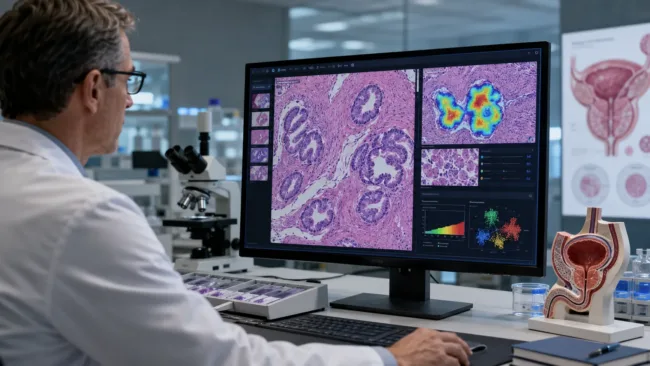
PathoCare Holdings, Inc., the investment and parent company behind diagnostics technology firm PathoCare, LLC, has received a private third-party tendered offer that implies a valuation of approximately $1.75 billion. The offer, which involves the secondary purchase of shares from existing investors, arrives alongside the launch of an independent fairness opinion and the expansion of its proposed private equity capital raise from $25 million to $50 million. The simultaneous developments suggest a step-change in how institutional investors are valuing next-generation, AI-enabled diagnostics platforms in 2026
Why the leap from $500 million to $1.75 billion matters for diagnostics investors
The new valuation marks a significant jump from the previously disclosed $500 million tender offer received by PathoCare Holdings, Inc., which was validated by Lehrer Financial, a Houston-based valuation firm known for its conservative approach and experience in healthcare, banking, and emerging technologies. That increase reflects a sharp rise in institutional confidence in the company’s Raman spectroscopy-based diagnostic platform, particularly its flagship device, PathoWand. Analysts interpret this momentum as more than a valuation story. It points to a shift in how investors are benchmarking diagnostic platforms that blend physics, machine learning, and embedded software rather than relying solely on reagents and wet lab processing.
PathoCare’s point-of-care diagnostic system is designed to deliver rapid, non-invasive test results without the need for chemical reagents or long laboratory turnaround times. Its differentiator lies in its use of adaptive artificial intelligence and Raman spectroscopy, a technique typically used in high-precision material science but increasingly being applied to biological signal detection. That scientific underpinning, when coupled with a reusable, programmable device design, appears to be pushing PathoCare into a category of its own.
Unlike lateral flow assays or PCR machines, PathoWand is being positioned as a diagnostic platform rather than a single-test product. This distinction is crucial. Platform diagnostics, especially those that can integrate across care settings and enable multi-disease detection, are being valued on software-like multiples if they demonstrate defensibility and real-world clinical potential.
How the fairness opinion could influence broader institutional participation
To support decision-making around the third-party offer, PathoCare Holdings has commissioned an independent financial advisory firm to provide a formal fairness opinion. The outcome of this analysis will likely serve two purposes. First, it gives the board a formal assessment of whether the valuation and deal structure align with shareholder interests. Second, and more importantly, it could validate the company’s growth assumptions and financial trajectory for future rounds or strategic alternatives.
A positive fairness opinion could serve as a de-risking signal to new institutional investors looking to participate in the now-enlarged $50 million private placement. It may also impact how late-stage crossover funds, venture debt providers, or even potential acquirers view the company’s trajectory.
Industry observers believe that if PathoCare secures a clean fairness opinion from a well-regarded firm, it will strengthen its negotiating position in any upcoming institutional syndication or partnership talks. At this valuation tier, institutional players are likely to demand deep due diligence, which makes a third-party fairness assessment a strategic asset as well as a fiduciary safeguard.
What doubling the private round implies about commercialization readiness
The decision to increase the company’s private raise from $25 million to $50 million is not merely opportunistic. According to the company’s disclosure, the expanded raise is in direct response to greater-than-expected market demand and institutional interest. That level of demand suggests that capital is not being raised to backfill operations but to fund forward momentum.
Executives at diagnostics-focused funds point out that $50 million is a meaningful amount for a private company at this stage. It allows PathoCare to finance multiple strategic objectives simultaneously, including regulatory readiness, expanded IP protection, commercial pilot programs, and supply chain scaling. This level of capital could also support workforce expansion in engineering and clinical affairs, two functions typically underfunded at the post-prototype phase in diagnostics startups.
The move also provides optionality. With sufficient capital, PathoCare can begin early deployments without the immediate need to lock in revenue-generating distributor partnerships or licensing deals that could cap its upside. It positions the company to scale on its own terms while preserving its technology stack and brand identity.
How PathoCare’s technology platform is challenging diagnostics conventions
The core of PathoCare’s value proposition lies in its integrated use of Raman spectroscopy and adaptive artificial intelligence. Raman spectroscopy enables the detection of molecular vibrations in biological samples, producing high-resolution spectral fingerprints that can be analyzed in real time. When paired with trained AI algorithms, this approach offers high specificity and sensitivity without the need for traditional reagents or sample preparation steps.
The PathoWand system leverages this physics-based approach to deliver point-of-care results for bacterial and viral respiratory infections. Because it avoids the constraints of reagent supply chains, consumable test cartridges, and complex lab infrastructure, it offers potential advantages in settings ranging from primary care clinics to rural health systems and even telehealth-enabled home testing scenarios.
What sets the technology apart is its adaptability. It is programmable, reusable, and capable of supporting multiple diagnostic workflows. This makes it more akin to a diagnostic operating system than a single-use test. Analysts tracking the space believe this could make PathoCare attractive not only to hospital buyers but also to digital health platforms seeking plug-and-play diagnostic layers.
What regulatory and operational headwinds could slow down progress
Despite investor enthusiasm, regulatory clarity remains a major hurdle. Because the platform blends hardware, AI software, and real-time analytics, it may fall under multiple regulatory classifications. Depending on the diagnostic claims made, the U.S. Food and Drug Administration may evaluate the product as a software-as-a-medical-device (SaMD), a Class II device, or potentially under De Novo pathways. Each of these routes has distinct timelines, data requirements, and labeling implications.
Another challenge is manufacturing. While PathoCare has emphasized its reusable design, the spectroscopic sensor modules that form the hardware backbone may not be easy to mass-produce at low cost. Questions remain about the durability of the sensors, recalibration needs, and field-service requirements. These factors could affect not only cost per test but also user experience and device uptime in real-world settings.
Reimbursement is a further wildcard. Even if the device secures clearance, payers will need to see real-world evidence that it delivers actionable clinical value, reduces downstream costs, or improves patient outcomes. This often requires costly health economic studies or provider partnerships, which need to be orchestrated early and strategically.
Why PathoCare’s momentum reflects a broader diagnostics sector revaluation
The surge in PathoCare’s valuation is not happening in a vacuum. Diagnostics investors have grown increasingly selective after a volatile post-pandemic cycle marked by boom-and-bust fundraising patterns. What differentiates PathoCare is its full-stack integration of novel signal detection methods with machine learning and hardware design.
Investors are looking for diagnostics companies that combine defensible IP, non-replicable data assets, and scalable delivery models. PathoCare appears to check several of those boxes. Its current portfolio of 17 issued and pending patents, along with plans to file up to 15 more, indicates a serious push toward establishing a proprietary moat. The timing of this IP expansion aligns with the capital raise, reinforcing the narrative that the company is preparing to scale.
If PathoCare succeeds in executing its capital raise, securing a favorable fairness opinion, and making progress toward regulatory engagement, it could serve as a blueprint for other diagnostics startups navigating the late-stage funding landscape. In a market where valuations have contracted and exits remain elusive, a credible $1.75 billion tendered offer sets a new benchmark for diagnostics platforms that offer more than just chemistry.