CorVista Health, a Bethesda-based cardiovascular diagnostics company, will present new data on a non-invasive, machine-learning-based point-of-care test for ischemia with non-obstructive coronary arteries (INOCA) at the American College of Cardiology’s Annual Scientific Session (ACC.26) in New Orleans on March 30, 2026. The oral poster presentation, titled ‘Noninvasive Ischemia Detection in Symptomatic Patients: A Physiologic Feature Machine-Learned Model,’ applies the company’s FDA-cleared CorVista System platform to a condition that affects an estimated three to four million people in the United States, with a pronounced female predominance. This marks the latest in a series of annual ACC presentations through which CorVista and its manufacturing partner Analytics For Life have progressively expanded the diagnostic scope of the CorVista platform beyond its two currently cleared indications.
Why INOCA represents one of the most underserved diagnostic gaps in cardiology today
INOCA occupies an unusual and clinically costly position in cardiovascular medicine. Patients present with genuine anginal symptoms and, in many cases, objective evidence of ischemia on stress testing, yet conventional coronary angiography reveals no flow-limiting obstructions in the major epicardial arteries. The clinical consequence has historically been dismissal. Patients are frequently reassured that their arteries are clear, medications are withdrawn, and the underlying dysfunction goes untreated. The diagnostic challenge is compounded by the fact that the mechanisms driving INOCA, primarily coronary microvascular dysfunction and coronary vasospasm, are not visible on standard angiography and require separate functional or provocative testing to identify.
The condition disproportionately affects women. Studies based on the Women’s Ischemia Syndrome Evaluation cohort found that nearly two thirds of women undergoing clinically indicated coronary angiography for suspected ischemic heart disease had no obstructive coronary disease. More critically, these patients are not at low risk: the ten-year rate of cardiovascular mortality or non-fatal myocardial infarction in women with INOCA has been documented at approximately 12.8%, and women with INOCA face three-fold to four-fold higher hospitalisation rates than men with comparable presentations. The estimated annual economic burden in the United States is approximately $21 billion. Despite this, less than half of patients with confirmed INOCA receive appropriate treatment, partly because the diagnostic pathway to identify the condition’s specific endotype remains complex, invasive, and poorly standardised across care settings.
What CorVista’s platform offers that existing non-invasive tests do not currently provide
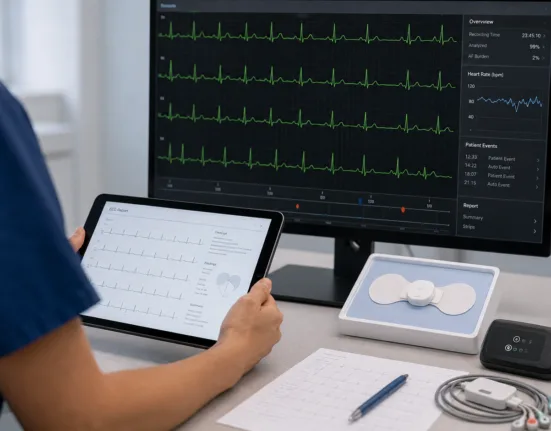
The CorVista System collects cardiac and hemodynamic signals non-invasively over a 3.5-minute resting test and applies machine-learned algorithms to identify patterns associated with specific cardiovascular conditions. The platform requires no radiation, no contrast agents, no injections, no fasting, and no exercise, positioning it as deployable in primary care or low-resource settings where capital-intensive diagnostic equipment is unavailable. The system’s diagnostic outputs are delivered via a secure web portal within minutes of signal collection, providing clinicians with actionable results without specialist-dependent hardware.
The platform already holds FDA clearance for two indications: coronary artery disease evaluation and pulmonary hypertension detection. The INOCA work being presented at ACC.26 represents a third proposed application, currently investigational. This expansion pattern reflects a deliberate platform strategy: rather than seeking regulatory clearance for a single fixed indication and deploying a purpose-built device, Analytics For Life and CorVista are progressively adding algorithmic add-ons to the same signal-collection hardware, each trained against a different cardiovascular phenotype. The commercial logic is that once a device is physically in a clinical setting for one cleared indication, additional diagnostic functions can be delivered through software without requiring new equipment installation or workflow changes.
How CorVista’s prior ACC data establishes the methodological baseline for the INOCA model
The ACC.26 presentation sits within a progression of annual conference data that provides useful context for calibrating expectations. At ACC.25 in March 2025, CorVista presented results from a machine-learning algorithm targeting pulmonary capillary wedge pressure (PCWP) elevation, a key indicator of heart failure with preserved ejection fraction. That dataset involved 283 patients and reported a receiver operating characteristic area under the curve of 0.92, with 90% sensitivity and 76% specificity, alongside a diagnostic odds ratio of 29. Analytics For Life subsequently announced completion of a clinical study meeting the primary sensitivity endpoint for the PCWP algorithm in August 2025. At ACC.24, the company presented preliminary evidence of feasibility for detecting elevated left ventricular end-diastolic pressure. The consistent trajectory across these presentations suggests a methodology in which early-stage feasibility data are followed by larger validation studies before regulatory submission.
For the INOCA application, the clinical challenge is more granular than for straightforward CAD or PH detection. INOCA is not a single pathophysiological entity but a heterogeneous cluster of endotypes that include microvascular dysfunction, epicardial coronary vasospasm, endothelial dysfunction, and combinations of these. Detecting ischemia non-invasively in the absence of obstructive lesions requires that the algorithm capture hemodynamic and cardiac signal patterns associated with functional impairment rather than structural stenosis. The ACC.26 abstract title references a ‘physiologic feature machine-learned model,’ which implies that the algorithm is trained on specific physiological signal features rather than on anatomical or imaging-based inputs. Whether the model can meaningfully differentiate between INOCA endotypes, or is limited to ruling ischemia in or out without further phenotyping, is a critical question the poster data will need to address.
What the current standard of care pathway reveals about where a non-invasive test could fit
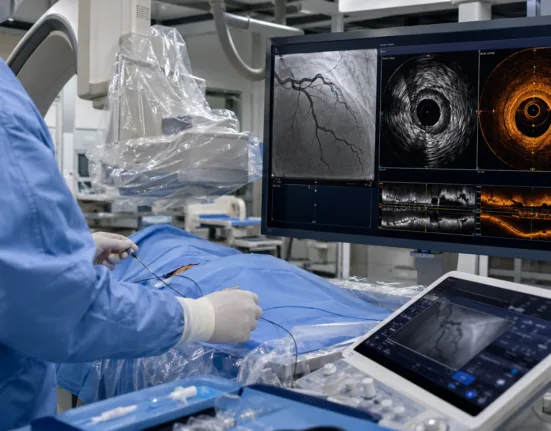
Current guideline-directed evaluation of INOCA involves a two-stage process. Standard coronary angiography first establishes the absence of obstructive epicardial disease. Where INOCA is suspected, both the American College of Cardiology and the European Society of Cardiology now carry a Class IIa recommendation for invasive guidewire-based coronary physiology testing, including measurement of coronary flow reserve and index of microcirculatory resistance, along with provocative acetylcholine testing for vasospasm. This protocol, while diagnostically informative, requires catheterisation laboratory resources, specialist operators, and patient willingness to undergo an additional invasive procedure after already having had an angiogram. In practice, the recommendation is infrequently followed across routine cardiology settings outside specialist centres.
A non-invasive point-of-care test that could reliably identify patients with INOCA at an earlier stage in the pathway would serve several potential functions. It could flag patients for upstream referral before angiography, helping clinicians decide whether invasive coronary physiology testing is warranted. It could also function as a rule-out test, providing reassurance in lower-risk patients and avoiding unnecessary downstream investigations. Industry observers tracking the INOCA diagnostic space have noted that the condition’s female predominance creates a specific equity dimension: women with INOCA are more likely than men to have their symptoms attributed to anxiety or non-cardiac causes, and a validated objective diagnostic tool could reduce this clinical bias. Whether the CorVista INOCA algorithm is being positioned primarily as a referral filter or as a standalone diagnostic will shape how it is evaluated by payers and integrated into clinical pathways.
What trial design limitations and unresolved questions the poster data must address to advance the programme
The structural limitation of conference poster presentations is that they report preliminary data from typically small, single-centre or limited-cohort datasets. The validation studies that CorVista’s prior algorithms have required before regulatory submission have involved several hundred patients. For the INOCA application, the validation challenge is likely more demanding. INOCA is defined partly by exclusion, requiring documented absence of obstructive coronary artery disease alongside evidence of ischemia. Building a robust, representative training dataset that captures the full heterogeneity of INOCA endotypes, across age, sex, body mass index, and comorbidity profiles, is a non-trivial clinical undertaking. The prior PCWP dataset showed consistent performance across sex, BMI, and age subgroups, which will be a necessary bar for the INOCA algorithm to clear before clinicians are likely to trust it in real-world practice.
Regulatory pathway clarity also remains outstanding. The CorVista System’s cleared indications were evaluated as diagnostic aids rather than as standalone diagnostic tests. How the FDA approaches a non-invasive INOCA detection tool will depend significantly on the intended clinical use, the proposed position in the diagnostic pathway, and whether the algorithm is framed as a rule-in, rule-out, or triage tool. Each framing carries different sensitivity and specificity requirements and different implications for the verification study design. Clinicians tracking the field will be watching whether the ACC.26 data begin to define those parameters, or whether the presentation remains at the feasibility stage seen in prior years.
Why the broader platform strategy matters as much as the INOCA indication itself
The strategic significance of CorVista’s ACC.26 presentation extends beyond the INOCA indication in isolation. The company has now presented data at consecutive ACC sessions covering heart failure indicators (LVEDP at ACC.24), diastolic dysfunction and heart failure with preserved ejection fraction (PCWP at ACC.25), pulmonary hypertension (cleared), coronary artery disease (cleared), and now INOCA. This breadth of indication coverage from a single, brief, non-invasive point-of-care test represents a fundamentally different model for cardiovascular diagnostics than the specialised, single-condition imaging platforms that currently dominate the field.
The commercial viability of this model depends on whether the platform can achieve acceptable diagnostic performance across each new indication without the incremental accuracy that deeper, condition-specific modalities provide. Echocardiography, cardiac MRI, nuclear perfusion imaging, and invasive physiology testing each offer levels of anatomical and functional detail that a three-and-a-half-minute resting signal collection cannot replicate. The CorVista platform’s competitive positioning is not as a replacement for these modalities but as a gateway test in settings where they are unavailable, unaffordable, or logistically impractical. Whether that positioning translates into reimbursement frameworks that support broad adoption, particularly in the U.S. primary care environment where the need is clearest and the specialist infrastructure is thinnest, remains the central unresolved commercial question for the programme as a whole.