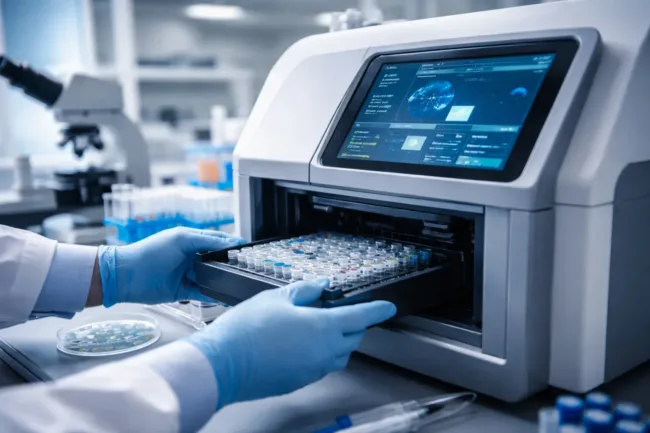
Intelligent Bio Solutions Inc. has entered into a strategic manufacturing agreement with Syrma Johari MedTech Ltd. to scale up production of its Intelligent Fingerprinting Drug Screening Reader, a non-invasive, sweat-based drug testing platform. The company stated that the partnership is expected to reduce production costs by more than 40 percent and drive a gross margin improvement of approximately 20 percentage points as it prepares for its planned commercial entry into the United States in 2026.
What the Syrma Johari partnership signals about Intelligent Bio Solutions’ U.S. ambitions
This partnership is more than just a tactical cost optimization exercise. It reflects a significant strategic realignment as Intelligent Bio Solutions prepares to enter one of the most regulated and competitive drug testing markets in the world. While the company has focused primarily on international deployments to date, including sectors such as mining, transport, logistics, and drug treatment services, the United States represents both a commercial opportunity and a regulatory challenge of a different scale.
Syrma Johari MedTech Ltd. brings substantial regulatory and operational strengths that are likely to de-risk and accelerate Intelligent Bio Solutions’ pathway into the U.S. market. With 14 manufacturing facilities and four design centers spread across India, Europe, and the United States, Syrma Johari offers a dual benefit of global scale and jurisdictional compliance. It holds certifications including ISO 13485, MDSAP, FDA registration, TUV SUD, and Good Manufacturing Practice, all of which are critical for U.S. commercialization in the workplace drug testing sector. For a company like Intelligent Bio Solutions that is still navigating regulatory pathways in the U.S., the presence of a partner with in-house documentation and quality system support will likely prove essential.
This is not merely a supply chain update; it is a manufacturing and compliance infrastructure overhaul designed to support broader geographic expansion. Industry observers believe that such a shift suggests internal confidence in the drug screening reader’s performance, and a readiness to meet rigorous quality, scalability, and policy standards across multiple jurisdictions.
How Intelligent Bio Solutions is reshaping cost structure for competitive scale
The headline cost savings from the partnership are attention-grabbing for good reason. An expected 40 percent reduction in manufacturing costs is not a marginal efficiency. It fundamentally reshapes the unit economics of a diagnostic device that must eventually compete with deeply entrenched legacy drug testing technologies such as urine and saliva-based systems.
Intelligent Bio Solutions’ existing manufacturing arrangements likely offered limited flexibility for ramping up volume or driving down per-unit costs as the company scales. Syrma Johari’s production capacity is approximately four times that of Intelligent Bio Solutions’ current capabilities, allowing for a step change in both volume and cost-efficiency. Additionally, the integration of Syrma Johari’s new medical-grade plastics facility in India, scheduled to open in early 2026, positions the company to internalize more of the tooling and molding processes required for the device, thereby compressing lead times and material costs even further.
This cost compression also arms Intelligent Bio Solutions with greater pricing flexibility in the U.S. market, where buyers in the occupational health and safety sectors are highly cost-sensitive. Many of these clients, particularly in industries such as construction or transportation, are already locked into long-term vendor agreements for conventional drug testing methods. Introducing a novel testing modality will likely require Intelligent Bio Solutions to offer not just superior technology but clear cost or operational benefits.
Syrma Johari’s vertically integrated model, which includes electronics, PCB assembly, mechanical tooling, and functional testing under one roof, is structured to enable those benefits. Unlike lower-tier contract manufacturers, Syrma Johari does not rely heavily on fragmented supply chains or third-party validators, which helps preserve margin and speed up compliance cycles.
Why sweat-based fingerprint drug testing still faces hurdles in clinical trust and market policy
The Intelligent Fingerprinting Drug Screening Reader represents an emerging alternative in drug detection. By using a sweat sample collected from the fingertip, the device screens for drugs such as cannabis, cocaine, methamphetamine, and opioids. The sample collection takes seconds, and results are generated in under ten minutes, eliminating the need for supervised urine collection or lab processing delays. From a hygiene, portability, and operational perspective, the technology is disruptive.
Yet for all its user-friendliness, fingerprint-based drug testing has not yet achieved widespread regulatory validation in the U.S. setting. Clinical experts continue to raise concerns about the analytical sensitivity and specificity of sweat-based matrices compared to gold-standard assays. Moreover, policy frameworks from federal agencies such as the Department of Transportation and the Substance Abuse and Mental Health Services Administration still lean heavily toward urine and saliva-based protocols for workplace testing.
Even with Syrma Johari’s manufacturing quality and Intelligent Bio Solutions’ device performance claims, regulatory endorsement will not be automatic. The pathway is likely to involve supplemental validation studies, third-party performance benchmarking, and pilot program data shared with U.S. regulators and occupational health stakeholders. Until those layers are in place, full market penetration into the U.S. workplace segment may remain aspirational.
It is also unclear whether the U.S. Food and Drug Administration will require a de novo classification or whether the device can proceed via the 510(k) pathway by demonstrating substantial equivalence to existing drug testing technologies. That regulatory question alone can significantly impact timelines and commercial strategy.
How Syrma Johari is emerging as a strategic infrastructure player in global medtech
What distinguishes this partnership is not just cost arbitrage or geographic expansion but strategic alignment. Syrma Johari is not simply a vendor with ISO credentials. It is emerging as a global contract manufacturer that offers infrastructure-as-a-service for high-compliance medtech firms looking to derisk offshore production.
Its export-oriented model, with in-region QARA teams and regulatory document preparation services, makes it a logical choice for medtech companies that are either under-resourced or looking to avoid the friction of building in-house infrastructure. Syrma Johari’s ability to produce over 245 commercialized medical products and its integration of both design and assembly functions give it an unusually high degree of control across the product lifecycle.
This could be particularly advantageous to Intelligent Bio Solutions as it iterates on its reader platform or expands into adjacent applications. With Syrma Johari embedded early in the production scale-up phase, the feedback loop between design, production, and regulatory validation could become significantly more agile.
For other medical technology companies watching this development, the move could also signal growing maturity in the Indian medtech manufacturing ecosystem. Syrma Johari is positioning itself not as a lower-cost alternative but as a partner that can meet Western quality and compliance expectations without the corresponding cost structure of U.S. or European facilities.
Why this move won’t be enough without U.S. regulatory clarity
Even with expanded capacity, vertical integration, and a quality-certified partner, Intelligent Bio Solutions will ultimately need regulatory traction to monetize its U.S. ambitions. The workplace drug testing market is governed not just by FDA oversight but by a patchwork of state and federal policies that shape employer adoption. Without clear endorsements or a structured pilot rollout demonstrating equivalence or superiority over current testing standards, uptake may be slow.
Additionally, shifting testing behavior among U.S. employers requires not just validation but education. Many occupational health decision-makers may be unfamiliar with sweat-based testing or unsure about its admissibility under existing workplace testing policies. Intelligent Bio Solutions will need to proactively engage with regulators, unions, insurers, and employer groups to build awareness and support.
The Syrma Johari deal is an enabler, not an outcome. It provides the tools and capacity to execute, but regulatory approval and market activation remain on the critical path.