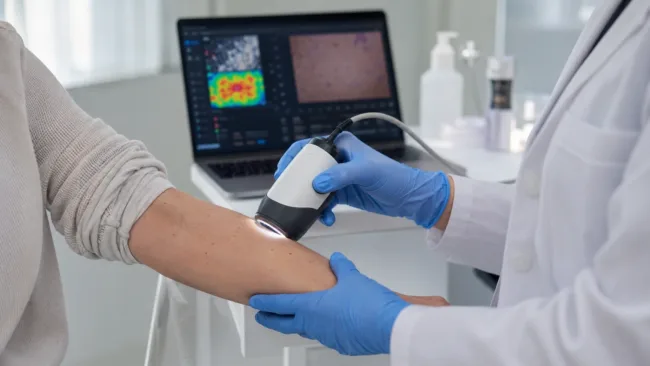
Pattern Bioscience has surpassed 1,000 enrolled samples in its multi-center U.S. clinical trial evaluating the pneumonia ID AST panel and Pattern system, marking the halfway point of a pivotal study designed to support a 510(k) submission for a culture-free, rapid phenotypic diagnostic targeting critically ill pneumonia patients. The Austin-based diagnostics-focused company is progressing toward a planned third-quarter regulatory filing as it seeks to introduce a direct-from-specimen alternative to conventional microbiology workflows.
Why this milestone signals a potential inflection point in the long-standing reliance on culture-based microbiology
Reaching the midpoint of enrollment does not validate clinical performance, but it shows that Pattern Bioscience is approaching the stage where its central claim will be tested at scale. For decades, microbiology diagnostics have depended on culture-based workflows that introduce delays of two to four days before actionable results are available. In critically ill pneumonia patients, that delay is not just operational friction but a direct contributor to suboptimal therapy decisions and poorer outcomes.

Industry observers note that most innovation in diagnostics has focused on accelerating culture or layering molecular tools on top of it. Pattern Bioscience is attempting to bypass culture entirely, which represents a structural shift rather than an incremental improvement. That distinction is important because it raises both the potential upside and the evidentiary burden required for acceptance. A system that replaces culture must demonstrate consistent accuracy across diverse pathogens and resistance profiles, not just faster turnaround times.
How rapid phenotypic susceptibility testing could change the timing and precision of antibiotic therapy decisions
The pneumonia ID AST panel is designed to deliver phenotypic antimicrobial susceptibility results directly from clinical samples. This addresses a key limitation of existing rapid diagnostics, which often rely on genotypic detection and cannot fully capture how pathogens behave in response to antibiotics in real-world conditions.
Clinicians tracking the field believe that earlier access to phenotypic data could shift treatment decisions closer to the point of care. Current ICU practice is heavily dependent on empiric therapy, with broad-spectrum antibiotics initiated under uncertainty. While necessary, this approach contributes to antimicrobial resistance and exposes patients to unnecessary toxicity.
A system that reduces diagnostic uncertainty could enable earlier de-escalation or targeted therapy, improving both patient outcomes and stewardship practices. However, this benefit depends on clinician trust. Rapid results must not only be accurate but also consistently reliable across clinical scenarios. Without that confidence, clinicians may continue to rely on empiric treatment pathways despite faster diagnostics being available.
What differentiates Pattern Bioscience from existing molecular and sequencing-based diagnostic platforms
The current diagnostics landscape includes polymerase chain reaction panels and sequencing-based platforms that have significantly reduced time to pathogen identification. However, these technologies are limited in their ability to provide phenotypic susceptibility data, particularly in a direct-from-specimen format.
Pattern Bioscience’s single-cell microbiology platform is designed to analyze bacterial behavior without culture amplification, preserving phenotypic characteristics that may otherwise be altered. This creates the potential to detect resistance patterns that are not fully captured by genetic markers alone.
Compared with molecular diagnostics, this approach introduces greater technical complexity. Isolating and analyzing individual bacterial cells within heterogeneous clinical samples is inherently challenging and requires robust validation. Molecular platforms benefit from established workflows and clinician familiarity, which can influence adoption decisions even when their capabilities are narrower.
Pattern Bioscience is therefore positioning its platform as a more comprehensive solution, but that positioning must be supported by clear clinical advantages to justify the transition away from existing technologies.
What the trial design suggests about regulatory strategy and the challenges of demonstrating clinical utility
The pivotal study includes approximately 2,000 samples across multiple clinical sites and incorporates prospective clinical specimens alongside contrived samples to ensure comprehensive evaluation. The primary endpoint focuses on concordance with reference methods, aligning with standard expectations for a 510(k) submission.
Regulatory watchers suggest that concordance alone may not fully capture the value of a rapid phenotypic diagnostic. Increasingly, regulators are interested in whether a diagnostic tool can influence clinical decision making and improve patient outcomes, particularly when it proposes to alter established workflows.
The Breakthrough Device Designation signals recognition of the unmet need but does not reduce the requirement for robust evidence. Multi-site enrollment strengthens the dataset, yet it also introduces variability that must be carefully managed. Any inconsistencies in performance could raise questions about reliability in real-world settings.
For Pattern Bioscience, the challenge is not only to demonstrate equivalence with existing methods but to establish a clear clinical advantage that supports both regulatory approval and market adoption.
Why hospital adoption and reimbursement dynamics could limit uptake despite clinical advantages
Even with regulatory clearance, adoption is likely to face practical constraints. Hospital laboratories operate within tight financial and operational frameworks, and new technologies must justify both their clinical value and economic impact. The cost of instrumentation and consumables will be closely scrutinized, particularly in budget-constrained healthcare systems.
Reimbursement remains a key uncertainty. Diagnostics that derive value from downstream outcomes, such as reduced ICU stays or improved antibiotic stewardship, often struggle to fit within existing reimbursement structures. Without clear payer support, hospitals may delay adoption despite recognizing the clinical benefits.
Operational integration presents another challenge. Laboratories must validate workflows, train personnel, and ensure compatibility with existing systems. Clinicians must also adapt to new diagnostic inputs and incorporate them into decision making. These factors can slow adoption even when the underlying technology addresses a significant unmet need.
Why antimicrobial resistance and sepsis burden are creating urgency for faster diagnostic solutions
The development of rapid diagnostics is closely linked to the global burden of antimicrobial resistance and sepsis. Pneumonia remains a leading cause of sepsis-related mortality, and delays in appropriate therapy are a key driver of poor outcomes.
Industry observers note that public health agencies are prioritizing technologies that can reduce inappropriate antibiotic use and improve treatment precision. Support from organizations such as the Biomedical Advanced Research and Development Authority and CARB-X reflects this broader strategic focus.
However, the commercial landscape remains complex. Diagnostics companies often face challenges in translating clinical value into sustainable revenue models, particularly in hospital settings where cost containment is a priority. This creates a tension between public health importance and commercial viability.
What clinicians, regulators and industry observers will watch as Pattern Bioscience approaches submission
As the trial progresses toward completion and data submission, stakeholders will focus on whether the platform can deliver reliable and actionable results within clinically relevant timeframes. Clinicians will look for consistency across patient populations, while regulators will assess concordance data and any discrepancies with established reference methods.
Industry observers will also evaluate scalability, including manufacturing capacity and the potential to expand the platform to other infection types such as bloodstream and urinary tract infections. The broader applicability of the platform could influence its long-term positioning within the diagnostics market.
The central question remains whether rapid phenotypic diagnostics can deliver consistent real-world benefits. The 1,000-sample milestone represents progress toward that goal, but it does not resolve the underlying uncertainties around performance, adoption, and clinical impact.