Biofrontera Inc. has announced database lock of its Phase 1 maximal-use pharmacokinetics study evaluating Ameluz topical gel in combination with the BF-RhodoLED XL lamp for the treatment of mild to moderate actinic keratoses on the neck, trunk, and extremities. The U.S.-based dermatology-focused biopharmaceutical firm plans to use the pharmacokinetics data, together with previously reported positive Phase 3 efficacy results, to support a supplemental New Drug Application to the United States Food and Drug Administration in the third quarter of 2026 aimed at expanding the product’s label beyond its current face and scalp indication.
This milestone is procedural, but strategically important. Ameluz, a formulation of aminolevulinic acid hydrochloride used in photodynamic therapy, is already approved and commercialized. Biofrontera Inc. is not seeking approval of a new drug. Instead, it is attempting to expand anatomical coverage and increase the maximum treatment field size. In dermatology, such incremental expansions can meaningfully reshape commercial positioning even without introducing a new molecule.
Why maximal-use pharmacokinetics data will likely determine regulatory comfort with broader Ameluz use
The central regulatory question is systemic exposure. The Phase 1 study was non-randomized and open-label, enrolling seventeen patients who received a single photodynamic therapy treatment using three entire tubes of Ameluz applied across approximately 240 square centimeters. Plasma concentrations of aminolevulinic acid and its metabolite protoporphyrin IX were measured over ten hours following application.
This maximal-use pharmacokinetics design reflects regulatory expectations when topical drugs are proposed for larger body surface areas. While Ameluz has an established safety and efficacy profile on the face and scalp, expanding to extremities and trunk introduces a different exposure dynamic. The United States Food and Drug Administration will focus on whether systemic absorption remains minimal under worst-case use conditions.
The current label limits treatment fields to 60 square centimeters. Expanding to 240 square centimeters quadruples the exposure area and extends use beyond cosmetically sensitive regions. If systemic levels of aminolevulinic acid or protoporphyrin IX rise meaningfully under these conditions, regulators may request additional data or impose labeling restrictions.
Database lock signals data integrity, but the company has not yet disclosed pharmacokinetics outcomes. Until those figures are available, external observers cannot assess whether exposure remains comfortably within expected ranges. In this context, the pharmacokinetics dataset is the primary regulatory gatekeeper.
How anatomical expansion could shift photodynamic therapy’s role in actinic keratosis management
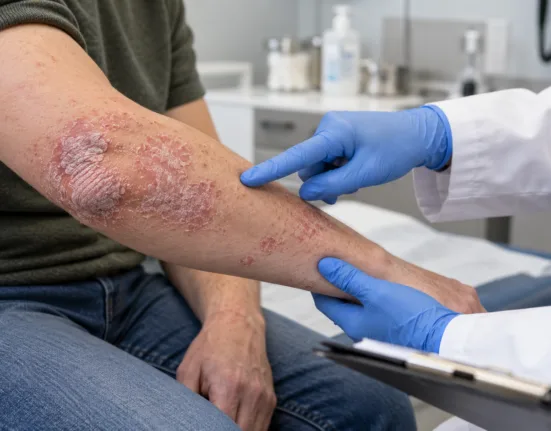
Actinic keratosis is a field disease associated with chronic ultraviolet exposure. Patients frequently present with clusters of lesions on forearms, upper chest, and lower legs, not only on the face and scalp. Treatment options include lesion-directed cryotherapy and several field-directed topical agents.
Photodynamic therapy occupies a specific niche, often favored for facial areas due to cosmetic outcomes and procedural control. Field-size limitations have historically constrained broader application.
If Ameluz receives approval for treatment fields up to 240 square centimeters on extremities and trunk, dermatologists could reconsider its role in managing high-burden field disease. A larger approved surface area would allow consolidation of multiple lesions into a single photodynamic therapy session, potentially improving efficiency for selected patients.
However, anatomical expansion does not automatically translate into routine use. Extremity skin differs in thickness and lesion characteristics. Hyperkeratotic lesions on arms or legs may respond differently to topical aminolevulinic acid activation. Pain during light illumination, a known feature of photodynamic therapy, could also be more pronounced when treating larger areas.
Clinicians following the field suggest that the therapy’s appeal may lie in patients who struggle with adherence to multi-week topical regimens. A procedure-based approach offers predictability but requires clinic infrastructure and trained staff. Workflow considerations and patient tolerance will influence real-world uptake as much as regulatory approval.
What this move reveals about Biofrontera’s lifecycle management and competitive positioning
Biofrontera Inc. appears to be executing a disciplined lifecycle management strategy. Rather than introducing a new asset, the dermatology-focused biopharmaceutical firm is seeking to extract additional value from an established drug-device platform.
Ameluz is used in conjunction with the BF-RhodoLED XL lamp, creating an integrated therapeutic system. Expanding anatomical indications increases the potential utility of that system. Clinics that have already invested in the light source could broaden its application without additional capital expenditure, strengthening the ecosystem effect.
In a mature actinic keratosis market populated by generic and branded topicals, differentiation is often incremental. Label breadth can influence physician confidence, payer perception, and marketing positioning. A broader indication may enhance Ameluz’s standing as a comprehensive field-directed therapy rather than a facial-focused option.
At the same time, the competitive landscape remains stable. Topical 5-fluorouracil and other agents are well entrenched and inexpensive. Newer therapies emphasize shorter treatment durations or improved tolerability. Ameluz’s differentiation rests on photodynamic activation and procedural control, not on systemic innovation.
Regulatory watchers note that supplemental applications tied to expanded use of approved products are generally lower risk than first approvals, provided safety data are robust. Nonetheless, expansion into larger fields increases scrutiny of systemic exposure and tolerability.
Why regulatory, tolerability, and reimbursement variables could still complicate Ameluz’s expanded field approval trajectory
Although Biofrontera Inc. previously reported positive Phase 3 efficacy results in extremities, neck, and trunk, efficacy alone will not determine regulatory success. Several uncertainties remain.
First, detailed pharmacokinetics results have not been disclosed. The magnitude and variability of systemic exposure under maximal-use conditions will be critical. Even small increases could prompt additional regulatory questions.
Second, regional differences in skin biology may influence outcomes. Clearance rates, durability of response, and local tolerability could vary between facial and non-facial sites. If labeling reflects nuanced efficacy or safety language, commercial impact may be moderated.
Third, tolerability across 240 square centimeters remains a practical consideration. Photodynamic therapy is associated with discomfort during illumination. Larger treatment areas could intensify this effect, potentially affecting patient satisfaction and repeat utilization.
Fourth, reimbursement alignment will be decisive. Procedure-based therapies depend on coding clarity and payer support. If expanded field treatments are not reimbursed proportionally to time and resource demands, adoption may remain selective.
Fifth, supply and cost dynamics must support increased per-session product use. Larger treatment areas require more gel per patient. Maintaining margin while scaling volume will require operational discipline.
The planned supplemental New Drug Application submission in the third quarter of 2026 sets a defined regulatory timeline. Once submitted, the United States Food and Drug Administration’s acceptance decision and subsequent review interactions will provide clearer insight into the agency’s comfort with the maximal-use dataset.
From an industry standpoint, the broader significance lies in incremental repositioning. Actinic keratosis is a high-prevalence condition, and modest shifts in treatment patterns can translate into meaningful commercial outcomes. If pharmacokinetics data demonstrate minimal systemic exposure and regulatory review proceeds smoothly, Ameluz could transition from a primarily facial therapy to a broader field-directed platform.
Database lock marks the end of data collection, not the end of uncertainty. The coming months will determine whether Biofrontera Inc. can translate this regulatory milestone into label expansion and, ultimately, expanded utilization in clinical practice. For clinicians, regulators, and competitors alike, the key variable remains clear: whether maximal-use pharmacokinetics data convincingly support safe scaling of photodynamic therapy beyond its current boundaries.