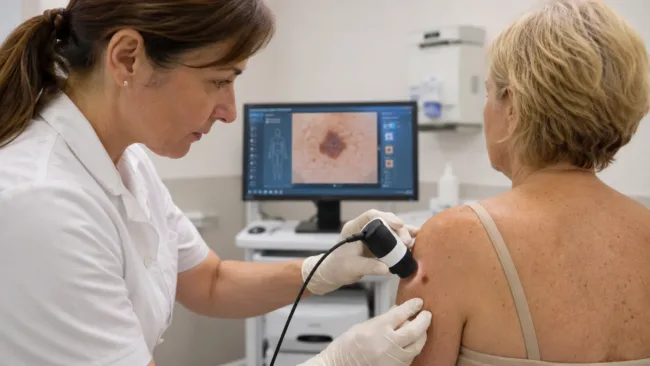
Rubedo Life Sciences, Inc. has reported preliminary Phase 1b/2a results showing that its topical drug candidate RLS-1496 1% cream reduced actinic keratosis lesion counts by 46 percent at four weeks, compared with 11 percent in untreated control areas. The open-label, multicenter United States study evaluated the safety, tolerability and clinical effects of RLS-1496 in adults with actinic keratosis on the forearms, positioning the drug as an early-stage dermatology asset in a precancerous skin condition where tolerability remains a major barrier to treatment adherence.
Why Rubedo’s RLS-1496 actinic keratosis data matter beyond a small early-stage dermatology trial
The immediate signal from Rubedo Life Sciences is not simply that RLS-1496 reduced visible actinic keratosis lesions over four weeks. The more strategically relevant point is that the reduction was reported alongside minimal local irritation, no serious adverse events and no discontinuations due to adverse events during the study period. In actinic keratosis, that combination matters because patients are often treated not only for visible lesions but for broader fields of sun-damaged skin, where inflammation, erythema, peeling and discomfort can affect whether patients complete therapy.
Actinic keratosis is a common precancerous condition associated with chronic ultraviolet exposure and aging skin. Dermatologists already have multiple treatment options, including lesion-directed approaches and field therapies, but real-world treatment decisions often involve a trade-off between clearance, tolerability, treatment duration and cosmetic downtime. A topical therapy that can show meaningful lesion reduction without the irritation profile commonly associated with some established treatments could create a clearer adherence argument, particularly for older patients with recurring or widespread lesions.
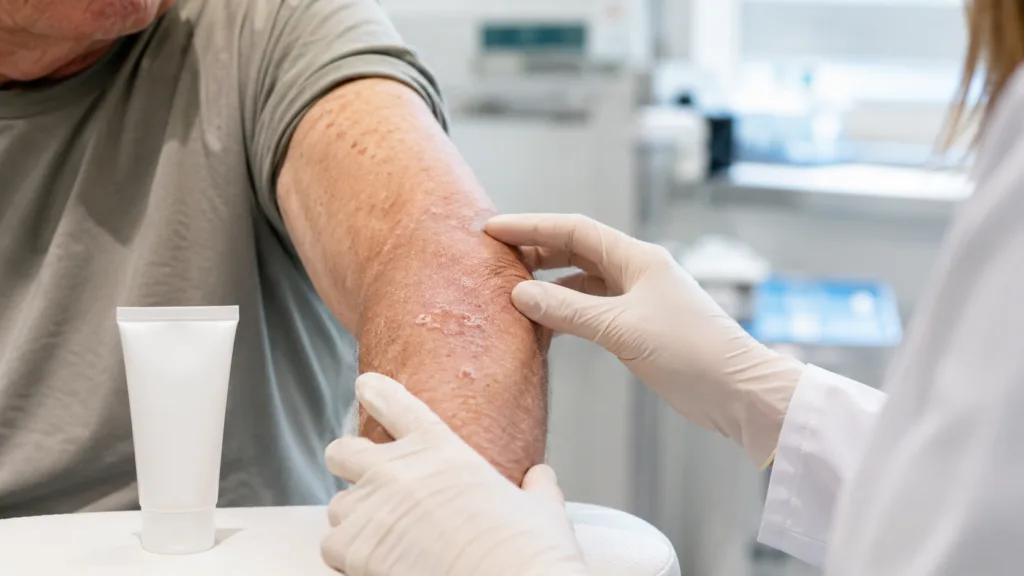
However, the early nature of the study is the central limitation. The readout involved the first 18 of 24 evaluable patients, and the trial design used an untreated control area rather than a randomized vehicle-controlled arm. That makes the signal useful for hypothesis generation, but not yet strong enough to determine how RLS-1496 would perform against standard field therapies or placebo-like vehicle effects in a larger, more controlled setting. The planned Phase 2b dose-ranging study is therefore not just a continuation step. It is the point at which Rubedo Life Sciences must show whether the early tolerability and lesion-count signal can survive a more rigorous test.
How RLS-1496 could challenge the tolerability problem in current actinic keratosis treatment
The actinic keratosis market already includes therapies with established clinical utility, so RLS-1496 is not entering an empty treatment landscape. The clinical opening is narrower and more demanding. Rubedo Life Sciences must demonstrate that RLS-1496 can offer a differentiated balance of efficacy and tolerability, rather than merely adding another topical option to a crowded dermatology toolkit.
That distinction is important because many patients with actinic keratosis require repeated treatment over time. Field cancerization means that lesions can recur or emerge across chronically sun-damaged skin, and dermatologists often need therapies that patients can tolerate across treatment cycles. If RLS-1496 can reduce lesions with minimal irritation, the drug could be positioned around treatment completion, patient acceptance and suitability for broader use in visible or sensitive skin areas. Those are commercially meaningful attributes, even when a product is not dramatically more effective than existing options.
The unresolved question is whether a four-week preliminary result can translate into durable clinical value. Lesion reduction at four weeks is encouraging, but the long-term relevance depends on durability of clearance, recurrence rates, cosmetic outcomes, histologic confirmation where appropriate, and whether reductions in visible lesions correlate with meaningful risk reduction. Regulators and clinicians are unlikely to view short-term lesion-count improvement alone as sufficient if later data do not clarify how sustained the response is and how the drug performs across different lesion burdens and patient types.
What the GPX4 mechanism reveals about Rubedo’s broader cellular rejuvenation strategy
RLS-1496 is being advanced as a selective glutathione peroxidase 4 modulator, which makes the program strategically different from conventional anti-inflammatory or cytotoxic topical approaches in dermatology. Rubedo Life Sciences is trying to build a therapeutic thesis around targeting pathological senescent and stressed aging cells, with actinic keratosis serving as a visible, measurable and clinically relevant testing ground for that biology.
This is where the announcement has significance beyond actinic keratosis alone. Dermatology offers accessible tissue, visible clinical endpoints and biopsy-based pharmacodynamic opportunities, making it a practical entry point for companies developing aging-biology mechanisms. If RLS-1496 can show target engagement, clinical improvement and acceptable tolerability across actinic keratosis, psoriasis, atopic dermatitis and photo-aged skin, Rubedo Life Sciences could argue that its platform is not chasing a single lesion type but a broader disease biology linked to aging, inflammation and tissue dysfunction.
The risk is that platform narratives can move faster than clinical proof. Terms such as cellular rejuvenation and senotherapeutics may attract investor and scientific attention, but drug development still turns on reproducible endpoints, dose response, safety margins and comparative efficacy. A GPX4-modulating approach may prove biologically compelling, but the company still needs larger studies to show whether the mechanism delivers advantages that clinicians can observe, prescribe and defend in routine practice.
Why the open-label design strengthens early feasibility but limits competitive conclusions
The Phase 1b/2a design appears well suited to early safety, tolerability and signal detection. Participants applied RLS-1496 1.0% cream to a designated affected area on one forearm, while the opposite forearm remained untreated as a control. That bilateral comparison can help reduce some patient-level variability because each participant contributes both treated and untreated skin areas, which is useful in a small exploratory trial.
Still, the design does not answer the questions that will matter most in later development. An untreated comparator does not fully account for vehicle effects, behavioral changes during trial participation, lesion-count variability or investigator expectation in an open-label setting. Actinic keratosis assessments can also be influenced by lesion selection, baseline severity, skin type, sun exposure history and counting consistency across visits.
For that reason, the 46 percent reduction should be read as a promising early signal rather than definitive evidence of treatment efficacy. The number is useful because it gives Rubedo Life Sciences a rationale to proceed into dose-ranging development. It is not yet enough to establish where RLS-1496 would sit versus 5-fluorouracil, imiquimod, diclofenac, tirbanibulin, photodynamic therapy, cryotherapy or other approaches used across actinic keratosis management. The next trial will need to narrow that gap.
What clinicians and regulators will watch as RLS-1496 moves into Phase 2b
The planned Phase 2b dose-ranging study is likely to become the critical inflection point for RLS-1496 in actinic keratosis. Dose-ranging matters because tolerability is central to the drug’s potential positioning. If higher exposure improves clearance but introduces irritation, Rubedo Life Sciences will need to identify the therapeutic window that preserves the product’s current differentiation. If lower doses retain activity with very limited local reactions, the candidate could gain a clearer patient-use argument.
Clinicians will also watch whether lesion reduction is accompanied by field improvement. Actinic keratosis treatment is not only about removing visible lesions. It is also about managing sun-damaged skin where subclinical lesions may exist. Biomarker, biopsy and tape-stripping data could help determine whether RLS-1496 is producing a biological effect consistent with its proposed mechanism, rather than only changing surface-level lesion appearance over a short treatment window.
Regulatory watchers will focus on endpoint selection and trial comparators. A future pivotal pathway would likely require stronger evidence than an untreated-arm comparison, particularly if Rubedo Life Sciences seeks a treatment label that competes with established actinic keratosis therapies. The company will need to show clarity on primary endpoints, lesion clearance thresholds, safety follow-up, local skin reaction scoring and the clinical relevance of any pharmacodynamic markers included in the development package.
How prior RLS-1496 dermatology data support the case but do not remove execution risk
The actinic keratosis readout follows earlier RLS-1496 data in plaque psoriasis, atopic dermatitis and photo-aged skin, where Rubedo Life Sciences reported favorable safety and early signs of biological and clinical activity. That broader dermatology dataset gives the program some continuity, particularly because the same topical candidate is being evaluated across conditions tied to inflammation, aging skin biology and tissue remodeling.
This continuity matters because early-stage dermatology programs often struggle when promising single-indication signals fail to generalize. If RLS-1496 shows consistent target engagement and tolerability across multiple inflammatory and age-related skin settings, Rubedo Life Sciences could build a more credible case for a platform mechanism. It may also help guide indication prioritization, especially if one disease area offers a faster regulatory path, clearer endpoints or stronger commercial opportunity.
The limitation is that multiple early signals do not equal late-stage validation. Each indication has different endpoint expectations, competitive benchmarks, patient populations and reimbursement dynamics. A psoriasis signal does not automatically strengthen an actinic keratosis claim unless the mechanistic link is supported by robust tissue-level data and reproducible clinical outcomes. Rubedo Life Sciences will need to avoid overextending the program before dose, duration and indication strategy are firmly established.
Could RLS-1496 become more than another topical actinic keratosis therapy?
The commercial opportunity for RLS-1496 will depend on whether it can offer dermatologists a more usable field therapy, not merely a novel mechanism. In actinic keratosis, a drug that combines moderate efficacy, low irritation and convenient topical administration could still matter if it improves patient willingness to start and complete treatment. Dermatology adoption often rewards practicality as much as biological novelty.
That said, payers and prescribers will require more than tolerability language. Rubedo Life Sciences will need to show whether RLS-1496 can deliver lesion clearance rates, recurrence outcomes and safety consistency that justify adoption against inexpensive generics and established branded therapies. The stronger the tolerability advantage, the more important it becomes to quantify how that advantage affects completion rates, retreatment patterns and real-world outcomes.
The biggest strategic question is whether RLS-1496 becomes a dermatology product with a cellular-aging story or a cellular-aging platform validated through dermatology. The answer will depend on the Phase 2b study design, the strength of dose-response data, and whether Rubedo Life Sciences can convert preliminary lesion-count reduction into clinically meaningful, regulator-ready evidence. For now, the early data give the program momentum, but the next trial will decide whether that momentum becomes a development pathway or remains a promising early signal.