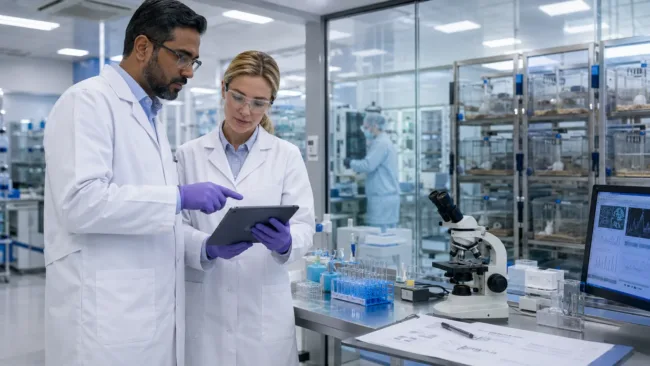
Bio-Techne Corporation has announced a strategic partnership with the Wyss Center for Bio and Neuroengineering in Geneva to develop an automated platform for simultaneous RNA and protein detection in 3D tissue samples. The collaboration aims to reduce technical complexity and accelerate adoption of spatial biology tools by enabling high-resolution multiomic analysis in intact three-dimensional specimens. Positioned within the broader context of New Approach Methodologies and preclinical modeling, the project has the potential to reframe how organoids and tissue models are analyzed in research and diagnostics.
Why the Bio-Techne–Wyss Geneva tie-up could reset expectations in spatial omics
This collaboration represents more than just an incremental advance in assay technology. By aligning a commercial diagnostics and life sciences heavyweight with a neuroengineering innovation center, the project underscores the convergence of clinical-grade tools with cutting-edge research applications. Bio-Techne Corporation, through its Lunaphore brand, already offers multiomic analysis tools optimized for two-dimensional spatial resolution. The current push into 3D signals a strategic move toward volumetric tissue analysis, long viewed as a critical but technically daunting next step in spatial biology.
For researchers in oncology, neurology, and regenerative medicine, spatial data is no longer a luxury. Understanding the microenvironment of tissues, the spatial relationships between different cell types, and the molecular gradients within disease-affected regions is increasingly essential. While traditional spatial transcriptomics and proteomics provide detailed insights, their scope is often constrained to flat sections that do not reflect the full three-dimensional architecture of living systems.
The new partnership is focused on automation and accessibility, two factors frequently cited by industry observers as bottlenecks to broader adoption. Existing 3D analysis methods tend to be manual, labor-intensive, and dependent on bespoke protocols. By embedding automation and standardization into the workflow from the outset, Bio-Techne Corporation and Wyss Geneva are attempting to bypass the scalability limitations that have stalled wider deployment of 3D omics tools.
How this project aligns with the shift toward animal-free preclinical modeling
One of the most significant dimensions of this collaboration is its potential to reinforce the growing industry pivot toward New Approach Methodologies. These NAMs include organoids, microphysiological systems, and predictive modeling techniques that aim to reduce reliance on animal testing in early-stage research. Spatial biology tools that can characterize cellular and molecular behaviors in organoids or other 3D models are expected to become core infrastructure in this transition.
By enabling automated detection of both RNA and proteins in thick tissue sections, the Bio-Techne–Wyss Geneva initiative is positioning itself at the center of this methodological shift. Analysts tracking the rise of organoid platforms note that the absence of standardized 3D analytical workflows has been a key barrier to scale. Regulators are increasingly looking for tools that improve reproducibility and human relevance in preclinical studies, making this kind of automation a potentially important enabler for industry-wide adoption of organoid-based assays.
Moreover, the collaboration could support pharmaceutical and biotech companies aiming to shorten drug development timelines. The ability to obtain spatially resolved, multiomic data from organoids and other NAM-compatible systems can improve screening efficiency, toxicity assessment, and early biomarker discovery, while remaining aligned with ethical and regulatory trends toward reduced animal usage.
What sets Bio-Techne’s 3D approach apart from first-generation spatial tools
The shift from 2D to 3D spatial biology is not simply a matter of dimensional expansion. Technical complexities increase significantly when working with thick sections, including challenges related to staining depth, signal-to-noise ratio, image clarity, and multiplexing capacity. Most current platforms are optimized for slide-based workflows and require time-consuming manual intervention when adapted to thicker specimens.
By introducing a fully automated pipeline for dual RNA and protein detection, Bio-Techne Corporation is attempting to address several of these limitations simultaneously. This is consistent with the company’s broader spatial biology strategy, which was recently extended through the enhanced Leo System. That platform, launched in December 2025, incorporates dual-channel fluorescence detection and chemiluminescence, enabling expanded multiplexing of up to 24 targets per sample and accommodating more complex assay configurations.
Together, the Wyss Geneva collaboration and the Leo System upgrade suggest that Bio-Techne is moving toward a vertically integrated spatial biology suite, one capable of supporting discovery-stage research, translational diagnostics, and possibly clinical pathology applications. The company’s emphasis on throughput, reproducibility, and compliance features such as 21 CFR Part 11 support indicates a clear intention to serve regulated environments in addition to academic labs.
From a comparative standpoint, this distinguishes Bio-Techne Corporation from competitors like 10x Genomics and Akoya Biosciences, which have primarily focused on transcriptomics or single-modality imaging. The dual-detection feature of the Bio-Techne–Wyss workflow adds a layer of complexity and biological insight that may give it an edge in systems biology and integrated tissue profiling use cases.
Why automation may unlock mainstream use, but not without friction
Despite the compelling value proposition, the move to 3D automation is not without operational challenges. Automation of thick tissue sectioning and staining requires highly calibrated instrumentation, precise fluidics control, and imaging platforms capable of capturing multiple optical channels without compromising resolution. There are also limitations related to the penetration of reagents into dense or fibrotic tissues, as well as the risk of signal dropout or cross-channel bleed when performing high-plex assays.
Clinicians and translational researchers will likely ask whether the added complexity of 3D workflows translates into actionable insight. The burden of proof will rest on demonstrating clear performance gains over 2D methods in specific applications such as tumor profiling, neurodegeneration studies, or immune cell tracking. Any real-world adoption will also depend on how the tools integrate into existing laboratory information management systems and whether the generated datasets can be harmonized with standard bioinformatics pipelines.
There are also commercial considerations. While academic interest in 3D spatial biology is growing rapidly, routine adoption in core labs or contract research organizations will hinge on total cost of ownership, support infrastructure, and ease of use. Training, data storage, and workflow standardization remain nontrivial barriers, particularly for institutions without dedicated spatial omics teams.
Finally, the road to clinical relevance will require alignment with regulatory standards for data integrity, repeatability, and method validation. If the platform is to move beyond discovery research into diagnostic or therapeutic development environments, it will need to demonstrate reproducibility across sample types, labs, and populations. Until then, widespread adoption may remain limited to high-end translational research hubs.
What stakeholders in diagnostics, pharma, and AI-driven biology will be watching next
The Bio-Techne–Wyss Geneva collaboration is likely to attract attention from a diverse set of stakeholders. For diagnostic developers, the ability to map both RNA and protein targets in three dimensions could enhance spatial biomarker discovery and improve prognostic accuracy. For pharmaceutical researchers, integration with organoid-based models may offer a more human-relevant and scalable way to study drug-tissue interactions, reducing attrition in preclinical stages.
Technology investors and strategic partners will also be evaluating whether Bio-Techne Corporation’s approach enables defensible IP positions, streamlined adoption, and cross-platform compatibility. With artificial intelligence playing an increasing role in spatial data analysis, the availability of large, high-resolution, multiomic 3D datasets could also open new frontiers in predictive modeling, digital pathology, and virtual biopsy development.
Academic and regulatory institutions may watch for proof-of-concept studies that validate the new platform’s ability to produce reproducible, biologically meaningful insights. Success in pilot studies could trigger demand for broader method standardization and inter-lab reproducibility initiatives, potentially accelerating acceptance of 3D spatial workflows in regulatory science.
This partnership exemplifies the shift from incremental tool upgrades to full-stack innovation. Bio-Techne Corporation and the Wyss Center are not just building a better assay. They are betting on a future where 3D spatial biology is routine, automated, and integral to how we understand and treat disease.