
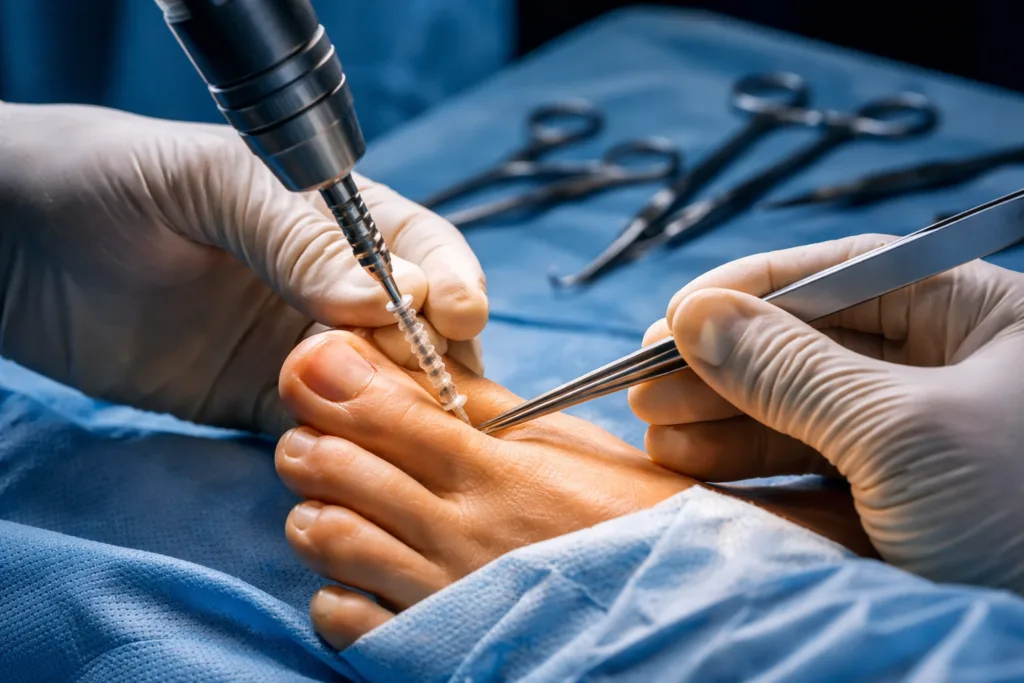
Ossio Inc. has launched the OSSIOfiber Minimally Invasive All Natural Bunion Correction System, a bio integrative, metal free fixation platform designed for bunionectomy procedures, and unveiled the system at the American College of Foot and Ankle Surgery annual meeting in Las Vegas
The Tampa based orthopedic technology company is positioning the threaded trimmable fixation nail and streamlined instrument set as a next step in minimally invasive hallux valgus correction within a high volume surgical category historically dominated by permanent metal hardware.
What this changes for minimally invasive bunion surgery as fixation strategy becomes the real battleground
Minimally invasive bunion surgery is no longer novel. Percutaneous Chevron and Akin techniques have steadily gained acceptance, supported by growing radiographic outcome data and lower soft tissue disruption compared with open approaches. What remains contested is not the osteotomy technique itself but the fixation method that holds correction in place during healing.
By introducing a bio integrative fixation nail that is designed to gradually incorporate into native bone rather than remain permanently implanted, Ossio Inc. is reframing the debate. Instead of competing on incision size or alignment angles, the company is targeting the long standing trade off between mechanical strength and long term implant presence. In elective forefoot surgery, where patients are often active and sensitive to implant related discomfort, this shift may resonate.
Industry observers tracking biomaterials note that fixation strategy has historically oscillated between metal screws for reliability and bio absorbable devices for patient preference. Many earlier absorbable options struggled with inconsistent degradation timelines or inflammatory reactions. The OSSIOfiber platform is being positioned differently, emphasizing integration and replacement by natural bone rather than simple absorption
If that distinction holds up clinically, it may offer a more durable biological solution than legacy polymers.
What is genuinely new versus incremental in the OSSIOfiber MIA bunion platform
The genuinely new element is not minimally invasive hallux valgus correction itself. That surgical pathway has been studied and refined over more than a decade, including U.S. based research demonstrating effective radiographic correction with low complication rates
The innovation lies in the fixation substrate and its intraoperative adaptability.
The 4.5 by 70 millimeter beveled threaded trimmable fixation nail can be adjusted during surgery to accommodate patient specific anatomy
That design feature addresses one of the practical realities of bunion surgery, where first metatarsal geometry and bone quality vary widely. Surgeons often face compromises in screw length or trajectory. A trimmable, sharpenable implant introduces procedural flexibility, but it also raises questions about reproducibility and consistency across operating rooms.
Regulatory clarity appears supported by the implant’s broader indication for maintenance of alignment and fixation of fractures and osteotomies across multiple anatomical sites
That suggests the bunion system builds upon an already cleared platform rather than requiring a novel regulatory classification. However, expanding claims around superiority or complication reduction would require more robust comparative evidence.
How early clinical signals compare with established metal fixation outcomes in hallux valgus correction
The company references an eighteen patient case series presented at an international minimally invasive foot and ankle conference, reporting significant correction, return to normal activity within six weeks, confirmed osseous union by 26 weeks, and no hardware removal or revision procedures
These outcomes are directionally consistent with what surgeons expect from well executed minimally invasive bunion surgery.
The analytical question is whether the absence of metal hardware will translate into measurable differences in irritation rates, secondary procedures, or patient satisfaction. Hardware removal after bunionectomy is not universal but remains clinically relevant, particularly in thin soft tissue envelopes. If bio integrative fixation reduces reoperation rates meaningfully, the economic and quality of life implications could be material.
However, clinicians and regulatory watchers will note that small case series without control groups cannot establish non inferiority to titanium or stainless steel screws. Comparative multicenter trials with longer follow up will be essential to determine whether correction durability persists once the implant has fully integrated into bone.
What this means for reimbursement, adoption, and health system economics in elective foot surgery
One of the more strategic elements of the launch is the emphasis on compatibility with existing reimbursement codes
In a cost constrained healthcare environment, technologies that require new billing pathways often face adoption friction. By aligning with established coding structures and surgical techniques, Ossio Inc. reduces administrative barriers.
For payors, the central economic argument will revolve around downstream cost avoidance. If metal free fixation reduces hardware removal procedures, imaging related concerns, or implant related complications, total episode of care costs may decrease. Health system decision makers will likely demand real world data demonstrating such reductions before endorsing broad purchasing agreements.
Surgeon adoption will hinge on workflow integration. Minimally invasive bunion surgery carries a learning curve, and instrumentation simplicity is critical. The streamlined instrument set is intended to minimize disruption but widespread uptake will depend on hands on experience and peer to peer validation within the foot and ankle community.
What risks and unresolved questions remain as bio integrative fixation scales beyond early adopters
Several unresolved issues warrant attention. First, long term structural integrity must be demonstrated in larger and more diverse patient cohorts, including those with osteopenia or comorbidities. Second, the biological response to the mineral fiber matrix must remain predictable across demographic groups. Third, manufacturing consistency will become increasingly scrutinized as procedural volume expands.
The company reports more than 75,000 OSSIOfiber implants used in the United States through January 2026
That cumulative experience supports commercial momentum, yet bunion surgery represents a distinct biomechanical environment. Forefoot loading patterns differ from other orthopedic applications, and durability over multiple years of ambulation will be closely monitored.
The broader epidemiology underscores the opportunity and the scrutiny. Bunions affect roughly one third of U.S. adults and increase with age
The procedure is high volume and highly visible. Any new fixation approach introduced into this setting will be evaluated quickly by both surgeons and patients.
What this reveals about the future direction of orthopedic fixation technology
Beyond bunionectomy, the OSSIOfiber Minimally Invasive All Natural Bunion Correction System signals a strategic attempt to redefine the default material for internal fixation. For decades, metal has been synonymous with strength and reliability. Bio absorbables offered a partial alternative but struggled with consistency. A platform that promises both mechanical performance and biological integration aims to close that historical gap.
Industry observers suggest that if bio integrative fixation can deliver comparable stability without leaving permanent foreign material, elective orthopedic procedures may increasingly favor such solutions. The shift would not occur overnight, and metal implants will remain indispensable in many high load scenarios. Yet forefoot surgery may represent an ideal proving ground for broader transformation.
In its current form, the OSSIOfiber MIA bunion platform represents an incremental but strategically significant expansion. The technology does not reinvent minimally invasive hallux valgus surgery. It challenges the assumption that metal must anchor it. Whether that challenge translates into standard of care status will depend on comparative evidence, long term follow up, and sustained surgeon confidence.

