Fulgent Genetics, Inc. (NASDAQ: FLGT), the California-based diagnostics and therapeutic development company, has completed the acquisition of Bako Diagnostics and StrataDx for a combined cash consideration of approximately $56.9 million, finalising a deal first announced in December 2025. Bako Diagnostics, headquartered in Alpharetta, Georgia, is a national specialty pathology laboratory offering anatomic pathology, molecular genetic testing, and peripheral neuropathy immunohistochemical services, while StrataDx, based in Lexington, Massachusetts, is a dermatopathology laboratory with board-certified expertise across melanocytic lesions, soft tissue tumours, dermatoses, and lymphomas.
Why this deal is about more than adding laboratory capacity
The timing of the closing matters as much as the assets acquired. Fulgent Genetics enters 2026 facing a significant revenue headwind: its largest customer, which contributed $70.8 million or 22% of total 2025 revenue, has begun bringing testing volume in-house. Management has signalled that revenue from this customer is expected to fall to approximately $11.8 million across 2026, implying a roughly $59 million reduction in precision diagnostics revenue. The Bako and StrataDx acquisitions were modelled specifically to offset this gap, with management projecting the two businesses will contribute between $50 million and $55 million in revenue to the 2026 results, assuming a March close. The acquisition has now closed, which means execution of the integration, not the deal mechanics, is the operative risk.
This is a structurally different kind of acquisition for Fulgent. The company’s organic growth over recent years has been concentrated in precision diagnostics and next-generation sequencing, areas where it built a sophisticated genomic informatics platform. Bako and StrataDx bring volume in anatomic pathology, a segment that operates on different commercial rhythms and requires a large, geographically dispersed sales team to serve surgery centres, dermatologists, and referring physicians at scale. Fulgent’s own management acknowledged it had been subscale in this area, and industry observers tracking the diagnostics sector note that anatomic pathology remains a volume-driven, relationship-intensive business where scale and turnaround time are primary competitive levers. The acquisition nearly doubles the size of Fulgent’s pathology sales team, which represents a material shift in how the company reaches its market.
How the Eziopath platform positions Fulgent differently from traditional pathology consolidators
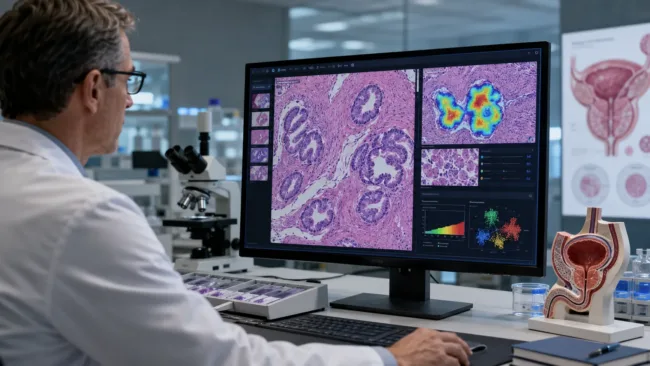
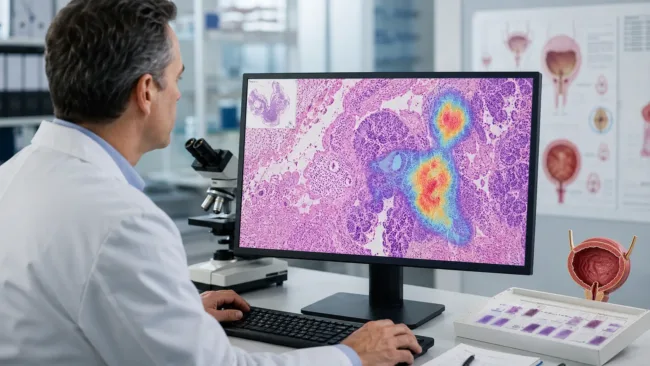
The acquisition is not purely a revenue replacement play. Fulgent has invested substantively in digital pathology infrastructure, including a proprietary image management system called Eziopath, which the company reports has achieved close to full adoption across its pathology operations. This is notable because capacity constraints have historically been the binding constraint in anatomic pathology: reading glass slides under microscopes is labour-intensive, and specialist pathologist supply is limited relative to diagnostic demand. By digitising the workflow and layering AI modules for image analysis and quality control, Fulgent is positioning itself to absorb the additional slide volume from Bako and StrataDx without proportional increases in staffing costs. Industry observers watching the AI-in-pathology space note that full digitisation at this scale is still uncommon among mid-sized independent laboratories, and that deployment of AI diagnostic modules in routine dermatopathology workflows remains an area without established clinical benchmarks, meaning the efficiency gains cited by management will require independent validation over time.
Bako’s proprietary polymerase chain reaction testing menu adds another dimension. Proprietary molecular tests in pathology carry higher margins than send-out or reference laboratory work, and they also create a degree of client stickiness because physicians ordering those tests cannot easily switch to a competing laboratory that does not offer them. The degree to which Fulgent can cross-sell these proprietary assays through its expanded combined salesforce will be one of the more closely watched integration metrics in 2026. StrataDx contributes oral pathology alongside dermatopathology expertise, which broadens the service profile beyond skin conditions into a speciality with its own referral networks.
What the financial model reveals about the risks Fulgent is carrying into 2026
The 2026 financial picture framed by management at the Q4 2025 earnings call reflects a company deliberately absorbing near-term earnings pressure in exchange for a reconfigured revenue base. Fulgent guided to full-year 2026 revenue of approximately $350 million, representing 8.5% growth, but guided to a non-GAAP earnings per share loss of $1.45, well below the consensus estimate of approximately negative $0.59. The stock sold off sharply following that guidance, which is consistent with the market interpreting the acquisition and the customer transition as a meaningful reset in the profitability trajectory, not merely a short-term disruption.
The gross margin outlook compounds the concern. Non-GAAP gross margins are expected to stay slightly above 40% for the full year, but management noted they will be lower in the first half of 2026 as fixed costs are spread across a smaller revenue base before Bako volumes are fully consolidated. Anatomic pathology as a segment typically carries lower gross margins than advanced genomics testing, so the mix shift toward a larger anatomic pathology contribution, projected to reach $162 million in 2026 against $106 million in 2025, structurally depresses margins even as it improves scale. The offsetting thesis rests on Eziopath-enabled efficiency gains and the operating leverage that comes from deploying the expanded sales team across both legacy Fulgent products and the newly acquired testing menu.
One liability item that received less analytical attention outside the earnings call was a $14.5 million professional liability settlement absorbed in Q4 2025. This is a one-time item, but it reflects the legal exposure that comes with operating high-complexity diagnostic laboratories at scale. As Fulgent integrates two additional pathology businesses, each with their own testing histories and physician relationships, the liability surface of the combined entity expands. Clinicians and laboratory directors familiar with pathology quality systems will note that dermatopathology, in particular, is an area with persistent medicolegal sensitivity given the consequences of missed or misclassified skin malignancy diagnoses.
Customer concentration risk has been addressed but not eliminated
Management forecasts that no single customer will account for more than 10% of total 2026 revenue once the acquisitions are fully consolidated, a meaningful improvement from a position where one customer represented 22% of revenue as recently as 2025. This is a genuine derisking of the business model. The previous concentration created fragility: a single insourcing decision by one large health system or laboratory network could, and evidently did, generate a $59 million revenue headwind within a single year. Distributing revenue across a larger number of smaller clients through the expanded anatomic pathology business reduces that vulnerability.
The residual risk is that the Bako and StrataDx client bases have their own concentration profiles that are not yet publicly disclosed. Specialty pathology laboratories often develop deep dependencies on a small number of large dermatology practices or surgical groups that account for disproportionate specimen volumes. If either acquired business carries similar concentration characteristics, the apparent improvement in Fulgent’s risk profile at the corporate level may be less durable than the headline metric suggests. This is a question that laboratory operations and investor relations teams will need to address with specificity as integration reporting matures through the year.
What this acquisition signals about the direction of diagnostic laboratory consolidation
The Bako and StrataDx deal is consistent with a broader pattern visible across the US diagnostic laboratory sector, where technology-enabled platforms are using M&A to add clinical depth and geographic reach in specialty testing areas that have not yet been fully rationalised. Large national laboratory networks have traditionally dominated commodity testing, but specialty pathology, particularly in dermatopathology and molecular-augmented anatomic pathology, has remained fragmented because it requires subspecialty clinical expertise that is difficult to replicate at scale. Fulgent’s thesis is that digitisation and AI can substitute for some of that human capacity constraint, allowing a smaller platform to compete at a larger volume than the specialist headcount alone would traditionally support.
Whether that thesis holds in practice will depend on the clinical validation of the AI diagnostic modules being deployed through Eziopath, the pace at which referring physicians accept digital pathology outputs as equivalent to or better than traditional glass-slide review, and whether payers move to reimburse AI-augmented pathology services on distinct codes or continue to treat them as operational efficiency tools embedded in existing service fees. These are unresolved questions across the pathology sector, not specific to Fulgent, but they represent the horizon risks that will determine whether this acquisition looks like a well-timed pivot or an expensive bet on clinical adoption timelines that are still uncertain.