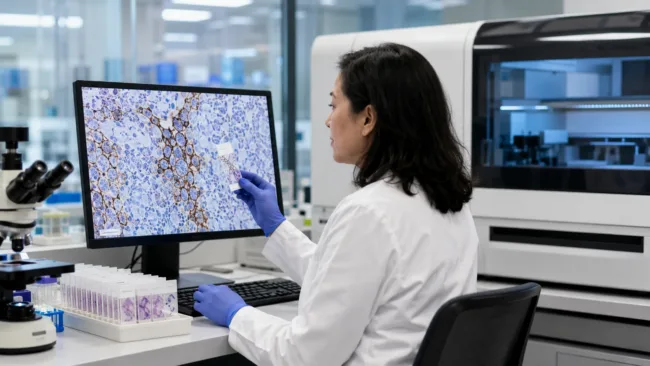
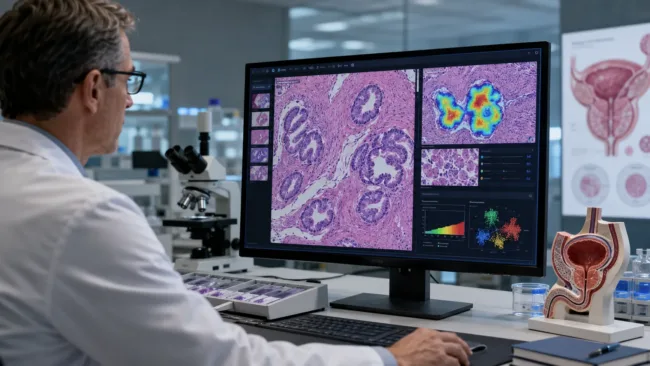
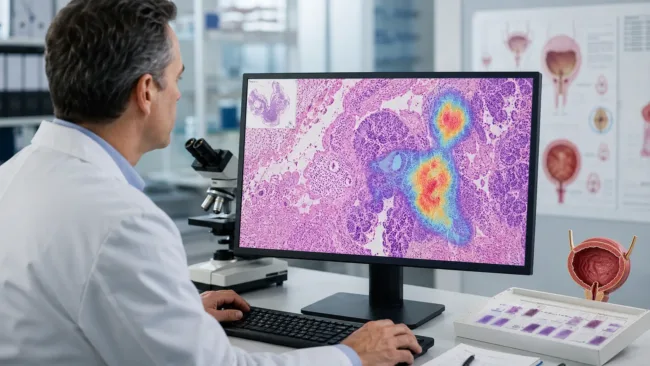
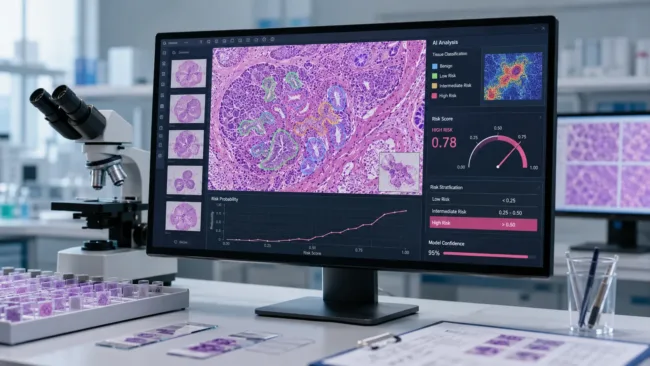
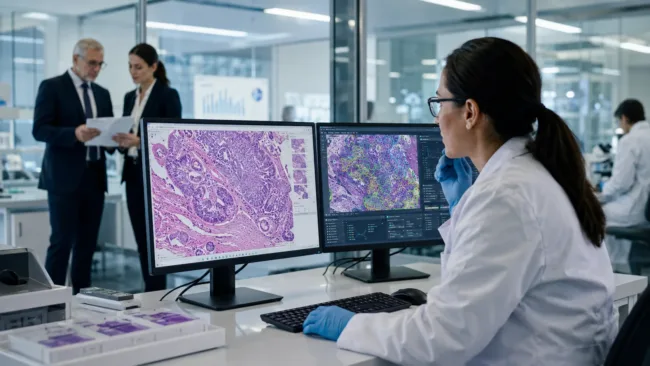
Agilent Technologies Inc. has launched the Agilent S540MD Slide Scanner System, a whole slide imaging (WSI) solution now available in key European markets. The launch strengthens the U.S.-based clinical diagnostics company’s footprint in digital pathology, with the product offering high-capacity slide scanning, AI-assisted workflows, and continuous-loading capabilities. Built on the Hamamatsu NanoZoomer platform, the Agilent-branded S540MD system will initially be marketed in Germany, France, Belgium, Spain, Austria, Luxembourg, Italy, the United Kingdom, and Switzerland under respective regional IVD regulations.
Why this launch signals a strategic shift in Agilent’s digital pathology ambitions
While Agilent Technologies has long held a presence in staining and sample prep for pathology labs, this move represents a deeper push into the end-to-end digital workflow arena. By branding and distributing the S540MD scanner through its own channels, the diagnostics company is no longer just interoperating with scanning partners—it is actively competing in a market increasingly dominated by vertically integrated platforms.
The strategic collaboration with Hamamatsu Photonics is noteworthy. Rather than developing a proprietary scanner from the ground up, Agilent chose to white-label an established platform. This move accelerates time-to-market but raises questions about how much differentiation Agilent can drive at the software and ecosystem level, where competitive advantage increasingly lies. Industry observers suggest that Agilent may be banking on workflow orchestration, integration with staining systems, and its growing AI suite as differentiators rather than hardware innovation alone.
Clinicians tracking digital pathology adoption see the S540MD as a viable high-throughput alternative in labs looking to scale WSI efforts without overhauling their entire infrastructure. The scanner’s 540-slide capacity, continuous-loading format, and compatibility with existing rack systems reflect a pragmatic design geared toward operational flexibility rather than novelty. It also signals Agilent’s understanding of the bottlenecks pathology labs face—not only in imaging, but in lab information system (LIS) integration, case throughput, and AI deployment.
What this means for digitisation bottlenecks and AI readiness in pathology labs
The transition from traditional glass slide workflows to digital pathology has been slowed by a mix of regulatory inertia, scanner throughput limitations, cost barriers, and clinician resistance to new digital interfaces. The S540MD attempts to tackle two of these: speed and scale. With AI-assisted tissue detection and automation features, the scanner aims to free up technician time and reduce manual intervention. However, full workflow transformation also depends on LIS interoperability and regulatory clarity around AI tools used downstream.
Agilent’s announcement did not detail which AI solutions will be natively supported or what level of integration exists across its pathology ecosystem. That gap may prove decisive. Competitors such as Roche Diagnostics and Philips have already bundled scanners with proprietary image analysis software, cloud-hosted workflows, and AI decision support modules. If Agilent’s scanner remains modular but lacks bundled AI analysis capability, customers may face longer validation and deployment timelines.
Still, regulatory watchers suggest the initial IVD designations in multiple European jurisdictions may offer Agilent an edge in the near term. The fragmentation of regulatory pathways across the IVDR, MDR2002, and IvDO frameworks complicates digital pathology deployment, particularly for AI-assisted systems. Having a CE-marked scanner pre-cleared in major European economies gives Agilent a ready-made commercial runway, especially in high-volume histopathology labs in France, Germany, and Italy where digitisation investments are accelerating.
How platform partnerships may shape scalability and reimbursement outcomes
Agilent’s broader strategy appears to be one of plug-and-play interoperability rather than full-stack enclosure. That approach could appeal to pathology labs that have already made selective digital investments but are hesitant to commit to a closed ecosystem. However, modularity often trades off with validation complexity, especially when AI analysis tools require data governance, audit trails, and regulatory harmonisation for reimbursement eligibility.
Industry analysts believe this is where Agilent’s staining-to-AI positioning could be either a strategic strength or a missed opportunity. If the company can demonstrate seamless integration between the S540MD and its staining platforms, LIS connections, and image management systems, it may offer labs a transition pathway that preserves past investments while future-proofing AI readiness. If not, it may find itself stuck in mid-tier positioning: neither fully platform nor fully integrator.
From a reimbursement perspective, the role of whole slide imaging remains in flux. In some European jurisdictions, digital pathology infrastructure is bundled into capital expenditures and not directly reimbursed, while others are experimenting with AI-assisted triage reimbursements. Agilent’s ability to articulate a value proposition that aligns with regional payer models—especially in countries like France and Germany where centralised health systems drive procurement—will be a key determinant of commercial success.
Remaining gaps include U.S. strategy, AI transparency, and data ownership
What remains notably absent from this announcement is any clarity on Agilent’s regulatory strategy for the United States, where the U.S. Food and Drug Administration has taken a more cautious stance on whole slide imaging systems. Several WSI devices remain classified under premarket approval (PMA) pathways, making rapid scaling harder than in Europe.
The lack of information on AI transparency and data privacy also raises flags. As labs digitise more of their diagnostic workflows, questions around image ownership, cloud storage compliance (especially under GDPR), and algorithm explainability become central. Agilent’s scanner may have the technical specs to compete, but without clearly articulated policies around data handling and AI validation, enterprise buyers may hesitate.
Finally, there is little public information on pricing, support models, or commercial timelines beyond the initial markets. This could indicate a phased rollout strategy designed to test operational fit and performance before broader scaling, or it may signal internal caution about commercial risks in a rapidly shifting market.
The competitive landscape may hinge on clinical validation, not specs
Despite the S540MD’s high throughput and automation credentials, its long-term differentiation may depend more on real-world validation studies than technical brochures. Clinicians watching the field are likely to ask: How well does the scanner maintain image quality across 500+ samples? Does AI-assisted tissue detection reduce turnaround time measurably? What failure rates are observed under continuous load?
Answering these questions will require performance benchmarking not only in lab settings but in clinical impact studies—a step many WSI vendors have historically underinvested in. Agilent’s ability to secure such evidence could shift its position from supplier to standard-bearer. Without it, adoption may remain confined to early-stage digitisation projects or labs already predisposed to modular workflows.