Genmab A/S has formally discontinued the clinical development of acasunlimab (GEN1046), a PD-L1x4-1BB bispecific antibody previously co-developed with BioNTech SE, citing internal portfolio prioritization and an increasingly crowded immuno-oncology landscape. The decision, announced on December 29, 2025, follows a prior restructuring of the collaboration in which Genmab assumed sole control of the candidate earlier this year. The move does not alter Genmab’s 2025 financial guidance.
Why this signals a deeper realignment in Genmab’s bispecifics strategy
The discontinuation of acasunlimab represents more than a routine pipeline cull. It reflects Genmab’s sharpened emphasis on late-stage programs with near-term commercial potential—particularly epcoritamab (EPKINLY), petosemtamab, and rinatabart sesutecan (Rina-S). While acasunlimab had generated encouraging early signals, its value proposition as a conditional 4-1BB co-stimulatory agent in solid tumors may have been eclipsed by a convergence of external and internal factors.
Clinicians tracking the field suggest that Genmab’s exit from acasunlimab also underlines the high bar for clinical differentiation in the PD-L1 and 4-1BB axis, a mechanism that has proven mechanistically promising but clinically elusive. The initial strategy to fuse immune checkpoint blockade with conditional T cell activation aimed to overcome tumor microenvironment resistance, particularly in immune-excluded cancers. Yet, despite mechanistic rationale and preliminary activity in non-small cell lung cancer (NSCLC), the broader bispecific antibody class targeting 4-1BB has seen uneven clinical progress, with some candidates stalling due to toxicity, suboptimal activation thresholds, or lack of durable efficacy.
Industry observers believe Genmab’s willingness to shutter the program—after already assuming full development responsibility from BioNTech earlier in 2024—suggests either a lack of internal confidence in risk-adjusted return or strategic triage amid a wave of late-stage investments elsewhere.
How acasunlimab’s mechanism reflects broader challenges in conditional agonist design
Acasunlimab’s core innovation lay in its use of DuoBody® bispecific architecture to enforce co-engagement of PD-L1 and 4-1BB, effectively turning 4-1BB stimulation into a conditionally localized effect. This was intended to sidestep the systemic toxicity historically associated with 4-1BB agonists, such as hepatotoxicity seen in prior monoclonal programs. The drug candidate’s dual mechanism was also meant to amplify antitumor immune responses by simultaneously inhibiting checkpoint-mediated suppression while activating cytotoxic effector cells.
However, the development of 4-1BB-based agents has consistently faced a tight therapeutic window. Some bispecific constructs from peer companies—such as Roche’s RO7122290 and Pieris Pharmaceuticals’ PRS-343—have shown early signs of activity but struggled to sustain durable response or progress beyond Phase 1 or 2. As the field matures, regulators and sponsors alike are demanding clearer signals of clinical utility before advancing resource-heavy pivotal trials.
In this context, acasunlimab’s development pause appears less surprising. While preliminary data shared at the 2024 American Society of Clinical Oncology (ASCO) meeting hinted at tolerability and signal activity in NSCLC, the thresholds for efficacy and differentiation remain high. Sources familiar with the program note that enthusiasm was tempered by the growing challenge of defining monotherapy benchmarks in an indication saturated by checkpoint-experienced patients.
What Genmab gains—and avoids—by stepping away now
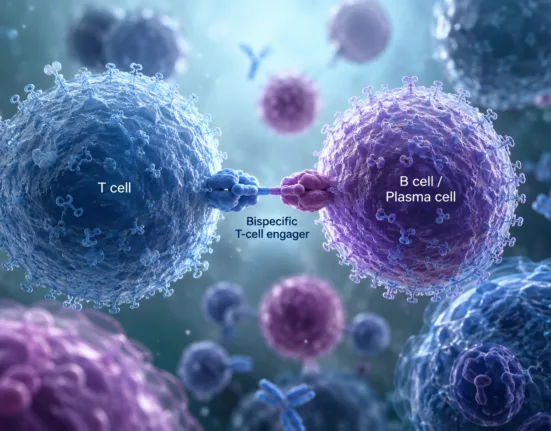
By discontinuing acasunlimab before advancing into a full Phase 3 program, Genmab conserves clinical and operational resources for assets with higher probability of regulatory and commercial success. That includes the company’s first-in-class epcoritamab, a subcutaneously administered CD20xCD3 bispecific that has already secured regulatory approvals and continues to expand its label in B-cell malignancies.
In parallel, petosemtamab, an EGFRxMET bispecific antibody, and rinatabart sesutecan (Rina-S), a HER2-targeting ADC developed with Synaffix and Byondis technologies, are progressing through late-stage solid tumor studies. Both assets are seen as differentiated entries in their respective classes and align more directly with Genmab’s strategic focus on targeted immune-oncology combinations and antibody–drug conjugates.
From a capital allocation standpoint, analysts believe the decision avoids sunk cost bias and reinforces Genmab’s discipline in evaluating clinical opportunity cost. This is particularly relevant as investor attention turns to execution on core late-stage programs in a risk-sensitive funding environment.
It also implicitly closes the chapter on Genmab’s standalone development push for acasunlimab, which it took over from BioNTech in August 2024. At the time, BioNTech had opted out of co-development, citing portfolio realignment, leaving Genmab responsible for further development, milestone payments, and royalties.
Regulatory watchers note that since the candidate had yet to enter pivotal trials, the wind-down avoids regulatory overhang and allows Genmab to realign its development footprint without requiring public explanation of failed endpoints or adverse event profiles.
What this means for the broader PD-L1 and 4-1BB landscape
The acasunlimab decision adds to a growing list of investigational 4-1BB–targeting agents facing strategic reassessment. While the mechanism remains scientifically valid and theoretically attractive, few bispecifics in this class have demonstrated clean, reproducible efficacy in checkpoint-refractory tumors. That said, select candidates such as INBRX-105 (Inhibrx) and GEN1042 (another Genmab program targeting CD40x4-1BB) continue to progress, suggesting the approach is not entirely out of favor.
Moreover, with the rise of T-cell engagers, ADCs, and checkpoint pathway combinations, the immuno-oncology field has grown more competitive and more selective in its definition of what constitutes “transformational” innovation. Incremental benefits are increasingly insufficient to justify standalone development costs unless supported by compelling biomarker strategy, novel formulation, or manufacturing advantage.
Clinicians point out that conditional agonist designs must now navigate not only biological hurdles but also payer and trial design complexity. In solid tumors especially, where PD-L1 monotherapy is already entrenched, layering on complex bispecifics requires clear rationale for benefit beyond immune reactivation.
In this light, Genmab’s decision to pull back on acasunlimab may reflect a pragmatic recognition of shifting expectations. While the science behind 4-1BB targeting remains a potential lever for next-gen immune modulation, execution risk has grown—particularly in light of Genmab’s broader commitments across lymphoma, breast cancer, and lung cancer programs.
What future signals should investors and clinicians track next
For stakeholders watching Genmab’s evolving strategy, attention is likely to shift toward three near-term catalysts. First, the ongoing rollout and label expansion of epcoritamab will be a key commercial and clinical bellwether. Second, the progression of petosemtamab in head and neck squamous cell carcinoma, and Rina-S in HER2-expressing tumors, will test the company’s ability to scale complex modalities across multiple indications.
Third, Genmab’s remaining collaborations with BioNTech and other partners—including its DuoBody-based bispecifics and ADC programs—will remain under scrutiny as investors evaluate which platforms continue to deliver versus those facing attrition.
From a broader oncology pipeline lens, the acasunlimab decision serves as a useful case study in disciplined portfolio governance. It illustrates the challenge of advancing novel mechanisms in crowded pathways and highlights the need for early, unambiguous signals of clinical differentiation. The fact that Genmab made this decision absent regulatory failure or financial strain reinforces a message increasingly echoed across the industry: success is not just about having a mechanism, but about proving that it works better than what already exists.