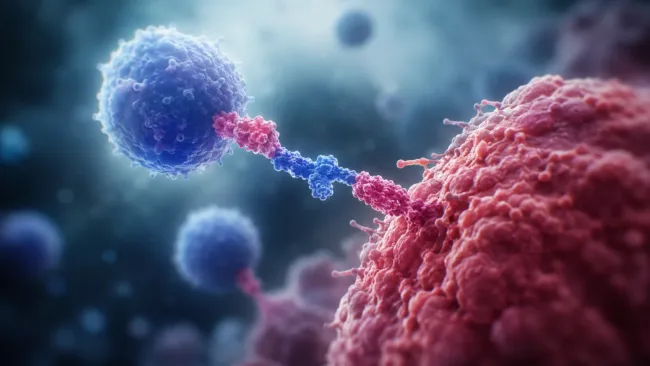
Onchilles Pharma has presented new preclinical data at AACR 2026 showing that its systemically delivered NEU-002 program produced anti-tumor activity in preclinical colon cancer models after both intravenous and intraperitoneal administration. The update matters because NEU-002 is designed to extend the company’s ELANE pathway beyond localized tumor-directed delivery, potentially opening a broader solid tumor opportunity as two lead candidates move toward final development candidate selection.
Why systemic delivery could determine whether the ELANE pathway becomes a platform or stays a niche approach
The biggest strategic significance of the NEU-002 update is not simply that tumors shrank in mice. It is that Onchilles Pharma is trying to solve the central scalability problem that often limits promising cancer mechanisms: getting them to work beyond local or directly injected settings. For many solid tumor programs, local delivery can generate intriguing biology, but it also narrows the addressable market and complicates clinical deployment. A therapy that can be given systemically has a very different commercial and clinical profile, particularly in metastatic or anatomically inaccessible disease.
That makes the NEU-002 program less of a follow-on asset and more of a test of whether the ELANE pathway can become a true modality rather than a single-product concept. If systemic administration holds up in later development, Onchilles Pharma could move from a localized proof-of-concept story to a platform story spanning a far larger set of tumor types. That is where the valuation and partnering interest usually start to change in oncology.
The catch, of course, is that systemic delivery also raises the bar dramatically. A locally administered anti-tumor mechanism can sometimes tolerate exposure constraints that a circulating therapy cannot. Once a program moves into the bloodstream, questions around stability, off-target effects, pharmacokinetics, tolerability, and immunologic consequences become much harder to ignore. In other words, NEU-002 becomes more valuable precisely because it is trying to do something harder.
What the CT26 tumor clearance data may suggest about mechanism strength, and what it still does not prove
The most eye-catching part of the update is the reported complete tumor clearance in all treated animals in a CT26 flank model following intravenous delivery of a NEU-002 candidate, alongside durable protection across multiple tumor rechallenges. In biotech land, that is the kind of result that gets people leaning forward in poster sessions instead of reaching for coffee.
Mechanistically, the rechallenge data are especially important because they hint that the therapy may be doing more than directly killing tumor cells. Onchilles Pharma’s broader thesis is that ELANE-pathway activation can induce immunogenic cancer cell death while preserving immune cells, potentially generating adaptive anti-tumor immunity. Durable protection in rechallenge experiments is directionally consistent with that idea. If reproduced and extended, this could position NEU-002 as a hybrid proposition, part direct cytotoxic therapy and part immune-priming mechanism.

Still, experienced oncology watchers will not treat CT26 cure data as clinical destiny. CT26 is a widely used and informative syngeneic mouse model, but it is also a preclinical setting that has made many programs look stronger than they later proved in humans. Complete clearance in an immunocompetent model is encouraging, yet it does not answer how broad the effect is across tumor types, whether the activity depends on a narrow biological window, or how much therapeutic margin exists at clinically relevant exposure levels.
That leaves a familiar gap between compelling preclinical biology and development-grade confidence. The result strengthens the rationale for advancing the program, but it does not yet establish that systemic ELANE-pathway therapy will retain the same selectivity and potency in heterogeneous human tumors.
Why the abdominal disease signal matters for solid tumors, but also raises tougher translation questions
The intraperitoneal data in the CT26 visceral model may end up being just as important as the flank-model clearance result, even if it sounds less dramatic at first glance. Reduction in ascites and total tumor burden points toward potential use in disseminated abdominal disease, an area where treatment limitations remain substantial and delivery challenges often complicate drug performance.
That matters because abdominal metastatic settings often represent clinically messy disease rather than neat, measurable lesions. A therapy that shows activity in that environment begins to look more relevant to real-world tumor spread, particularly for gastrointestinal and peritoneal disease contexts. It also suggests that the program may have flexibility in route of administration depending on disease setting, which could become strategically useful later in development.
At the same time, visceral and disseminated tumor models introduce their own set of translation problems. Measuring benefit in these settings can be more complex, and what counts as meaningful disease control in mice does not always translate into human endpoints that regulators or oncologists find persuasive. Reducing ascites is clinically relevant, but the field will still want to understand duration of effect, reproducibility, safety trade-offs, and whether anti-tumor activity can be sustained without unacceptable systemic toxicity.
So while the abdominal disease angle broadens the story, it also broadens the burden of proof. The more settings a company hints at, the more investors and future partners will expect the mechanism to demonstrate versatility without losing selectivity.
How engineering around circulating protease inhibitors could shape the entire fate of NEU-002
One of the most important details in the announcement is also the least flashy. Onchilles Pharma said NEU-002 was engineered to protect elastase activity against circulating serine protease inhibitors. That may sound technical, but it is actually the heart of the systemic-delivery challenge.
The biology of enzyme-based therapeutics can look elegant until blood chemistry turns into the party pooper. Circulating inhibitors, rapid clearance, and unintended tissue exposure are exactly the kinds of issues that can shut down otherwise promising therapeutic ideas. By engineering the program specifically to preserve elastase function in circulation, Onchilles Pharma is signaling that NEU-002 is not just a reformulation exercise. It is trying to redesign the mechanism for a different pharmacologic environment.
If this engineering works as intended, it could become the differentiating feature that separates NEU-002 from more conventional protein-based oncology approaches that struggle with systemic durability. It may also help explain why the company is framing this as a translational development effort rather than just another preclinical tumor-killing poster.
But this is also where hidden risks often sit. Engineering against inhibitors can alter biodistribution, potency, immunogenicity, manufacturability, and safety in ways that are not fully obvious in early studies. What helps a molecule survive in circulation can also create downstream complications in repeat dosing or non-human primate studies. That is why the announced move into non-human primate pharmacokinetic work matters. It is less glamorous than mouse efficacy, but far more relevant to whether the program starts to resemble a real clinical asset.
Why NEU-002 could expand Onchilles Pharma’s strategic options beyond N17350, if the safety window cooperates
Onchilles Pharma’s pipeline positioning is fairly clear. N17350 is the clinical-stage, tumor-directed program already in first-in-human testing, while NEU-002 is meant to extend the reach of the ELANE pathway into systemic delivery. In strategic terms, that gives the company a two-track story: one nearer-term program that can validate the mechanism clinically, and one potentially larger opportunity that could unlock broader tumor coverage if the underlying biology scales.
That is a sensible architecture for a platform company. It allows early human data from N17350 to de-risk the mechanism while NEU-002 attempts to solve the reach problem. If both programs mature well, Onchilles Pharma could argue that it has not just one asset but a programmable therapeutic approach for solid tumors regardless of anatomical origin or immune status.
However, investors and future development partners are unlikely to give full credit for that platform narrative until safety and exposure data start to arrive. Cancer-selective killing while sparing immune cells is an attractive claim, but systemic oncology drugs live or die on therapeutic index. A mechanism can be beautifully selective in concept and still run into tolerability issues once repeated systemic dosing begins.
That is why the next development phase may matter more than this AACR presentation itself. The field now knows the program can produce preclinical anti-tumor signals after IV and IP administration. The next question is whether it can deliver a safety window, exposure profile, and manufacturable candidate robust enough to support formal clinical entry.
What clinicians, partners, and oncology investors are likely to watch next as candidate selection approaches
From here, attention will likely shift from proof-of-concept efficacy to candidate quality. Two lead candidates are advancing toward final development candidate selection, which means comparisons around pharmacokinetics, biodistribution, tolerability, and formulation readiness will become central. Posters can win attention, but candidate-selection packages win financing rounds and partnership meetings.
Clinicians tracking the space will want to know whether the immune-preserving and immune-activating aspects of the ELANE pathway can be demonstrated with enough rigor to distinguish NEU-002 from standard cytotoxic approaches. Development observers will also watch whether Onchilles Pharma can show activity beyond CT26 and broaden the translational case into multiple solid tumor settings. Regulators, when the time comes, will likely focus on the usual systemic oncology flashpoints: dose predictability, normal tissue exposure, and reproducibility across models.
The bottom line is that Onchilles Pharma has used AACR 2026 to make NEU-002 look more like a serious systemic oncology program and less like an interesting biology project. That is real progress. But the company is now entering the stage where elegant mechanism stories have to survive exposure data, safety scrutiny, and candidate selection discipline. In oncology, that is where promise either becomes a pipeline, or quietly goes back to the poster hall.