Gilead Sciences, Inc. said all required regulatory approvals have now been obtained for its acquisition of Arcellx, and it extended its tender offer for the biotechnology company to April 27, 2026. The move keeps the $115-per-share cash offer, plus a contingent value right tied to future sales of anitocabtagene autoleucel, on track as Gilead pushes to secure full ownership of one of the most closely watched late-stage CAR-T assets in relapsed or refractory multiple myeloma.
This update may sound procedural, but it is strategically important because it removes one of the few remaining external obstacles to closing a deal that was always more about speed and control than simple portfolio expansion. Gilead is not buying a distant pipeline bet. It is moving to fully consolidate an asset already nearing a U.S. regulatory decision, one that sits in a disease setting where commercial upside is large, physician differentiation matters enormously, and competitive timing can decide whether a therapy becomes a category leader or merely another expensive entrant.
Why this acquisition is really about control of the commercial endgame for anito-cel
The central logic of the transaction is that Gilead no longer wants to share the upside, or the execution risk, around anitocabtagene autoleucel, also known as anito-cel. Gilead and Arcellx were already linked through their 2022 collaboration, but full ownership changes the strategic equation. It simplifies decision-making across manufacturing, launch planning, medical affairs, pricing, global expansion, and life-cycle management. In cell therapy, those are not side issues. They are often the difference between a promising product and a scalable franchise.
The structure of the offer also reveals how Gilead is balancing conviction with discipline. Arcellx shareholders are still set to receive $115 per share in cash, plus one contingent value right worth an additional $5 if cumulative worldwide sales of anito-cel exceed $6 billion by December 31, 2029, with payment due by March 31, 2030 if that threshold is met. That framework lets Gilead pay heavily for regulatory proximity and platform value today, while reserving part of the premium for actual commercial execution later. It is a familiar biotech M&A compromise, but in this case it also signals that even an enthusiastic buyer sees the road to multibillion-dollar CAR-T sales as real, yet not effortless.
There is a second layer here that should not be missed. Reuters reported when the deal was announced in February that the acquisition would also eliminate up to $1.5 billion in potential milestone payments Gilead might otherwise have owed under the prior structure. In other words, the takeover is not just about gaining more upside. It is also about rewriting the economic architecture around a product Gilead already appeared prepared to back aggressively. That makes the deal look less like opportunistic consolidation and more like a deliberate attempt to optimize long-term value capture before launch.
How close anito-cel is to market, and why that timing raises both upside and pressure
The reason this acquisition attracted so much attention in the first place is that anito-cel is not a preclinical dream or an early Phase 1 story wrapped in M&A theatrics. The biologics license application for anito-cel in fourth-line relapsed or refractory multiple myeloma has been accepted by the U.S. Food and Drug Administration, with a PDUFA action date of December 23, 2026. That means Gilead is buying a near-commercial asset in a high-value hematology market rather than waiting for the usual post-approval bidding war.
That timing creates a powerful strategic window, but it also increases pressure. Once an asset is this close to the finish line, investors expect less storytelling and more evidence of operational readiness. Gilead will need to show that it can convert regulatory momentum into real-world execution across manufacturing slot availability, treatment-center access, physician education, reimbursement preparation, and patient logistics. CAR-T therapies do not win simply because they are approved. They win if they can be delivered reliably, referred efficiently, and reimbursed without excessive friction. The closer anito-cel gets to market, the less room there is for acquisition rhetoric and the more focus there will be on infrastructure.
This is where Gilead’s ownership of Kite becomes especially relevant. Gilead is not entering cell therapy from scratch. It already has commercial and manufacturing experience through Kite, and that existing platform is a major reason the Arcellx deal looked strategically coherent from day one. Even so, prior experience is not an immunity shield. Multiple myeloma is already a demanding market, and late-line treatment landscapes can shift quickly as new regimens, sequencing practices, and competing cell therapies evolve.
Why the multiple myeloma market opportunity is big enough to justify bold M&A, but not simple enough to guarantee a payoff
Multiple myeloma remains one of the most commercially attractive and clinically dynamic hematologic malignancy markets, which helps explain why Gilead was willing to pay an implied equity value of about $7.8 billion for Arcellx. Yet this is not a case where market size alone guarantees success. The key commercial question is whether anito-cel can carve out durable physician preference in a field where efficacy matters, but safety, logistics, and treatment timing matter almost as much.
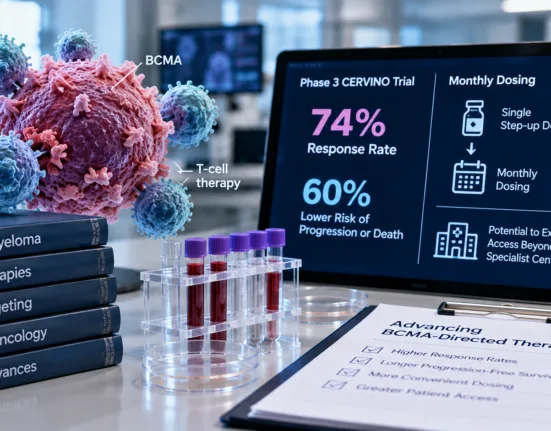
Much of the enthusiasm around anito-cel has come from the perception that it may offer a differentiated profile in BCMA-directed CAR-T therapy. The regulatory filing is supported by data from the Phase 1 study and the pivotal Phase 2 iMMagine-1 study. Industry watchers have focused particularly on whether the product’s design and observed clinical profile could support meaningful competitive differentiation. That said, late-stage promise is not the same as commercial inevitability. The burden on Gilead is to translate promising data into a real treatment choice that physicians prefer and treatment centers can operationalize at scale.
The risk is that even if anito-cel reaches the market with favorable enthusiasm, the company will still be fighting in a field where competitors are not standing still. Physicians treating relapsed or refractory multiple myeloma are already accustomed to rapidly shifting standards, and payers will eventually scrutinize not just label language, but comparative value, durability, and total care costs. A strong launch can create momentum. A complicated or uneven one can quickly narrow the commercial runway.
What the tender extension says about deal mechanics, shareholder behavior, and remaining closing risk
The extension of the tender offer to April 27, 2026 does not in itself signal trouble, but it does reveal where the remaining work sits. As of April 16, about 10.27 million shares, or roughly 17.5% of outstanding Arcellx shares, had been validly tendered and not withdrawn. The deal still requires a sufficient number of tendered shares so that, together with shares already owned by Gilead, the buyer controls at least a majority of Arcellx shares, along with satisfaction or waiver of other customary conditions.
In practical terms, regulatory clearance is no longer the central gating item. The transaction is now more about shareholder completion mechanics and closing choreography. That matters because biotech deals can look locked in from a strategic perspective while still needing careful execution at the transactional level. The good news for Gilead is that there is no sign here of a new antitrust complication. The Australian Competition and Consumer Commission published its decision allowing the acquisition to proceed subject to the waiting period, and the relevant Austrian review period has expired. That substantially narrows residual uncertainty.
Still, a clean regulatory path does not erase market scrutiny. Investors often reassess biotech acquisitions once the first emotional reaction fades and the transaction moves from headline shock to valuation math. The current market pricing tells part of that story. Gilead shares were at $137.64 in the latest available trading snapshot, while Arcellx traded at $115.05, essentially hugging the cash component of the offer. That suggests the market sees the base deal economics as largely credible, while placing a more measured value on the longer-dated CVR upside.
Why investors may view this as a smart oncology consolidation move, even if near-term sentiment stays mixed
From a capital allocation perspective, the acquisition fits Gilead’s broader need to deepen its oncology growth profile with assets that can matter at franchise scale. The company has long faced the question of how to build durable growth engines beyond its foundational antiviral business. Full ownership of anito-cel gives it a clearer path to doing that in cell therapy, especially if the product can evolve beyond an initial late-line multiple myeloma position into broader use over time.
But near-term investor sentiment does not have to be euphoric for the deal to make strategic sense. Big oncology acquisitions often produce a familiar split-screen reaction. The target’s shareholders celebrate the premium, while the acquirer’s investors ask whether the price already bakes in too much success. That tension appeared at announcement, when Arcellx surged and Gilead slipped. It reflects a sober reality: even strong assets can be overpaid for if the competitive field tightens, launch execution falters, or earlier-line expansion proves harder than expected.
That is why the most important question now is no longer whether Gilead wants Arcellx. It very clearly does. The more important question is whether Gilead can turn ownership into acceleration. If closing happens as expected, attention will shift rapidly from approvals and tender extensions to launch readiness, physician confidence, manufacturing throughput, and eventual real-world commercial adoption. In biotech M&A, the paperwork often gets the headline. The franchise only gets built afterward.