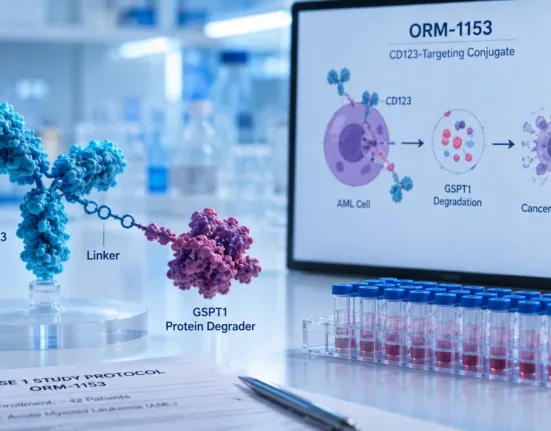
Orum Therapeutics, a South Korea and U.S.-based public biotechnology company, announced that new preclinical data on ORM-1153, a CD123-targeting degrader antibody conjugate incorporating a proprietary GSPT1-degrading payload, will be presented at the American Association for Cancer Research Annual Meeting in San Diego in April 2026. The data, covering efficacy, pharmacology, and repeat-dose non-human primate safety studies, are intended to support an investigational new drug filing and initial clinical trials in acute myeloid leukemia, which the company has indicated it intends to pursue in the second half of 2026.
Why the AACR dataset moves ORM-1153 beyond earlier ASH preclinical disclosures
The distinction between the data being presented at AACR 2026 and what was disclosed at the American Society of Hematology Annual Meeting in December 2025 is material. The ASH dataset established in vitro and xenograft antitumor activity, including approximately 1,000-fold higher potency than the unconjugated GSPT1 degrader payload and dose-dependent complete tumor regression in disseminated AML models. What the AACR posters add is repeat-dose non-human primate safety data, which represents a qualitatively different category of evidence. In IND-enabling studies, repeat-dose primate toxicology is the most scrutinised submission component because it informs the starting dose, dose escalation scheme, and safety monitoring requirements that regulators will expect in a first-in-human protocol. Companies that fail primate tox or see limiting adverse events at clinically relevant exposures face significant programme delays or redesign. That Orum Therapeutics is presenting these findings publicly before filing the IND suggests confidence in the tolerability profile observed.
What the CD123 and GSPT1 targeting combination actually means for AML treatment gaps
AML remains one of the most treatment-resistant haematological malignancies. The venetoclax plus hypomethylating agent combination has become the dominant first-line approach for older or unfit patients, but relapse rates remain high, and patients whose disease harbours TP53 mutations respond poorly to this regimen as well as to most cytotoxic chemotherapy regimens. Currently, only one antibody-drug conjugate is approved for AML: gemtuzumab ozogamicin, which targets CD33 and carries a narrow therapeutic window and significant hepatotoxicity risk. The CD123 antigen is expressed at high levels on AML blasts and leukaemic stem cells, including in TP53-mutant disease, while its expression on normal haematopoietic progenitors is comparatively lower. This differential expression is the biological rationale for the CD123-targeting approach. The addition of GSPT1 as the intracellular degradation target is where ORM-1153 diverges from conventional ADC design. GSPT1 is a translation termination factor with particular relevance in haematological malignancies, and its degradation triggers cell death through a mechanism unrelated to topoisomerase inhibition or DNA damage, the pathways exploited by most existing ADC payloads.
How ORM-1153 addresses the toxicity problem that stopped oral GSPT1 degraders in development
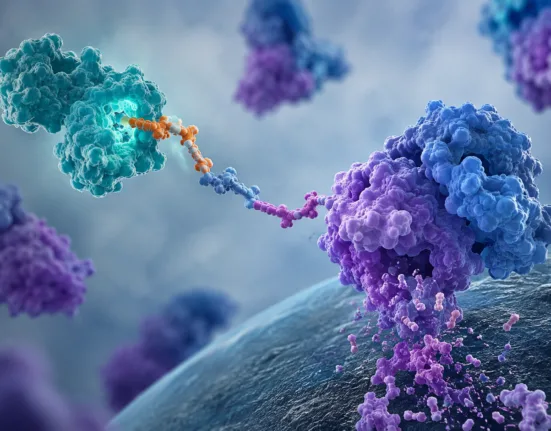
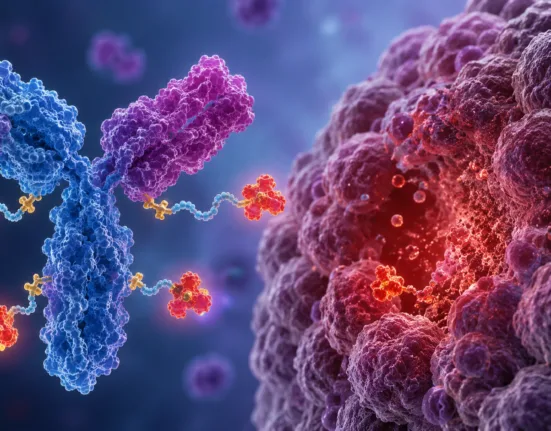
The history of GSPT1 degradation as a therapeutic strategy is directly relevant to understanding what Orum Therapeutics is attempting to solve. Earlier oral GSPT1 degrader compounds, including work conducted at Celgene prior to its acquisition by Bristol Myers Squibb, demonstrated strong antitumour efficacy in preclinical settings but could not achieve a viable therapeutic index in human dosing because systemic GSPT1 degradation produces dose-limiting toxicity across multiple normal tissues. The conjugation strategy in ORM-1153 is designed to confine GSPT1 degradation to CD123-expressing tumour cells by keeping the payload inactive in circulation until the antibody-drug conjugate is internalised following CD123 binding. The beta-glucuronide cleavable linker used in ORM-1153 is intended to release the payload intracellularly, limiting systemic exposure. Industry observers tracking the DAC field note that this cell-specific payload delivery is the central premise distinguishing degrader antibody conjugates from small-molecule degraders, but it requires demonstrated selectivity in vivo and not merely in cell lines. The non-human primate data being disclosed at AACR are the first repeat-dose evidence that this containment strategy is holding up in a non-rodent safety model.
Where Orum Therapeutics sits in the broader degrader antibody conjugate competitive landscape
Orum Therapeutics has significant institutional knowledge of the GSPT1 target in AML. Its earlier DAC candidate ORM-6151, targeting CD33 rather than CD123, was acquired by Bristol Myers Squibb in November 2023 in a deal valued at up to 180 million dollars and is now designated BMS-986497 in the BMS pipeline. That transaction validated both the DAC format and the GSPT1 payload approach, but it also transferred the programme that generated Orum’s clinical-stage revenue base. ORM-1153 is effectively the next-generation successor, rebuilding the hematology pipeline around a different antigen, with CD123 selected partly because it is more consistently expressed on leukaemic stem cells than CD33 and may prove more relevant in chemorefractory disease. The broader DAC field is still early. The concept of replacing cytotoxic ADC payloads with targeted protein degraders is an active area for multiple companies, but ORM-1153 is among the most advanced programmes with publicly disclosed non-human primate data. Analysts watching the oncology drug pipeline note that the regulatory and competitive differentiation of DAC candidates will rest heavily on safety margins in primate models and on how well in vitro selectivity translates to in vivo outcomes.
What regulators and clinicians will examine closely before an AML IND is cleared
The IND submission that Orum Therapeutics is targeting for the second half of 2026 will be assessed by the U.S. Food and Drug Administration primarily on the adequacy of the preclinical safety package. For a CD123-targeting DAC intended for AML, regulators will scrutinise haematological toxicity findings from the primate studies closely, since the target antigen is expressed on normal immune and progenitor cell populations in addition to tumour cells. The earlier colony-forming assay data presented at ASH showed minimal effects on normal haematopoietic progenitors, which is an encouraging signal, but regulators will want to see whether this selectivity holds in a repeat-dose setting where cumulative payload exposure is higher. A second area of regulatory focus will be the pharmacokinetics and drug-antibody ratio stability of ORM-1153 in circulation. Linker stability and premature payload release are common failure points for ADC programmes entering first-in-human studies, and a beta-glucuronide linker will be examined for the rate and site of cleavage under physiological conditions. Clinicians designing the Phase 1 protocol will also need to determine whether the population should initially be restricted to relapsed or refractory AML, and what biomarker strategy, if any, will guide patient selection beyond CD123 expression.
Unresolved questions and risks that remain ahead of first-in-human dosing
Several material uncertainties persist for ORM-1153 at this stage. The preclinical data, however robust, remain generated in xenograft models that may not fully replicate the immunological and microenvironmental complexity of human AML. TP53-mutant disease has been a particularly difficult setting across multiple investigational approaches, and while the ASH data showed activity in this subtype, the clinical translation rate in this patient group is historically poor. The therapeutic window question also remains open. The primate safety data will provide important context, but non-human primate models do not perfectly predict human tolerability, particularly for payload-related toxicities affecting tissues that share antigen expression with tumour targets. Beyond safety and efficacy, manufacturing scalability for a DAC with a novel proprietary payload introduces complexity at the drug substance level that will become increasingly relevant as the programme approaches clinical manufacturing. Orum Therapeutics will also need to clarify its commercialisation and partnering intentions for ORM-1153; the BMS precedent with ORM-6151 suggests the company may seek to out-license at the preclinical or early clinical stage rather than progress independently, which introduces deal risk and timeline dependency.
What the AACR presentation signals about DAC platform validation and next steps
Presenting two posters at AACR 2026, one focused on efficacy and pharmacology and the other on quantitative modelling, is a deliberate disclosure strategy ahead of an IND filing. The dual-session format suggests the preclinical dataset is substantive enough to sustain both mechanistic and translational narratives for a scientific audience that will include potential partners and investors as well as academic clinicians. The quantitative pharmacology presentation is particularly important for an IND package because it provides the modelling framework that supports dose selection and translational predictions from animal to human. For the DAC field more broadly, ORM-1153’s AACR data represent a meaningful data point on whether cell-selective targeted protein degradation can achieve the safety margins that smaller molecule degraders could not. If the primate tolerability data hold up under scrutiny, the programme will move into a competitive IND and trial design process with a differentiated mechanistic rationale, a validated antigen target, and institutional familiarity with GSPT1 biology that few other companies can claim.