Piramal Pharma Solutions said it has installed a Korsch X3 high-containment tablet press at its Morpeth, United Kingdom site, a move tied to the facility’s 20th anniversary and aimed at expanding clinical and commercial manufacturing capacity for highly potent oral solid products. The new press, according to the company, is already commissioned and in active use, and is configured to support Band 5 containment for potent drug products at a site that integrates active pharmaceutical ingredient and oral solid dosage work.
That matters because this is not really a story about commemorative capital spending. It is a story about where contract development and manufacturing competition is moving in 2026. In oral solids, basic compression capacity is no longer enough to stand out. What increasingly separates one contract development and manufacturing organization from another is the ability to handle complex formulations, potent compounds, tighter containment expectations, smoother technology transfer, and the difficult jump from development to commercial execution without forcing a sponsor to rebuild the process somewhere else. Piramal Pharma Solutions is clearly trying to strengthen that pitch from Morpeth rather than treat the site as a narrower regional asset.
Why this equipment move reflects a broader shift toward containment-led differentiation in oral solid outsourcing
The most important new element here is not that Piramal Pharma Solutions bought a tablet press. Contract manufacturers buy equipment all the time. The more meaningful point is that the Korsch X3 was selected and customized around containment, throughput, broader tablet-size handling, and operation across clinical and commercial scales. That suggests Piramal Pharma Solutions sees customer demand shifting toward assets that can support more potent products without creating a handoff problem when programs advance. In outsourced manufacturing, every handoff adds risk, and risk is expensive. Sponsors do not just want capacity. They want continuity.
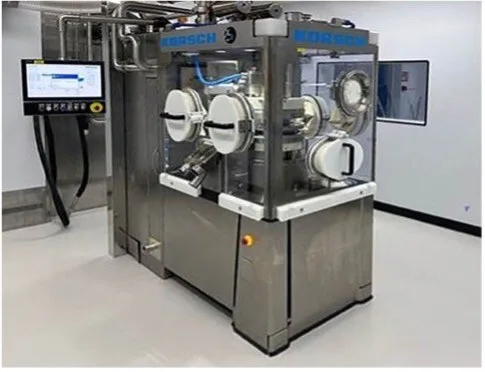
The Korsch X3 platform is positioned as a machine suited to product development, scale-up, clinical production, mid-range production, and continuous manufacturing, with options for single-layer and bilayer work. That broader operating range helps explain why Piramal Pharma Solutions appears to view the asset as more than a niche add-on. A press that can bridge different stages of a program has strategic value because it supports process familiarity, reduces redevelopment friction, and may improve scheduling flexibility for mixed customer demand.
The release also makes clear that Morpeth had already added a Korsch XM12 in the precommercial domain before moving to the X3. That sequencing matters. It indicates a staged buildout rather than a sudden one-off purchase. In other words, Piramal Pharma Solutions seems to have tested the operating model, identified where customer needs were outgrowing the earlier setup, and then expanded into a more capable platform. That is a more convincing signal than a generic claim about innovation because it reflects a capacity ladder that mirrors the way outsourcing demand usually matures.
What this reveals about where potent oral solid demand is becoming more operationally demanding
Highly potent drug manufacturing has become a tougher commercial proposition not simply because of chemistry, but because occupational safety, cross-contamination control, cleaning requirements, and material flow design are all under closer scrutiny. A site that wants to compete in this space has to show it can protect operators while still running efficiently enough to be commercially useful. Piramal Pharma Solutions is leaning into that argument by emphasizing contained infeed, contained product discharge, glove ports, dust-control measures, and a single-operator concept.
That does not automatically make Morpeth unique. Many specialized manufacturers advertise potent-handling expertise. What it does do is reinforce Morpeth’s value inside Piramal Pharma Solutions’ network. The site combines active pharmaceutical ingredient and oral solid drug product capabilities, and that integration matters because potent products often create coordination problems between drug substance and drug product steps. A sponsor looking for fewer interfaces may see integrated sites as strategically cleaner, especially when timelines tighten or supply plans need to be reworked quickly.
There is also a subtler point hiding in the release. Piramal Pharma Solutions highlighted demand for complex and personalized therapies, but the stronger commercial inference is that smaller-batch, higher-value, technically demanding oral solids are becoming more central to contract development and manufacturing organization economics. Big-volume commodity tablet work is rarely where differentiation lives. Contained, potent, smaller-batch, technically sensitive manufacturing is far more likely to support premium pricing and stickier customer relationships. That makes this equipment decision strategically logical even if the absolute scale of the announcement sounds modest.
Why the Morpeth upgrade could improve late-phase to commercial continuity, but not eliminate execution risk
One of the perennial headaches in outsourced manufacturing is the transition from development or precommercial activity into sustained commercial supply. A piece of equipment that can operate across multiple development stages can reduce some of that strain, but it does not erase it. The real test is not installation. It is reproducibility, training quality, validation discipline, scheduling performance, and how well the site handles product changeovers under containment constraints.
Piramal Pharma Solutions said the X3 is fully commissioned, qualified, and in active use, and that the site team received onsite and module-based training from Korsch. Those are necessary signals, but not sufficient proof of long-run execution strength. Industry observers typically watch what happens after the press release glow fades: batch success rates, campaign efficiency, customer retention, and whether the new asset becomes a bottleneck or a true enabler. Potent manufacturing can look impressive on paper and still prove operationally awkward if containment procedures slow turnaround too much or if maintenance complexity undermines uptime.
That is especially relevant because the X3 is marketed as a flexible platform with bilayer capability and mid-range production applicability. Flexibility is attractive, but flexibility also introduces operational choices that require strong process discipline. For a contract development and manufacturing organization, versatility only becomes an advantage when the organization can standardize enough around it to keep customer programs moving predictably. Otherwise, a flexible machine can become a scheduling puzzle wearing a nice brochure.
What clinicians, sponsors, and regulatory watchers may infer from a stronger Band 5 containment proposition
Clinicians are not likely to care which tablet press sits on a factory floor, but they do care whether manufacturing capability supports reliable access to complex therapies that depend on potent compounds. Sponsors care even more directly because manufacturing constraints can shape development decisions, transfer timing, and commercial launch confidence. When a contract development and manufacturing organization strengthens Band 5 handling and contained processing, the practical message is that programs involving more hazardous compounds may face fewer barriers to scale within that network.
Regulatory watchers, meanwhile, are likely to focus less on the machine itself and more on the quality system surrounding it. Containment features, operator protection, and product flow design are important, but they only matter commercially when paired with documentation, validation, cleaning verification, and inspection-ready controls. Piramal Pharma Solutions’ emphasis on an integrated and inspected site helps support that narrative, though external observers will still want proof through performance rather than marketing language alone.
For customers in hormone-related or other potent therapeutic categories, this may widen the appeal of Morpeth as a site capable of handling both technical complexity and safety requirements. But the commercial upside depends on something more mundane than the announcement suggests: whether customers actually move more programs into the site and whether Piramal Pharma Solutions can absorb that demand without creating new constraints elsewhere in the network.
Why this may be more meaningful for contract development and manufacturing organization positioning than for any immediate industrywide reset
It would be overstating things to call this a market-changing event. The installation of one press does not reshape the global outsourcing landscape. The smarter interpretation is narrower and more useful. This is an incremental but strategically coherent move that improves Piramal Pharma Solutions’ positioning in a part of the contract development and manufacturing organization market where technical barriers matter and where customers often value integrated execution over sheer plant size.
That distinction matters because the most credible life sciences manufacturing stories are usually accumulative, not cinematic. A stronger machine platform here, a more integrated site there, a better containment setup somewhere else, and gradually a company changes the kinds of projects it can win. Piramal Pharma Solutions appears to be pursuing exactly that kind of accumulation. The Morpeth investment fits with a broader network story in which end-to-end offerings and specialized capabilities are meant to pull in harder-to-execute programs rather than compete only on scale.
The unresolved question is how much demand actually exists for this specific capability mix and how intensely other contract manufacturers are making similar upgrades. In potent oral solids, differentiation windows can narrow fast when peers invest in the same direction. So while this move clearly strengthens Morpeth on paper, the commercial value will depend on whether Piramal Pharma Solutions converts the upgrade into faster onboarding, better technical outcomes, and deeper customer reliance. In contract development and manufacturing, that is the difference between a useful plant enhancement and a genuine competitive edge.